Hankyung Association 'New Industry Proposal Series' Announcement
"Budget at 0.86% in the US... Fostering Equipment and Satellite Communication Industries"
South Korea's space-related budget was found to be only 0.86% of that of the United States. In core technologies such as satellites and launch vehicles, it was also at 55-65% of the U.S. level. It is advised that South Korea should invest its limited resources centered on the satellite communication industry, where it has strengths, and promote space development led by the private sector rather than national research institutes.
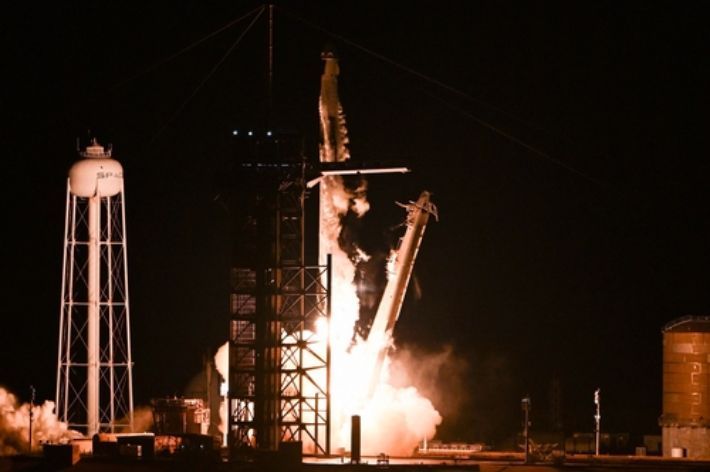 On September 10 (local time), a SpaceX spacecraft, tasked with the first-ever private citizen spacewalk mission, was launched from NASA's Kennedy Space Center in Florida, USA. Photo by Yonhap News.
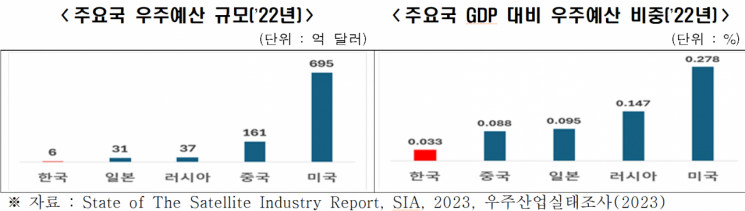
According to the 'New Industry Proposal Series' data released on the 19th by the Korea Economic Association, commissioned to Professor Kwak Shin-woong of Kookmin University, South Korea's space budget in 2022 was $600 million (about 840 billion KRW), which was 0.86% of the U.S. $69.5 billion (about 97 trillion KRW). It was less than China ($16.1 billion), Russia ($3.7 billion), and Japan ($3.1 billion). The proportion of the space budget relative to the gross domestic product (GDP) was 0.033%, smaller than that of the U.S. (0.278%), Russia (0.147%), Japan (0.095%), and China (0.088%).
The technology also lagged significantly. According to the Korea Institute of Science and Technology Planning and Evaluation, as of 2022, South Korea's space observation sensing technology was at 65% of the U.S. level (100%). It was behind the European Union (EU, 92.5%), Japan (81%), and China (80%). The level of large multi-stage combustion cycle engine technology, a core technology for space launch vehicles, was only 55% compared to the U.S. (100%). It was lower than China (86.0%), Japan (82.5%), and the EU (80.0%).
Professor Kwak argued that South Korea should develop its space industry focusing on areas where it has strengths. He suggested, "The satellite communication industry, including ground equipment and satellite communication services, which account for nearly 70% of the space industry, should be prioritized for development."
Professor Kwak advised that to target the large market of low Earth orbit satellite communication services, the ground equipment market such as terminals, control, and reception devices should be fostered. He also emphasized the need to develop production technologies that reduce the cost of satellite manufacturing. According to the aerospace industry, South Korea's satellite manufacturing cost is estimated to be 100 times that of the U.S. SpaceX and 10 times that of the UK company OneWeb. He also stated that new artificial intelligence (AI) technologies for satellites should be developed and orbital information processing technologies should be advanced, such as increasing the download speed of large-capacity satellite images.
Professor Kwak emphasized that measures should be prepared to prevent the advanced air mobility (AAM) industry from being encroached upon by China. He said that priority should be given to developing batteries with high energy density relative to weight and low fire risk. Efforts should be made to develop hybrid propulsion technology necessary for long-distance flights, composite materials that reduce aircraft weight, and noise reduction technologies. The development of Korea's own multi-passenger AAM aircraft is also urgent.
Professor Kwak presented key policy tasks for aerospace development, including expanding the space budget, private sector-led space development, opening space information to the private sector, and strengthening support systems. Regarding the budget, he said the government should secure at least 1.5 trillion KRW annually until 2027 as announced last May to reduce the gap with space superpowers.
In research and development (R&D), he emphasized that technologies developed by national research institutes should be boldly transferred to the private sector and the development model should shift to private sector leadership to keep pace with global trends such as those in the U.S. He suggested entrusting government and public satellite launches to the private sector and encouraging private-led cost reduction and technology development activities to drastically reduce launch vehicle production costs.
He argued that non-national security-related images from next-generation medium-sized satellites and geostationary orbit public satellite footage should be provided to the private sector to induce the creation of new satellite image utilization service industry ideas. Additionally, launch vehicles, satellites, satellite communication industries, and AAM-related technologies should be designated as national strategic technologies to strengthen tax support.
Furthermore, he stated that private sector access to space infrastructure such as launch sites should be guaranteed, opportunities for domestic companies in lunar exploration to cooperate overseas should be provided, AAM airworthiness (operational safety) certification standards should be finalized, and a dedicated AAM control system should be established.
© The Asia Business Daily(www.asiae.co.kr). All rights reserved.
![Clutching a Stolen Dior Bag, Saying "I Hate Being Poor but Real"... The Grotesque Con of a "Human Knockoff" [Slate]](https://cwcontent.asiae.co.kr/asiaresize/183/2026021902243444107_1771435474.jpg)

















