Geunok Lee, Chan An, Jeongchan Nam, Geugyoung Kim: A Thorough Look at Four 19th Century Uiryeong Scholars
In Uiryeong-gun, Gyeongnam, known as the "hometown of historical figures," a recent academic conference was held at the Uiryeong-gun Citizens' Cultural Center to closely examine new historical figures from Uiryeong, alongside renowned personalities such as General Gwak Jae-woo of Mangudang and Teacher An Hee-je of Baeksan.
Held under the theme "Figures and Scholarship of Uiryeong," this academic conference was organized to explore the literary world of scholars from Uiryeong who pondered the nation and its people during the late 19th century, a time of imperial invasions and national crisis. The Uiryeong Cultural Center and Uiryeong-gun jointly promoted the event to discuss the establishment of regional social identity and directions for development through scholarship.
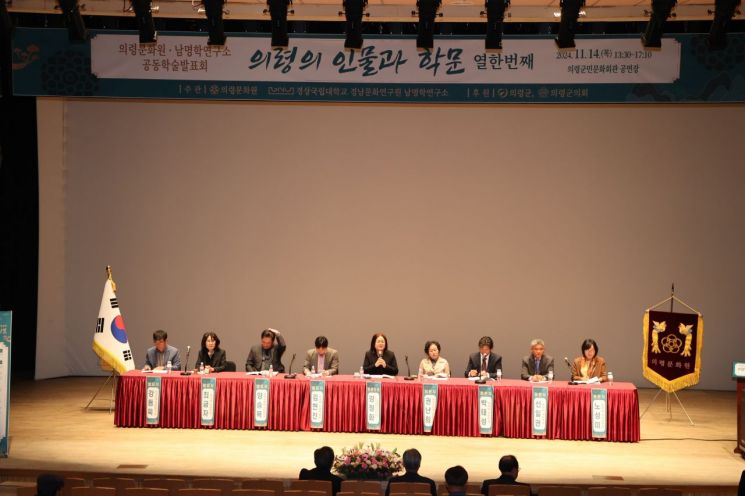 'The Hometown of Figures' Uiryeong-gun, Exploring Four 19th Century Uiryeong Scholars. Provided by Uiryeong-gun
At the conference, an intriguing scholarly interpretation was presented that the "Renaissance of Joseon Confucianism" began in Uiryeong.
This is because the two leading Confucian scholars representing Joseon, Toegye Yi Hwang and Nammyung Jo Sik, elevated their academic thoughts based on their connections to Uiryeong.
Newly highlighted figures from Uiryeong at the conference, such as Heulwa Lee Geun-ok, Chisa An Chan, Nisan Nam Jeong-chan, and Singodang Kim Geuk-young, each inherited the Toegye and Nammyung schools, flourishing Joseon Confucianism and literature.
Dr. Choi Geum-ja of the Department of Classical Chinese Literature at Pusan National University, Dr. Kim Hyun-jin of the Institute of Historical Figures at Suncheon National University, and Dr. Kang Dong-wook of the Gyeongnam Cultural Research Institute at Gyeongsang National University, through their presentations, unanimously emphasized that these individuals are "hidden figures" who urgently need historical rediscovery for their advocacy of the nation's and people's path through Confucianism and literature amid foreign invasions and political turmoil.
Particularly, there was an outpouring of praise for the literary achievements of Chisa An Chan (安?), including his poetry and prose.
An Chan, previously unknown, was revealed for the first time at this academic forum as a figure from the Tamjin An clan, Heonnapgong branch, of Ipsan-ri, Burim-myeon, which produced many prominent figures such as An Gi-jong, An Hyo-je, An Hee-je, An Chang-je, An Jun-sang, and An Ho-sang.
Professor Yang Seung-mok of the Department of Classical Chinese Literature at Gyeongsang National University stated, "An Chan fundamentally possessed the identity of a practical scholar, but his literary ability and aspirations are also clear. Academic discussions on his collected works, 'Cheosajip,' should continue. In particular, 'Simgunseol' from Cheosajip is evaluated as a work worthy of inclusion in the genealogy of Cheongun novels."
Dr. Park Tae-sung of the Department of Korean Literature at Changwon National University evaluated, "An Chan's poetry contains many excellent works with outstanding phrases that are by no means inferior to those of the refined Choi Chi-won. A deep study of An Chan's academic style, lineage, poetry, and prose will secure a new place for the Uiryeong literary figure An Chan in Korean literary history."
County Governor Oh Tae-wan said, "The deep concerns of these four individuals for the country over 150 years ago resonate with our current efforts to create a 'better Uiryeong.' This was a precious occasion to feel the greatness of the culture and scholarship that Uiryeong possesses. We will organize and publicize the achievements of these figures."
© The Asia Business Daily(www.asiae.co.kr). All rights reserved.
![Clutching a Stolen Dior Bag, Saying "I Hate Being Poor but Real"... The Grotesque Con of a "Human Knockoff" [Slate]](https://cwcontent.asiae.co.kr/asiaresize/183/2026021902243444107_1771435474.jpg)















