RDA's 'Innovative Agricultural R&D Plan'
Leading 14 Convergent Collaboration Projects
Director Kwon Jaehan: "Will Lay the Foundation for Agriculture's Future Blueprint"
The Rural Development Administration (RDA) has decided to focus next year’s budget on agricultural convergence projects, including the digital transformation of the entire breeding process, the expansion of smart agriculture, and the enhancement of weather disaster and pest information services. The aim is to improve responsiveness to global technological trends and secure new growth engines through convergence with advanced technologies.
On the 18th, RDA Administrator Kwon Jae-han announced the "Agricultural Research and Development Innovation Plan" containing these details at the Government Complex Sejong.
Administrator Kwon stated, "For agriculture and rural areas to maintain sustainability and grow into agriculture and rural communities that give hope to future generations, RDA’s research and development sector must play a pivotal role, and changes and innovations beyond the existing framework are essential. This innovation plan reorganizes RDA’s core projects and includes future-oriented organizational and functional innovations, as well as improvements in work methods to produce tangible results that the public can feel."
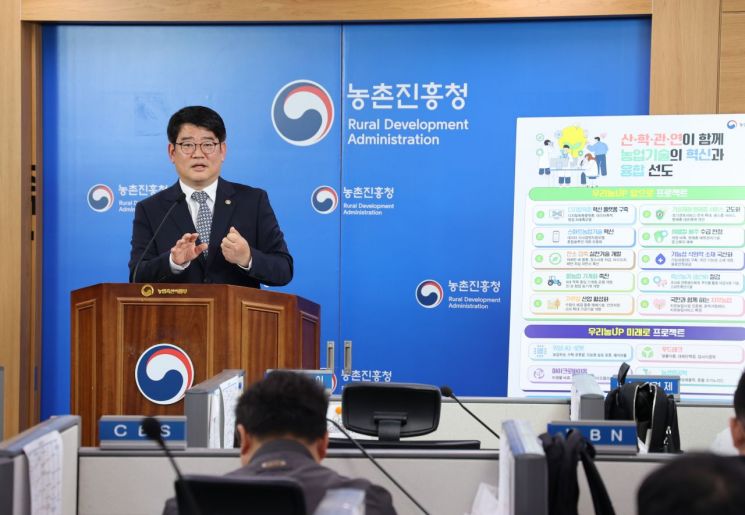 Kwon Jae-han, Administrator of the Rural Development Administration, is announcing the 'Agricultural Research and Development Innovation Plan' at the Government Sejong Complex on the 18th.
The innovation plan includes ▲ representative convergence collaboration projects based on advanced technology convergence and public-private cooperation ▲ improvements in work methods ▲ strengthening future-oriented organizations and professional workforce capabilities. In particular, a total of 14 convergence collaboration representative projects will be promoted with a budget investment of 350.6 billion KRW (an increase of 61.7 billion KRW compared to 2024, based on the government proposal).
Administrator Kwon emphasized, "Through this, we will contribute to achieving key national tasks in agriculture under the Yoon Suk-yeol administration, promptly resolve major agricultural and rural issues, and create new growth engines for agriculture. First, to technically support major agricultural policies and quickly solve pressing agricultural and rural issues, we will implement the 'Top 10 Projects for Policy Support and Issue Resolution.'"
RDA will fully digitize the entire breeding process. By 2025, the "Korean Digital Breeding Platform" will be established for 59 items, and by 2027, standardized breeding information such as core populations, genomes, and phenomes for each item will be accumulated on the platform and opened and shared with the private sector. A "Public-Private Cooperation Digital Breeding Council" will be operated to support this.
To innovate smart agricultural technology through data and artificial intelligence (AI)-based integrated smart agriculture solutions, the collection of cultivation environment and crop growth data will expand from 19 to 21 items by 2025. The farm decision support model, which suggests optimal growth conditions to farmers through accumulated data analysis, will also be expanded from 12 to 16 items.
For carbon reduction, one low-methane feed material will be selected and domestically produced, and low-carbon practice models such as appropriate biochar usage technology that permanently sequesters carbon in soil and deep fertilization technology that reduces nitrogen fertilizer use will be disseminated on-site. Additionally, mechanization of field farming to address rural labor shortages will be actively promoted. By 2025, seven types of agricultural machinery, including onion and cabbage transplanting machines, will be developed first, and by 2027, four more types, including radish and sweet potato harvesters, will be added, completing the development of machinery for the entire production process of eight major crops (garlic, onion, cabbage, chili pepper, potato, soybean, sweet potato, radish).
Alongside this, new varieties will be developed to revitalize the powdered rice industry, and domestic agricultural products will be developed as food and pharmaceutical materials to replace imported raw materials and create high added value. To stabilize livestock farmers’ management, early commercialization of technologies to reduce feed costs, which account for about 37% of production costs, and labor costs, about 10%, will also be pursued.
Enhancement of weather disaster and pest services will also be undertaken. By 2025, the early warning service for agricultural weather disasters will expand from the current 110 counties and cities to 155 nationwide. A system for "monitoring-prediction-control-post inspection" of crop pests and diseases will be established to support timely pest control for farmers. By integrating the currently separately provided four systems?weather disaster, pest and disease, soil information, and livestock breeding weather information?into a one-stop information service, convenience for agricultural users will be improved.
To resolve summer cabbage supply instability, comprehensive response technologies will be disseminated on-site. The RDA-developed storage period extension technology, which can double the current 40 days to 80?90 days, will be demonstrated at spring cabbage stockpiling Agricultural Product Distribution Centers (APCs) in 2025 and fully applied from 2026. Through this, RDA expects to supply spring cabbage during the vulnerable summer supply period from mid-August to late September.
RDA will also promote mid- to long-term projects based on public-private partnerships to create new growth engines for the future of Korean agriculture. First, an intelligent precision agriculture system integrating agricultural satellites, AI, and robotics will be established. The agricultural satellite precision observation system will continuously monitor farmland and crop conditions, and advanced private-sector technologies will be incorporated into autonomous precision harvesting robots and safety-enhanced wearable strength-assist robots to accelerate full automation of farm work and realization of intelligent precision and safety agriculture. Furthermore, to revitalize the bio-material industry, advanced bio-convergence technologies such as agricultural biotechnology and synthetic biology will be developed, and innovations in food tech, including personalized foods and alternative protein development, will be pursued.
Administrator Kwon said, "Through this agricultural research and development innovation plan, we will strengthen innovative and challenging R&D to leap forward as the world’s top agricultural science and technology research institution, actively introduce leading private technologies, and make this an opportunity for the public and private sectors to jointly solve agricultural problems that have faced limitations. This plan will serve as the foundation for drawing the future blueprint of our agriculture."
© The Asia Business Daily(www.asiae.co.kr). All rights reserved.

















