Measures Demanding Accountability of Officials to Restore Trust
"Difficult to Persuade Residents Due to Government Misuse of Consultations"
"Physician Workforce Estimates Vary Greatly Depending on Assumptions"
"Increase in Personnel Will Cause 10-Year Aftereffects... Will They Take Responsibility After Resignation?"
The Korean Medical Association (KMA) Emergency Response Committee chairman demanded measures from the government to restore trust. He emphasized that if there are no special changes from the government, the medical community cannot stop resisting.
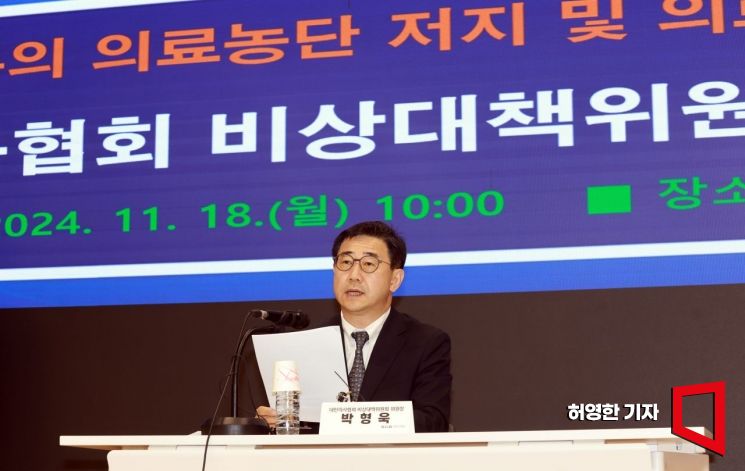 On the 18th, Park Hyung-wook, Chairman of the Emergency Response Committee of the Korean Medical Association, held a press conference at the Korean Medical Association, announcing the launch of the Emergency Response Committee and discussing the composition of the 15 committee members and demands to the government.
On the 18th at 10 a.m., the KMA Emergency Response Committee held an interview titled 'KMA Emergency Response Committee Chairman Interview for Preventing Government's Medical Manipulation and Normalizing Medical Care' at the KMA Hall in Yongsan-gu, Seoul, where they made this announcement.
Park Hyung-wook, chairman of the KMA Emergency Response Committee, said, "Unfortunately, looking at the government's stance, it is difficult to ask residents and medical students to trust the government," adding, "Reflecting on the worsening process of the government's medical manipulation incident, I want to say that the president needs to take measures to restore trust."
The measures he demanded include holding accountable those officials who falsely reported that the KMA was consulted despite no consultation on the scale of medical school quota increase, those who falsely reported that there was scientific evidence for the increase of 2,000 medical students, and those who infringed on residents' basic rights through administrative orders such as forbidding the acceptance of resignation letters.
Chairman Park criticized, "I participated in the medical issue consultation body, but the scale of medical school quota increase was never discussed there," adding, "Looking back, the government was creating a kind of 'alibi,' a facade of consultation."
He then questioned, "In a situation where consultation is abused like this, how can we tell residents and medical students to trust the government?"
Regarding the basis for the 2,000 increase, he emphasized, "The projection of physician manpower varies greatly depending on assumptions. In 2018, Professor Sheffler of the University of California, Berkeley, estimated using OECD data that by 2030, South Korea will have an oversupply of 3,821 physicians. On the 4th, Professor Kim Se-jik of Seoul National University's Department of Economics also stated that over the next 10 years, the medical supply growth rate will be 3.2% annually, exceeding the medical demand growth rate of 1.3 to 1.9%."
He also criticized the government for shifting the problems of the medical system onto residents. He said, "According to the Labor Standards Act, the maximum working hours per week are 40, and with labor-management agreement, up to 52 hours per week is possible. However, residents are made to work up to 88 hours per week under the name of the law."
Furthermore, he stated, "Residents are seriously exposed to the risk of medical lawsuits," explaining, "If a medical accident occurs in a moment of carelessness while working overnight, they may be liable for damages ranging from hundreds of millions to billions of won."
Meanwhile, he pointed out that the government's improvement plans lack substance. Chairman Park said, "The Medical Reform Special Committee announced the formation of a Medical Accident Review Committee (tentative name) to prosecute mainly cases of gross negligence," questioning, "Is there any country where a committee mainly composed of non-experts reviews whether gross negligence occurred?"
He continued to criticize the government's essential medical package. He said, "The government diagnoses supply shortages in severe and emergency care as 'market failure,'" and questioned, "Since Korea's National Health Insurance prices are determined by the government, why is the collapse of essential medical care considered market failure?"
He added, "Professor Kwon Jun-hyuk of the Cleveland Clinic in the United States said that the cost of liver transplantation in Korea is one-sixteenth that of the U.S., but the one-year survival rate is 95%, higher than the U.S.'s 90%," emphasizing, "While there are issues such as cosmetic medical care, is the one-sixteenth cost of liver transplantation in Korea caused by cosmetic medical care?"
He also stated that if there are no special changes from the government, the medical community cannot stop resisting. Chairman Park said, "A rapid increase in medical school quotas will cause aftereffects for 10 years. Will the president, ministers, vice ministers, and secretaries take responsibility after all resign?" He added, "If the president takes measures to restore trust in the government and stops this time bomb, it will be a starting point to resolve the current situation."
He further urged, "If there are no special changes from the government, the Emergency Response Committee will have no choice but to continue resisting and fighting against medical manipulation," adding, "I hope it does not come to that."
Meanwhile, the KMA Emergency Response Committee is composed of Chairman Park, Vice Chairpersons Na Sang-yeon and Han Mi-ae of the KMA Delegate Council, Lee Ju-byeong, president of the Chungcheongnam-do Medical Association, Choi Woon-chang, president of the Jeollanam-do Medical Association, Kim Chang-soo, chairman of the National Council of Medical School Professors (Jeon-ui-gyo-hyeop), Kim Hyun-ah, vice chairman of Jeon-ui-gyo-hyeop, Bae Jang-hwan, advisor of Jeon-ui-gyo-hyeop, and Yoon Yong-seon, director of the Barun Medical Research Institute. Three residents who resigned, including Park Dan, chairman of the Korean Intern and Resident Association Emergency Response Committee, and three medical students are also members.
© The Asia Business Daily(www.asiae.co.kr). All rights reserved.

















