Korea Investment & Securities Research Report
Amid increased volatility in the domestic stock market due to recent US interest rate hikes and a strong dollar, advice has emerged to manage portfolios based on earnings. Korea Investment & Securities particularly emphasized focusing on the defense and shipbuilding sectors in light of the fourth-quarter earnings outlook.
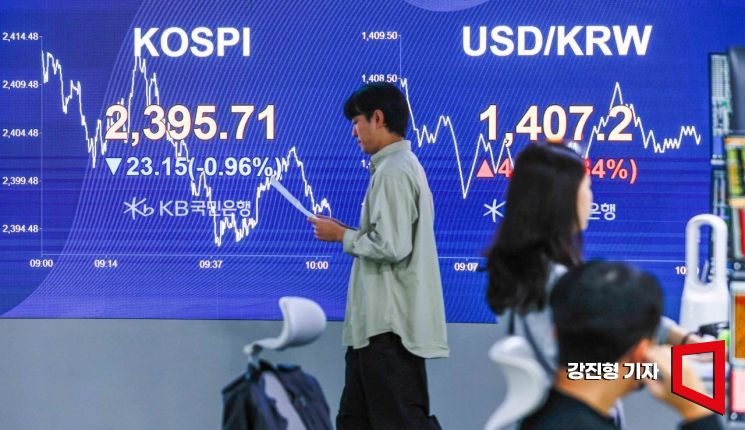 On the 15th, dealers were working in the KB Kookmin Bank dealing room in Yeouido, Seoul, as the KOSPI index fell below the 2400 mark for the first time in three months since the 'Black Monday' in August. On the same day, the won-dollar exchange rate opened at 1408 won, up 2.9 won from the previous day. Photo by Kang Jin-hyung
Kim Dae-jun, a researcher at Korea Investment & Securities, explained in a report released on the 18th, "Currently, the US has a higher economic surprise index than other countries. Because the US economic momentum is stronger than that of other countries, the financial markets are reflecting these changes," adding, "A representative example is interest rates."
Researcher Kim stated, "Despite the Federal Reserve's rate cuts, bond yields are rising. In particular, the bear steepening phenomenon, where long-term interest rates rise faster than short-term rates, is continuing," and elaborated, "Long-term interest rates change according to growth and inflation outlooks, excluding government bond supply and demand. Since the US economy is maintaining growth, upward pressure on interest rates continues."
He cited growth prospects as the reason behind the dollar's solo rally. This is because growth outlooks also affect currency values.
Kim said, "Of course, the impact of former President Trump winning the US presidential election cannot be ignored," but added, "Fundamentally, the US economy being better than other countries is the key variable behind the exchange rate changes. The dollar index recorded 106.7 points last Friday, marking a year-to-date high."
From the perspective of the Korean stock market, the one-sided strength of the dollar is a burden. Kim noted, "Since 2000, market participants have rarely seen an exchange rate above 1,400 won. This is because the exchange rate exceeded 1,400 won on only 1.3% of total trading days," and added, "Moreover, as the high exchange rate continues, foreigners have maintained a net selling trend in stocks. Foreigners have sold 16.5 trillion won worth of shares in the KOSPI over the past 12 weeks."
In this situation, he advised defending with sectors that have no supply-demand burden and solid profits. Kim said, "It is better to avoid semiconductors, displays, and home appliances (secondary batteries), which foreigners have heavily sold," while adding, "On the other hand, utilities, defense, and shipbuilding, whose fourth-quarter earnings are being revised upward, are sectors of interest. In times of rapidly changing macro environments, earnings can always serve as a safety net."
© The Asia Business Daily(www.asiae.co.kr). All rights reserved.
![Clutching a Stolen Dior Bag, Saying "I Hate Being Poor but Real"... The Grotesque Con of a "Human Knockoff" [Slate]](https://cwcontent.asiae.co.kr/asiaresize/183/2026021902243444107_1771435474.jpg)















