Maximum wind speed of 240 km/h causes extensive building damage and airport closure... "Impact of climate change"
Super Typhoon 'Manny' struck the Philippines, marking the sixth typhoon disaster in the country within a month.
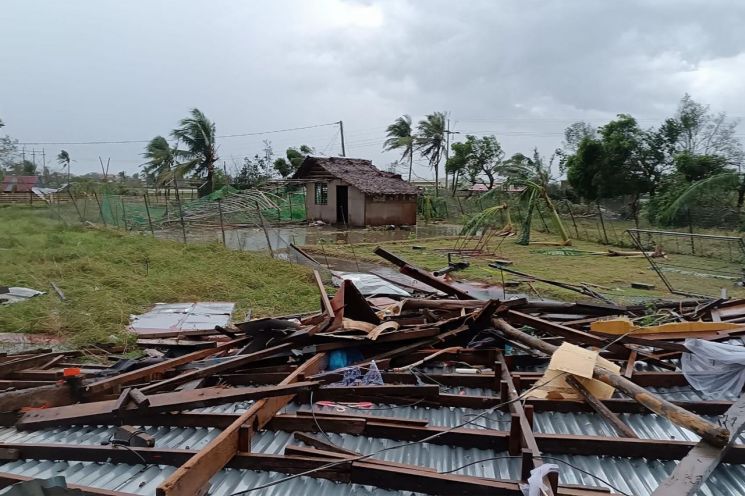 On the 17th (local time), buildings including houses collapsed due to strong winds brought by Super Typhoon "Manny" in Catanduanes Province, eastern Philippines.
According to AP, AFP, and others on the 17th (local time), Manny made landfall on the eastern Philippine island province of Catanduanes the previous night and then reached Luzon Island in northern Philippines on the same day.
With maximum sustained winds reaching an incredible 240 km/h, Manny caused extensive damage, destroying numerous homes, schools, and other buildings in Catanduanes and surrounding areas, according to civil defense authorities. Roberto Monterola, a disaster response official in Catanduanes, told AP, "There was very little rain, but the wind was so strong it sounded like a chilling howl," adding, "A tidal wave over 7 meters high surged near coastal homes, which looked truly terrifying."
Additionally, the typhoon toppled countless utility poles and trees, causing widespread power outages across the province. Authorities are currently assessing the extent of damage to homes. As Manny approached, the Philippine government evacuated more than 750,000 residents from vulnerable areas, including Catanduanes, according to local civil defense officials. Monterola said, "No casualties have been reported yet, likely because people followed evacuation orders." Furthermore, at least two international airports and 26 domestic airports temporarily closed due to Manny, and numerous ferries connecting the islands suspended operations, stranding thousands of passengers.
Meteorological authorities forecast that Manny will bring over 200 mm of heavy rainfall within the next 24 hours as it passes through Manila and other parts of Luzon Island, causing floods and landslides in various locations.
Manny is the sixth typhoon to hit the Philippines in about a month. Starting from late last month with Typhoon 'Chami,' five typhoons including 'Kong-rey,' 'In-fa,' 'Dorang,' and 'Usagi' have successively struck the country. According to AFP, floods and landslides caused by Chami and Kong-rey have resulted in at least 163 deaths in the Philippines.
Moreover, as of the 11th, NASA reported an unusual phenomenon in the Western Pacific where four typhoons?In-fa, Dorang, Usagi, and Manny?were active simultaneously. According to the Japan Meteorological Agency, this is the first time in seven years that four typhoons have been active at the same time in this region, and the first occurrence since records began in 1951 for the month of November.
Typically, about 20 typhoons pass through the Philippines annually, but experiencing multiple typhoon disasters in such a short period is believed to be an effect of climate change. Experts warn that Southeast Asia is one of the regions most vulnerable to climate change globally, with extreme weather events such as typhoons and heatwaves becoming increasingly severe.
© The Asia Business Daily(www.asiae.co.kr). All rights reserved.
![Clutching a Stolen Dior Bag, Saying "I Hate Being Poor but Real"... The Grotesque Con of a "Human Knockoff" [Slate]](https://cwcontent.asiae.co.kr/asiaresize/183/2026021902243444107_1771435474.jpg)















