As of the 15th, Napa cabbage costs 3,257 won per head
21.5% more expensive than the price one year ago
The price of napa cabbage, which had soared due to the heatwave and other factors, has dropped by more than 60% in a month as the autumn cabbage harvest continues and retailers join in discount sales.
On the 17th, Yonhap News Agency cited a survey by the Korea Agro-Fisheries & Food Trade Corporation (aT), reporting that as of the 15th, the average retail price of napa cabbage was 3,257 won per head. This is a 63.3% decrease compared to a month ago. In September, the average retail price of napa cabbage approached 10,000 won due to reduced summer cabbage supply caused by poor highland crop conditions from the heatwave, but it has stabilized since the late last month when the autumn cabbage harvest began in earnest.
On the 15th, the napa cabbage price was 8.3% lower than the three-year average of 3,552 won, which excludes the highest and lowest prices during the same period from 2019 to 2024. However, it is still 21.5% more expensive compared to the price a year ago.
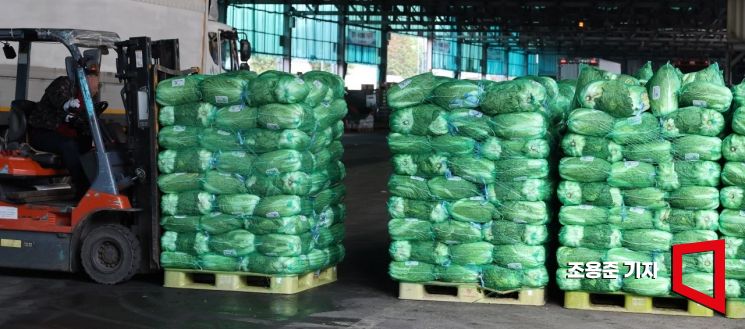 An official is organizing napa cabbages that arrived from the production area at the vegetable collection center in Garak Wholesale Market, Songpa-gu, Seoul.
Initially, as the heatwave continued until mid-September, there were concerns about a 'Kimjang crisis' due to potential difficulties in securing autumn cabbage for kimchi-making. Moreover, heavy rains in mid-September caused damage in major cabbage-producing areas such as Haenam County in Jeollanam-do, further increasing supply concerns. However, it is reported that the autumn cabbage crop has recovered as farmers replanted wilted plants and strengthened growth management.
An official from the Ministry of Agriculture, Food and Rural Affairs stated, "As the shipping regions have expanded and shipment volumes increased, napa cabbage prices have entered a downward stabilization trend," adding, "Prices are expected to stabilize further as shipments from the main production area in Honam begin in earnest from mid-month."
Government discount support and retailers' own discounts also contributed to the decline in retail prices. The Ministry of Agriculture, Food and Rural Affairs focused on supplying contract-grown napa cabbage and radish (24,000 tons of napa cabbage and 9,100 tons of radish) in preparation for the kimchi-making season. Additionally, until December 4, support is provided for discounts of up to 40% on 11 kimchi ingredients including napa cabbage and radish.
Emart introduced 390,000 heads of autumn napa cabbage at prices in the 1,600 won range per head and is lowering prices further to the 1,400 won range for 300,000 heads. Nonghyup Hanaro Mart is also offering discounts of up to 38% on kimchi ingredients such as salted napa cabbage and salted seafood.
The price of radish, which had shown a strong upward trend alongside napa cabbage prices, has also turned downward, although it remains higher than usual. As of the 15th, the retail price of radish was 2,524 won per piece, a 29.8% decrease compared to a month ago. However, this is 72.4% higher than a year ago and 11.0% above the average. The Korea Rural Economic Institute forecasts that winter radish production will decrease by 5.9% to 333,000 tons compared to last year.
Meanwhile, according to the distribution industry on the 14th, sales of packaged kimchi products at major large supermarkets increased compared to the same period last year. This is attributed to the increased burden of kimchi-making costs due to high inflation and the rise of so-called 'Kimpo-jok'?people who give up making kimchi?due to the increase in single-person and small households.
Emart's sales of packaged kimchi from September 1 to November 12 increased by 3.7% compared to the same period last year. Homeplus also saw a 25% increase in packaged kimchi sales last month compared to the previous year, and Lotte Mart recorded about a 15% sales growth in refrigerated kimchi products from November 1 to 12 compared to the same period last year. As demand for packaged kimchi increased, some kimchi manufacturers had suspended sales of certain products on their own malls or delayed deliveries, but with the smooth supply of autumn napa cabbage, kimchi manufacturers have resumed sales of packaged kimchi.
© The Asia Business Daily(www.asiae.co.kr). All rights reserved.
![Clutching a Stolen Dior Bag, Saying "I Hate Being Poor but Real"... The Grotesque Con of a "Human Knockoff" [Slate]](https://cwcontent.asiae.co.kr/asiaresize/183/2026021902243444107_1771435474.jpg)















