Citizen Groups Survey 1,000 Office Workers
It has been three years since the issuance of wage statements became mandatory, but a survey revealed that one in four office workers still do not receive their wage statements properly. Workers in smaller workplaces or with unstable employment were more likely not to receive wage statements.
Workplace Gapjil 119 announced on the 17th the results of an online survey conducted from September 2 to 10 among 1,000 workers aged 19 and older nationwide regarding the 'issuance of wage statements' (confidence level 95%, sampling error ±3.1%P). Wage statements are important documents that allow workers to verify whether their monthly salary has been properly paid. Employers who fail to issue wage statements or omit or falsify required information may be fined up to 5 million KRW. The Ministry of Employment and Labor classifies the issuance of wage statements as a 'basic labor order.'
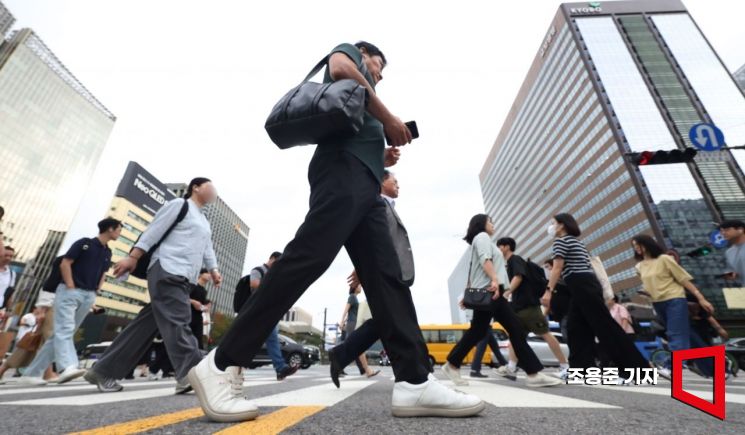 Citizens are hurrying to work on Sejong-daero, Gwanghwamun, Jongno-gu, Seoul. Photo by Jo Yongjun jun21@
The survey results showed that 76.2% of respondents receive their wage statements monthly via written form, email, KakaoTalk, or electronic viewing, while 23.8% do not receive them. This means one in four workers does not receive a wage statement. Notably, differences were observed based on workplace size, employment type, wage level, and gender. The rate of not receiving wage statements was relatively higher in workplaces with fewer than 5 employees (55.7%) compared to those with 300 or more employees (13.1%), among non-regular workers (46%) compared to regular workers (9%), among non-office workers (39.2%) compared to office workers (8.4%), among those earning less than 1.5 million KRW (59.5%) compared to those earning 5 million KRW or more (4.2%), among women (29.3%) compared to men (18.9%), and among non-union members (25.7%) compared to union members (8.8%).
Workplace Gapjil 119 stated, "Workers who do not receive wage statements find it difficult to even confirm wage arrears, and even if they file a complaint, it is hard to calculate the exact amount of unpaid wages." Leaving the issue of non-issuance of wage statements unaddressed inevitably worsens the problem of wage arrears. They also criticized, "When authorities only impose fines after workers report and then accept the submission of several months or years’ worth of wage statements at once without penalties, claiming it as 'correction,' it is tantamount to the authorities leading the violation of the law’s intent and encouraging breaches of basic labor order."
© The Asia Business Daily(www.asiae.co.kr). All rights reserved.

















