'Big Data-Based City Bus Route Reorganization Service' Route Reorganization Plan Prepared, Phased Reorganization
Route reorganization to be implemented in April next year after fully collecting citizen opinions through district and county resident briefings
Busan City has prepared a bus route reorganization plan through the ‘Big Data-Based City Bus Route Reorganization Service’ to resolve citizen inconveniences caused by long-distance routes and increased bus intervals, and to enhance the competitiveness of city buses. The city is preparing a phased reorganization that reflects citizens' opinions.
Due to the expansion of urban areas such as Gijang and Gangseo, the average city bus operation time increased from 109 minutes in 2007 to 161 minutes last year, and the average bus interval significantly increased from around 10 minutes in 2007 to 17 minutes last year.
To address these citizen inconveniences and improve city bus competitiveness, the city prepared a route reorganization plan through the ‘City Bus Route Reorganization Service (August 2023 to December 2024)’.
According to a citizen survey on the route reorganization, 44.7% of respondents indicated that their top priorities were ‘adjustment of long-distance routes’ and ‘shortening of bus intervals’.
Regarding the method of route reorganization, considering that 56% of respondents preferred a ‘phased reorganization,’ the city will prioritize reorganizing the Gijang-gun and Gangseo-gu areas (Phase 1), where there is no urban railway and chronic public transportation supply shortages make route reorganization urgent.
After analyzing the effects of the Phase 1 reorganization, the city plans to implement Phase 2 reorganization after 2026 for downtown areas, reflecting large-scale transportation environment changes such as the opening of the Mandeok?Centum Urban Expressway, Sasang-Hadan Line, and Bujeon-Masan Line.
This route reorganization plan aims to ▲reduce the average bus interval in Gijang and Gangseo areas by 6 minutes (2 minutes citywide) ▲expand the introduction of urban express buses that quickly connect downtown and outskirts ▲supply new routes in new towns and introduce internal circulation lines in Jeonggwan New Town ▲expand demand-responsive transport (DRT) in Gijang Osiria and Gangseo areas to provide seamless public transportation services without blind spots.
Through adjustments to long-distance routes, the average bus interval in Gijang and Gangseo areas will be shortened by 6 minutes, and by 2 minutes citywide. The current 145 city bus routes will be adjusted to 144 routes, with 9 new routes established, 21 routes changed, and 10 routes with very low ridership or duplication abolished.
For changed or abolished routes, alternative routes or demand-responsive transport (DRT) will be provided to minimize citizen inconvenience.
The ‘urban express buses,’ which can quickly move between downtown and outskirts via car-only roads such as bridges and tunnels, will be expanded from the existing 6 routes (60 buses) to 8 routes (83 buses).
New routes will be established in Eco Delta City, which currently has no city bus routes, and bus supply will be increased in new town areas such as the expansion of routes in Ilgwang New Town and the introduction of internal circulation lines in Jeonggwan New Town.
The demand-responsive transport (DRT), which was piloted in the Gijang Osiria area and received high citizen satisfaction, will be expanded. The number of DRT vehicles in Gijang will increase from 5 to 9, and 9 new DRT vehicles will be introduced in public transportation blind spots in Gangseo-gu to enable local residents to use public transportation more conveniently.
The city plans to implement the route reorganization in April next year after collecting and actively reflecting citizen opinions through the city council, district and county opinion inquiries, and resident briefings on the prepared route reorganization plan.
To increase citizen acceptance of the route reorganization plan, the city will hold resident briefings in six districts and counties, in addition to consultations with the city council and district and county offices, to listen to local residents' voices.
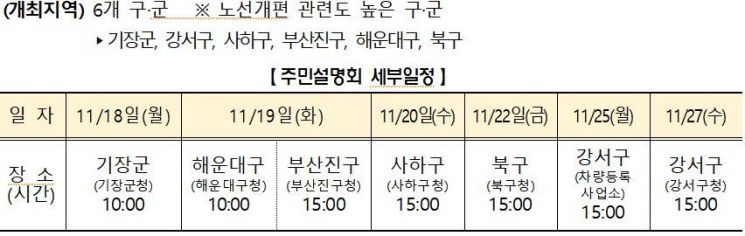
The reorganization plan will be disclosed to citizens through the websites of the districts and counties.
Mayor Park Hyung-jun said, “With this route reorganization plan, we will enhance competitiveness and improve operational efficiency to make city bus use more convenient so that more citizens can use city buses.” He added, “We will do our best to make Busan ‘the city where public transportation is most convenient’ by maximizing the collection and reflection of citizen opinions through resident briefings and other means, making this a route reorganization for the citizens.”
© The Asia Business Daily(www.asiae.co.kr). All rights reserved.
![Clutching a Stolen Dior Bag, Saying "I Hate Being Poor but Real"... The Grotesque Con of a "Human Knockoff" [Slate]](https://cwcontent.asiae.co.kr/asiaresize/183/2026021902243444107_1771435474.jpg)
















