First Japan-China Summit in One Year at Peru APEC Summit
Promotion of High-Level Visits Between the Two Countries
Early Import of Japanese Seafood to Be Steadily Implemented
Chinese President Xi Jinping and Japanese Prime Minister Shigeru Ishiba reaffirmed their commitment to promoting a "strategic and mutually beneficial relationship" that expands common interests between the two countries, the Japanese Ministry of Foreign Affairs reported.
According to the Ministry of Foreign Affairs, President Xi and Prime Minister Ishiba held a 35-minute bilateral summit on the 15th (local time) in Lima, Peru, on the sidelines of the Asia-Pacific Economic Cooperation (APEC) summit. This was the first meeting between Prime Minister Ishiba, who took office last month, and President Xi. It was also the first China-Japan summit in a year since the meeting between then-Japanese Prime Minister Fumio Kishida and President Xi in November last year.
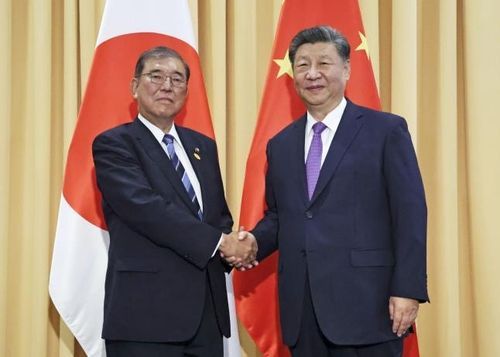 Chinese President Xi Jinping (right) and Japanese Prime Minister Ishiba shake hands ahead of the summit in Peru. Photo by Yonhap News
In his opening remarks at the meeting, Prime Minister Ishiba stated, "It is of great significance to the international community that the two countries share the broad direction of comprehensively promoting a strategic and mutually beneficial relationship and building a constructive and stable relationship. (Omitted) I want both sides to work together to accumulate concrete achievements that the public can feel, showing that China-Japan relations are developing." He added, "China and Japan bear important responsibilities for peace and prosperity in the region and the international community," and "While there are expanding great possibilities for development between the two countries, there are also many challenges and issues."
President Xi said, "China and Japan are close neighbors and important countries in Asia and the world, and the relationship between the two countries has significance beyond the bilateral level," adding, "(Japan) should face history squarely and look to the future, properly handle major principle issues such as history and Taiwan, and constructively manage differences to maintain the political foundation of bilateral relations."
He continued, "China-Japan economic interests and industrial supply chains are closely linked, and both sides must adhere to win-win cooperation and safeguard the stable and smooth flow of the global free trade system and production and supply chains."
The two countries also agreed to promote high-level communication and visits, including between their leaders. When asked about the possibility of his visit to China, Prime Minister Ishiba responded, "I recognized that exchanges and talks between leaders are important. There will be another opportunity." The last visit by a Japanese prime minister to China was by Shinzo Abe in 2019, who went to Chengdu for the trilateral summit between China, Japan, and South Korea. President Xi's most recent visit to Japan was in 2019 when he attended the G20 summit in Osaka.
During the meeting, Prime Minister Ishiba expressed to President Xi his "deep concern" regarding the situation in the East China Sea and China's military activities. In August, Chinese military aircraft violated Japanese airspace, prompting a strong protest from the Japanese government.
Additionally, Prime Minister Ishiba requested the early resumption of China's imports of Japanese seafood, which had been suspended since the discharge of contaminated water (referred to by the Japanese government as "treated water") from the Fukushima Daiichi Nuclear Power Plant in August last year. The two leaders confirmed their intention to steadily implement the agreement to resume imports.
Prime Minister Ishiba also raised the issue of the safety of Japanese nationals in China. Regarding the incident in September in Shenzhen, Guangdong Province, where a Japanese schoolchild was attacked and killed, he requested the securing of safety for Japanese people in China. President Xi responded, "We will ensure the safety of all foreigners, including Japanese nationals."
Prime Minister Ishiba said, "The potential for economic cooperation between the two countries is great," and according to Xinhua News Agency, he also stated, "Japan has no intention of decoupling (such as separating supply chains) from China." Regarding Taiwan, he told President Xi, "Japan's position on the Taiwan issue, based on the 1972 Japan-China Joint Communique, remains unchanged."
Regarding North Korea, the Japanese Ministry of Foreign Affairs stated, "The two leaders also exchanged views on the North Korean situation, including the issue of abductees."
© The Asia Business Daily(www.asiae.co.kr). All rights reserved.
![Clutching a Stolen Dior Bag, Saying "I Hate Being Poor but Real"... The Grotesque Con of a "Human Knockoff" [Slate]](https://cwcontent.asiae.co.kr/asiaresize/183/2026021902243444107_1771435474.jpg)















