5000 Visitors Gather Despite Noxious Odor
Corpse Flower Blooms in Australia, Botanical Garden Crowded
Blooms Once Every 10 Years
Flowering Lasts Only 24 to 48 Hours
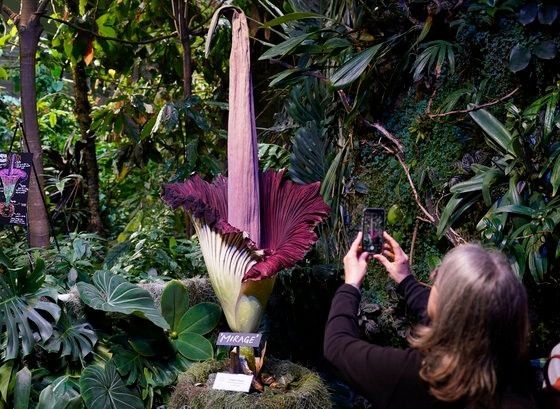 On February 29th (local time), visitors at the California Academy of Sciences in San Francisco, California, USA, are observing the Amorphophallus titanum, known as the "corpse flower." Photo by Xinhua News Agency - Yonhap News.
A rare flower, nicknamed the 'Corpse Flower' due to its corpse-like rotting smell, recently bloomed at a botanical garden in Australia, attracting thousands of visitors. This flower blooms only once every 10 years, and its blooming period lasts just 24 to 48 hours, making news of its bloom a global sensation.
According to CNN on the 11th (local time), a rare plant called the 'Corpse Flower' bloomed at a botanical garden in Geelong, south of Melbourne, Australia, drawing intense interest. The flower's official name is Amorphophallus titanum (Titan Arum), a giant flower that can reach up to 3 meters in height and weigh 100 kg. When it blooms, it emits a distinctive foul odor similar to the smell of a decaying corpse to attract beetles and flies, hence the nickname 'Corpse Flower.'
Upon news of the Corpse Flower's bloom, about 5,000 visitors flocked to the Geelong Botanical Garden on the first day of blooming. Some visitors reportedly returned multiple times to witness the blooming process. They described the smell as "similar to a dead rat" and "like a rotten pond." The botanical garden expected the bloom to continue until the evening and kept the garden open 24 hours during this period. For those unable to visit in person, an online live broadcast was also provided, reportedly watched by tens of thousands worldwide.
The Corpse Flower is native to Sumatra Island, Indonesia, and is classified as an endangered species by the International Union for Conservation of Nature (IUCN). With fewer than 1,000 individuals remaining, botanical gardens worldwide are working hard to conserve the Corpse Flower.
© The Asia Business Daily(www.asiae.co.kr). All rights reserved.
![Clutching a Stolen Dior Bag, Saying "I Hate Being Poor but Real"... The Grotesque Con of a "Human Knockoff" [Slate]](https://cwcontent.asiae.co.kr/asiaresize/183/2026021902243444107_1771435474.jpg)















