Disagreement Over Formation of Pension Reform Special Committee
Discuss in Special Committee vs Debate in Standing Committee
Although the 22nd National Assembly is approaching six months since the start of its term, the ruling and opposition parties have yet to begin discussions on pension reform. They are only engaged in a tug-of-war over which body should handle the pension reform discussions.
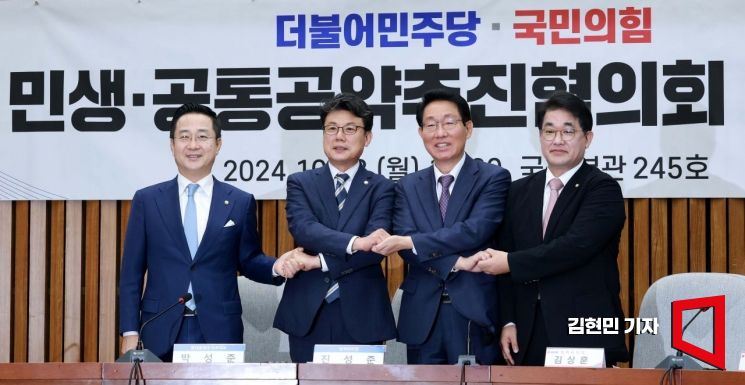 Park Seong-jun, Chief Deputy Floor Leader of the Democratic Party of Korea (from left), Jin Seong-jun, Chairman of the Policy Committee, and Kim Sang-hoon, Chairman of the Policy Committee of the People Power Party, along with Bae Jun-young, Chief Deputy Floor Leader, are holding hands at the launch ceremony of the Livelihood and Common Pledge Promotion Council held at the National Assembly on the 28th. Through this council, the two parties will discuss bills related to creating future growth engines such as semiconductors, AI, and expansion of the national power grid, economic revitalization, asset market value enhancement, support for small and medium-sized enterprises, small business owners, self-employed, support for local markets and regional economies, addressing low birth rates and regional disparities, abolition of parliamentary privileges, revival of district parties, and abolition of the financial investment tax. Photo by Kim Hyun-min
Last month, the ruling and opposition parties launched a council to promote livelihood and common pledges. This led to expectations that pension reform discussions would gain momentum, but nothing has changed. According to a senior official from the People Power Party on the 15th, the Democratic Party of Korea has not expressed any particular stance on the ruling party's proposal to form a National Assembly Special Committee on Pension Reform. No compromise proposals, such as not having an equal number of members from both parties on the pension reform special committee or allowing the opposition party to have more members, have been discussed. The busy schedule of the National Assembly due to the national audit and the confrontation between the ruling and opposition parties over various special investigation laws also appear to have contributed to the delay in pension reform discussions.
The Democratic Party argues that since the ruling and opposition parties formed a pension reform special committee and reached a certain agreement during the 21st National Assembly but failed to implement fundamental reforms of the National Pension parameters, it is better to execute the fundamental reforms first within the Health and Welfare Committee (Welfare Committee) subcommittee rather than forming the special committee again. Additionally, the Democratic Party is lukewarm about forming the special committee because its members would be equally divided between the ruling and opposition parties, whereas in the subcommittee, the opposition party maintains a numerical advantage.
The People Power Party insists that, just as the 21st National Assembly formed a pension reform special committee for bipartisan discussions in July 2022, the same committee should be established in the 22nd National Assembly to continue discussions. They believe that structural reforms, which cover not only fundamental reforms such as changing the income replacement rate or contribution rate but also basic pensions and retirement pensions, are important in pension reform. Since the Welfare Committee only handles the National Pension, the ruling party argues that a government-wide and National Assembly-wide discussion body is necessary, involving related ministries such as the Ministry of Employment and Labor, the Financial Services Commission, and the Ministry of Economy and Finance.
During the 21st National Assembly, the ruling and opposition parties agreed to raise the National Pension contribution rate from the current 9% to 13% and to set the income replacement rate?the ratio of pension benefits to average income during the contribution period?at around 44%. However, final negotiations broke down as the People Power Party insisted that structural reforms should be included alongside fundamental reforms in pension reform.
© The Asia Business Daily(www.asiae.co.kr). All rights reserved.
![Clutching a Stolen Dior Bag, Saying "I Hate Being Poor but Real"... The Grotesque Con of a "Human Knockoff" [Slate]](https://cwcontent.asiae.co.kr/asiaresize/183/2026021902243444107_1771435474.jpg)
















