Three Major Convenience Store Chains Hold Up Performance Amid Economic Downturn
Stand Out Amid Department Store and Mart Sales Slump
Highest Offline Sales Ratio in Retail Industry
Convenience stores are emerging as the strongest players in the domestic offline distribution industry. This is attributed to the increased demand from consumers who prefer small-scale purchases at nearby convenience stores due to high inflation and economic recession. The third-quarter performance of major domestic convenience store companies also showed improvement compared to last year.
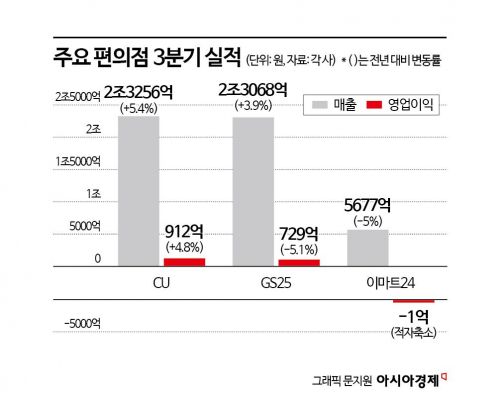
According to the distribution industry on the 15th, BGF Retail, which operates the convenience store CU, reported a tentative operating profit of 91.2 billion KRW for the third quarter of this year, a 4.8% increase compared to the same period last year. Sales during the same period rose 5.4% to 2.3256 trillion KRW.
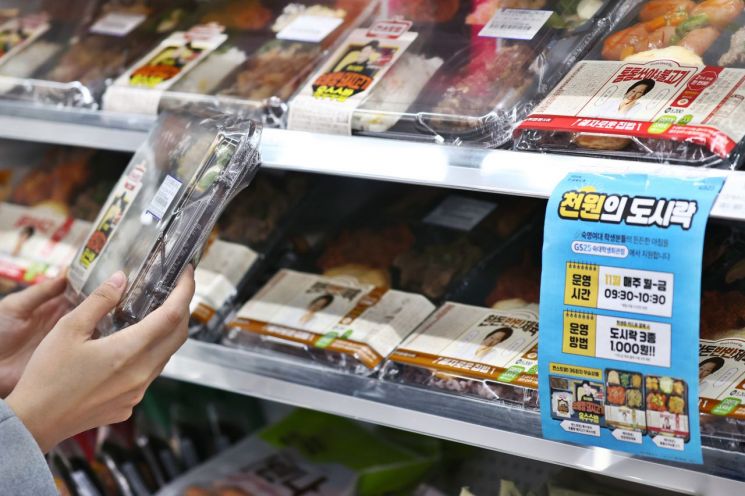 A student is purchasing a '1,000 won lunchbox' at the GS25 Sookdae Student Union Branch in Yongsan-gu, Seoul. Photo by Yonhap News
GS Retail, which operates GS25, also recorded convenience store division sales of 2.3068 trillion KRW, up 3.9% from the same period last year. However, operating profit decreased by 5.1% to 72.9 billion KRW due to increased advertising and promotional expenses from the rise in the number of stores. Emart24, a subsidiary of Emart, posted third-quarter net sales of 567.7 billion KRW and an operating loss of 100 million KRW. Although sales fell by 5% compared to the same period last year, it succeeded in reducing operating losses by 3 billion KRW.
This performance is commendable compared to other distribution channels during the same period, which saw declines in both sales and operating profits due to the economic downturn. Emart, the leading large-scale supermarket chain, experienced a 4.4% decrease in sales and a 3.8% drop in operating profit in the third quarter compared to the same period last year. Lotte Mart also saw sales and operating profit decline by 4.9% and 11.6%, respectively, compared to the previous year.
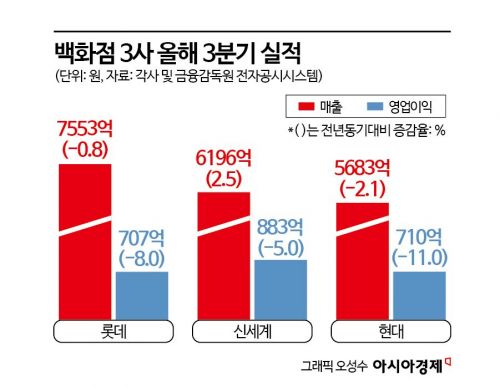
In the department store sector, operating profits of the three major companies all decreased. Lotte Department Store's third-quarter operating profit fell by 8% compared to the same period last year, and Shinsegae Department Store also saw a 5% decrease. Hyundai Department Store's operating profit dropped by 11% compared to the previous year. In terms of sales, Lotte Department Store and Hyundai Department Store recorded decreases of 0.8% and 2.1%, respectively, in the third quarter compared to the same period last year. Only Shinsegae Department Store saw a 2.5% increase in sales during the same period.
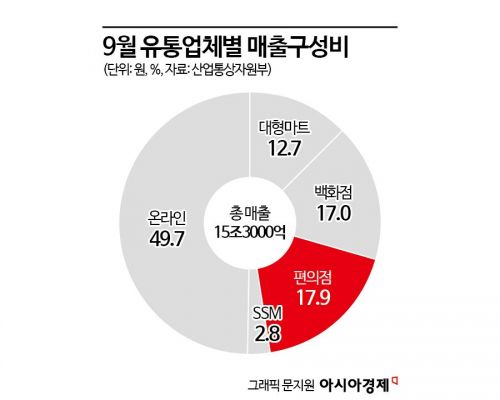
The strong performance of the convenience store industry is also reflected in its sales share within the overall distribution industry. According to the monthly sales trend survey conducted by the Ministry of Trade, Industry and Energy, convenience stores accounted for 17.9% of total sales across all distribution sectors. This figure surpasses department stores (17%), large-scale supermarkets (12.7%), and corporate supermarkets (SSM, 2.8%), making it the highest share among offline distribution sectors. The ministry's survey also showed that convenience stores maintained the highest offline sales share for four consecutive months after surpassing department stores by 1 percentage point in June with a 17.1% share.
This trend appears to be influenced by consumers opting to have meals at convenience stores amid economic recession caused by high inflation. An analysis by the Korea Chamber of Commerce and Industry of the first half sales trends of four major convenience store companies, based on data from the product data analysis firm Market Link, revealed that sales of meal replacement products at convenience stores grew by 17.6% compared to the same period two years ago.
The Korea Chamber of Commerce and Industry explained, "As rising prices increase the burden of meal costs, more consumers are choosing to eat at convenience stores instead of restaurants. With the recent increase in single-person households, convenience stores have become a popular channel for restaurant-style ready meals, establishing themselves as an alternative dining option."
The decline in department store performance in the third quarter due to seasonal factors also appears to have had an impact. This year, abnormal weather conditions extended the heat into early autumn, causing the three major department stores to experience sluggish sales of fall and winter (FW) fashion products. Typically, clothing accounts for 40-50% of annual department store sales, significantly contributing to their performance. However, the prolonged late heat with daytime temperatures nearing 30 degrees Celsius until the end of September prevented department stores from benefiting from the 'fashion boom.' Nevertheless, with the onset of colder weather expected in the fourth quarter, sales of outerwear and other clothing items are anticipated to increase, leading to forecasts that department stores will reclaim the top spot in offline sales share.
© The Asia Business Daily(www.asiae.co.kr). All rights reserved.
![Clutching a Stolen Dior Bag, Saying "I Hate Being Poor but Real"... The Grotesque Con of a "Human Knockoff" [Slate]](https://cwcontent.asiae.co.kr/asiaresize/183/2026021902243444107_1771435474.jpg)


















