Trump: "I Will Hang a 'Merry Christmas' Sign"
Years of Conservative and Progressive 'Christmas War'
Conservatives Enthusiastic About Trump Keeping His Promise
"Make Christmas Great Again"
Supporters of Donald Trump, the President-elect of the United States, are already enjoying Christmas in advance. Recently, on X (formerly Twitter) and other online platforms, Trump supporters have been quickly sharing photos taken inside the discount store Target. The photos show a sign hanging from the store ceiling that reads "Merry Christmas." They cheered the change revealed by Trump's election, saying, "Target has a Merry Christmas sign instead of Happy Holidays" and "Finally won the culture war."
Why is there such a reaction to Target's move? Target, a large discount store competing with Walmart, has been literally a "target" for conservatives for years. In 2005, when Target used the term "Holiday" instead of "Christmas" for its year-end sale event, the American Family Association (AFA) launched a boycott. In 2016, another boycott occurred when Target allowed gender-neutral restrooms for LGBTQ people.
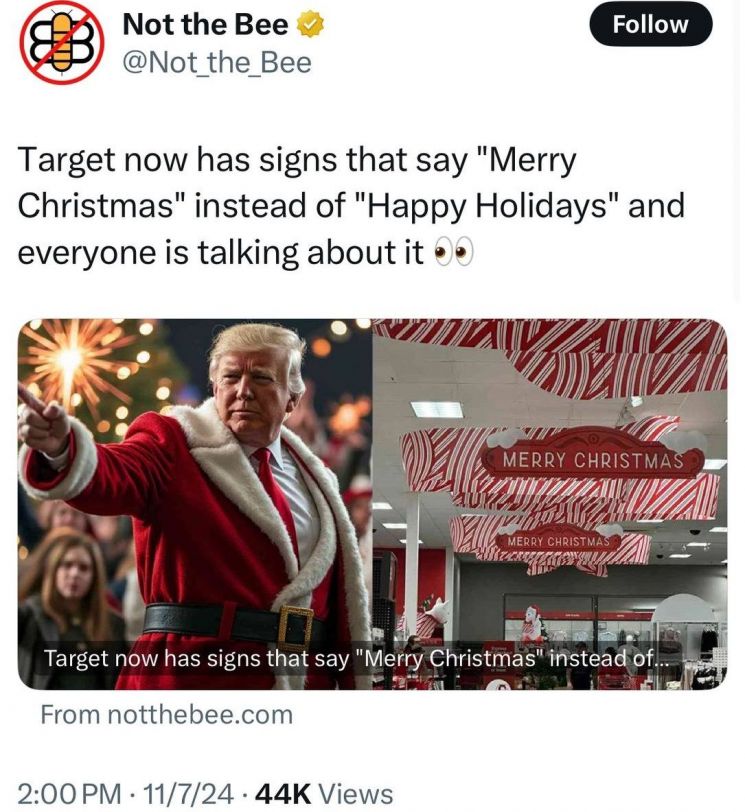 A post and photo showing a "Merry Christmas" sign hung in a Target store, a major discount retailer in the United States
 Photo by X (formerly Twitter)
The American conservative legal group Liberty Counsel named Target in 2021 as a bad company that silenced the birth of Jesus by changing Christmas to Holiday and self-censoring. Last year, Target faced backlash after placing related products prominently in stores during LGBTQ Pride Month. Due to conservatives storming the store and destroying product displays, Target suffered from poor sales and stock price drops. Until recently, Target ran ads with the phrase "Happier holiday," so it became a hot topic when the store put up a "Merry Christmas" sign after Trump's election.
War On Christmas

The spread of the greeting "Happy Holidays" was largely due to progressive groups. Although it seems like a greeting with diminished religious meaning, from the perspective of people of other religions or non-religious individuals, "Merry Christmas" carries a Christian meaning of rejoicing (Merry) and worshiping (mass) the birth of the Lord (Christ).
Progressive groups argued that "in a country with diverse religions and cultures, a greeting that encompasses the year-end season is more reasonable than one with excessive religious connotations." This argument, based on the First Amendment's principle of freedom of religion, was persuasively accepted in American society. On the other hand, conservative groups felt very uncomfortable, believing that America's identity, rooted in Christianity, was being undermined.
The conflict between conservatives and progressives during the Christmas season over the years is called the "War On Christmas."
At the Center of Conservative and Progressive Conflict, the First Amendment
At the heart of the conflict between the two sides is the First Amendment of the U.S. Bill of Rights. According to the First Amendment, Congress shall make no law respecting an establishment of religion or prohibiting the free exercise thereof. The reason separation of church and state and religious freedom are enshrined in the Constitution relates to the history of religious persecution experienced by Protestant Christians (Puritans).
In 17th-century England, where the Puritans lived, the established church was the Church of England (Anglican Church). Under the English king, the head of the Church of England, all English people had to be members of the Anglican Church. England had a "monopolistic established church" system where one denomination monopolized government support. Other religions faced religious persecution and unfair treatment. This monopolistic established church system was a decisive factor that led Puritans to seek religious freedom and set foot on what is now American soil. Later, through the First Great Awakening in the 18th century, Puritan faith (Evangelicalism) became the foundation of American identity and culture and sowed the seeds of the American Revolution.
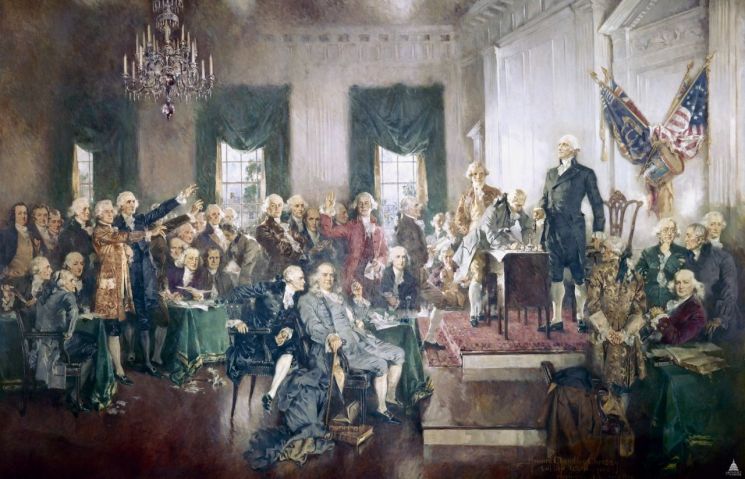 Scene of the signing of the United States Constitution. 1940 work by Howard Chandler Christy [Photo by U.S. Capitol Preservation Commission]
After independence, debates about the role of religion in the new nation took place. At that time, Article 4 of the Constitution prohibited monopolistic established churches. There were two options: a "general established church" that extended government support to all Protestant denominations, or the "abolition of established church" that allowed no support. Considering disparities in support between mainstream and minority denominations, the First Amendment was enacted to separate politics and religion and prohibit the establishment of a state religion.
However, this was intended to prevent attempts to establish a specific Protestant denomination as the state church and oppress others, not to deny that Protestantism was the mainstream religion or to create a society completely separate from Protestantism. It is understood as guaranteeing the right to freely believe in various denominations stemming from one Protestant root. Historians analyze that as various immigrants arrived later, the concept expanded to freedom for all religions.
Conservatives Enthusiastic About Trump's "Merry Christmas" Greeting
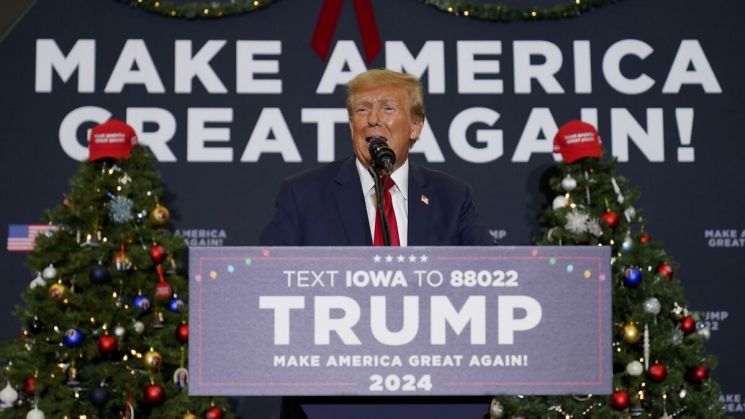 Donald Trump, then the Republican presidential candidate, giving a speech ahead of Christmas last December
 [Photo by AP Yonhap News]
In 2006, President George W. Bush sent cards to 1.4 million people for Christmas. The card read, "Wishing you a holiday filled with hope and happiness." Christian conservative groups expressed great disappointment at Bush's actions, as he claimed to be a devout Christian.
His successor, President Barack Obama, also did not use the term Christmas on his cards and even omitted common Christmas decorations. American politicians have increasingly used "Happy Holidays" as a greeting, as the perception of political correctness under the name of inclusion has widely spread.
However, Trump suddenly declared during the 2015 Republican primary, "If I become president, I will make it possible for every store to put up 'Merry Christmas' signs again." Trump emerged as a defender of traditional Christian evangelical values, which is why Christian fundamentalists and conservative groups could not help but be enthusiastic. Some criticize him for politicizing the word Christmas, but considering American history, this reaction is somewhat understandable.
Merry Christmas vs. Happy Holidays, What Do Americans Prefer?
Which greeting do Americans prefer? According to a 2013 survey by the U.S. polling organization Pew Research, when greeting customers of different faiths in stores, 49% of respondents said "Happy Holidays" should be used as a sign of respect. Meanwhile, 43% preferred "Merry Christmas."
Four years later, a 2017 Marist poll showed more respondents preferred "Merry Christmas." More than half of Americans (59%) said they preferred "Merry Christmas" over "Happy Holidays" (39%). In a 2022 survey conducted by Monmouth University Polling Institute, 61% of respondents said they use "Merry Christmas" as a greeting, while "Happy Holidays" accounted for only 30%.
© The Asia Business Daily(www.asiae.co.kr). All rights reserved.
![Clutching a Stolen Dior Bag, Saying "I Hate Being Poor but Real"... The Grotesque Con of a "Human Knockoff" [Slate]](https://cwcontent.asiae.co.kr/asiaresize/183/2026021902243444107_1771435474.jpg)

















