The ruling and opposition parties met and reached a consensus to handle livelihood bills during the regular National Assembly session. They are expected to prioritize bills that protect the common people’s economy, such as cracking down on illegal private loans and raising the deposit insurance limit.
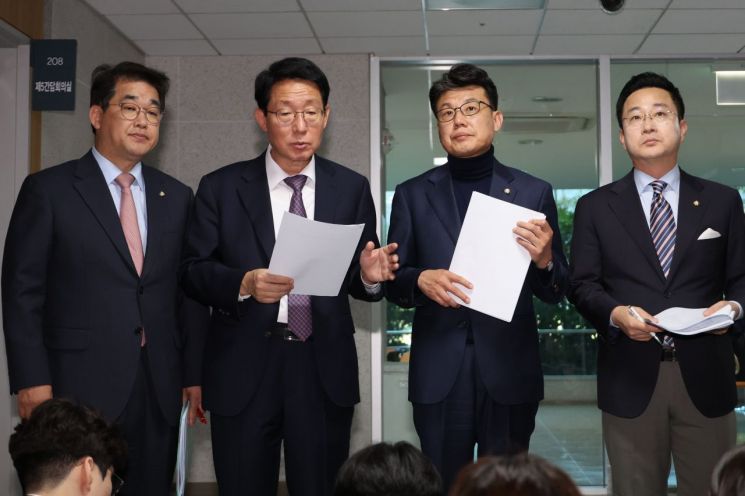 The policy chiefs and senior deputy floor leaders of the People Power Party and the Democratic Party of Korea are explaining the details of an agreement after holding a closed-door negotiation on the livelihood bills to be submitted as agenda items for tomorrow's plenary session, at the National Assembly Members' Office Building in Yeouido, Seoul, on the afternoon of the 13th. Photo by Yonhap News
On the 13th, the policy chiefs and floor deputy leaders of the People Power Party and the Democratic Party met at the National Assembly in Yeouido, Seoul, to discuss the direction for handling about 70 livelihood bills. Kim Sang-hoon, the policy chief of the People Power Party, said to reporters after the meeting, "We shared and organized bills that both parties can accept and some that can be partially accepted." Jin Sung-jun, the policy chief of the Democratic Party, said, "The number of bills that both parties’ policy chiefs exchanged and confirmed as acceptable or partially acceptable is about 70," adding, "We will do our best to review and pass them during this regular session."
The two parties plan to promptly handle amendments to the Loan Business Act and the Deposit Insurance Act. The amendment to the Loan Business Act includes strengthening the entry and exit requirements for loan businesses to eradicate illegal private loan companies. The amendment to the Deposit Insurance Act aims to raise the deposit insurance limit from the current 50 million won to 100 million won. In addition, they agreed to handle amendments to the Building Act, the Special Act on Expanding the National Power Grid, the Military Public Officials’ Disaster Compensation Act, and the Crisis Youth Support Act.
While there was agreement on the necessity of handling some bills, additional discussions remain. The ruling and opposition parties classified the Special Act on Strengthening Semiconductor Industry Competitiveness, the Artificial Intelligence (AI) Basic Act, the Government Organization Act, the Childcare Support Act, the Support for Low-Income Financial Services Act, and the Agricultural and Fishery Disaster Insurance Act as partially acceptable bills. Policy Chief Jin said, "Although there are some disagreements, there are more parts that can be accepted," and added, "We agreed that it is necessary to actively prioritize their review."
Going forward, the ruling and opposition parties plan to increase the number of bills handled by agreement. Policy Chief Kim said, "The policy committees of both parties will review the bills that are acceptable or partially acceptable to see if they can increase the number of bills that can be passed by agreement," adding, "These bills will be prioritized for review in the standing committees."
© The Asia Business Daily(www.asiae.co.kr). All rights reserved.
![Clutching a Stolen Dior Bag, Saying "I Hate Being Poor but Real"... The Grotesque Con of a "Human Knockoff" [Slate]](https://cwcontent.asiae.co.kr/asiaresize/183/2026021902243444107_1771435474.jpg)















