Risk of Exposure to Child Abuse and Neglect
Mandatory Reporting in the UK, Germany, Japan, etc.
Urgent Need for Legislation to Guarantee Basic Rights
# Refugee applicants Mr. and Mrs. A from C?te d'Ivoire live with their children aged 1, 3, and 7, who were born in Korea. The children are ‘unregistered’ as they have no birth registration in either C?te d'Ivoire or Korea. Since Mr. and Mrs. A cannot return to their home country, their children have no choice but to stay in Korea with them, but they must live without legal identity protection.
More than 4,000 foreign children like Mr. A’s children, born in Korea but without birth registration, remain ‘identity unknown,’ yet legislation to register their births has failed to pass the National Assembly for years. Unregistered children face difficulties in securing legal identity, making them vulnerable to crime. Moreover, without birth registration, they struggle to access various health, medical services, and basic education. Legal circles emphasize that both the UN Convention on the Rights of the Child and the Constitutional Court have declared the ‘right to birth registration’ as a fundamental basic right for children, calling for prompt legislation.
UN and Constitutional Court Declare ‘Right to Birth Registration’ a Fundamental Right
Korea ratified the UN Convention on the Rights of the Child in 1991, which declares the ‘right to birth registration’ as a fundamental right of children. In March last year, the Constitutional Court ruled on a constitutional complaint (2021HunMa975) against a provision of the ‘Act on the Registration of Family Relations’ that effectively prohibits birth registration by unmarried fathers, stating, “The right to birth registration immediately after birth is a fundamental right that requires minimum protective measures to allow children to express their personality and grow and develop healthily under the protection of parents and family.”
However, children born in Korea to foreign parents fall into a blind spot. Under the current Family Relations Registration Act, only Korean ‘citizens’ can register births. In other words, children born in Korea to foreign parents or born out of wedlock to foreign mothers have no ‘right to birth registration.’
Ryu Ho-yeon (40, passed the first bar exam), a researcher at the National Assembly Legislative Research Office, pointed out this legal gap in a report on the ‘Foreign Children Birth Registration System’ on the 5th. According to the Board of Audit and Inspection’s announcement last year, from 2015 to 2022, 4,025 children with foreign guardians remained registered under temporary newborn numbers without being converted to foreign registration numbers. Ryu said, “If similar cases existed before 2014, the number of people living without birth registration would be even higher.” He added, “Since the right to birth registration is a universal human right, it should be approached separately from nationality issues, and active legislative discussions should take place in the 22nd National Assembly.”
Legal Protection and Social Services Blind Spot
Unregistered children are administratively nonexistent, making it difficult for them to receive legal protection. They are at high risk of exposure to crimes such as abuse and neglect, and many are unable to access education, health, and other social services.
Jung Byung-soo, Head of the Child Rights Division at UNICEF Korea Committee, pointed out, “Children without birth certificates and legal identity protection fall into blind spots of all systems, making all activities cautious. They have difficulty accessing basic health services such as health checkups and infant vaccinations, let alone living information.”
Lee Jin-hye (38, passed the 4th bar exam), a lawyer at the Migrant Support Center Chingu, said, “If the exact birth date is proven through birth registration, children can be protected under juvenile law and other rights as minors. Since family relationship certificates are also issued through this, parents can act as legal representatives of minor children if problems arise.”
Siheung City Enacts Its Own Ordinance to Provide Support
Countries such as the UK, Germany, Australia, and Japan mandate birth registration for foreign children.
The UK requires all children to be registered at birth and death registrars under the ‘Births and Deaths Registration Act’ enacted in 1953. Germany and Australia require birth registration regardless of the parents’ nationality. Japan allows foreign-national children to register births just like Japanese children under the ‘Family Register Act.’
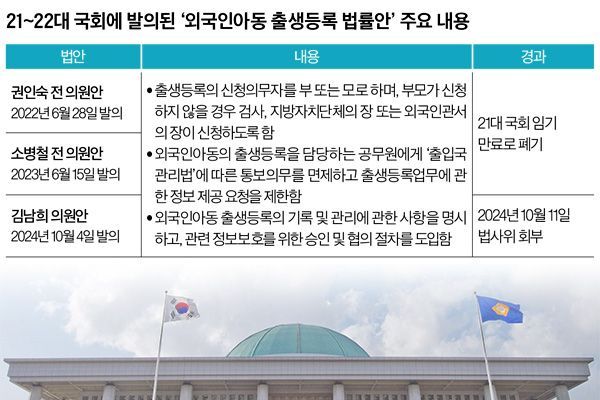
In Korea, bills mandating birth registration have been proposed but failed to pass the National Assembly. During the 21st National Assembly, former Democratic Party lawmakers Kwon In-sook and So Byung-chul (66, 15th class) each introduced bills on foreign children’s birth registration, but both were discarded due to the expiration of the Assembly’s term.
On the 4th of last month, Democratic Party lawmaker Kim Nam-hee (46, Judicial Research and Training Institute 32nd class) introduced the ‘Foreign Children Birth Registration Act’ as the main bill. Kim’s bill stipulates that the Supreme Court will oversee foreign children’s birth registration affairs and establish a ‘Foreign Children Birth Registration Office’ within the Court Administration Office to handle and support birth registration tasks. It also mandates parents as the applicants for birth registration, and if parents do not apply, prosecutors or local governments may apply.
With legislative progress stalled, some local governments have voluntarily undertaken birth registration projects for foreign children. Siheung City in Gyeonggi Province, where the foreign population accounts for 10% (as of 2022), enacted the ‘Ordinance on the Discovery and Support of Unregistered Children’ in August last year after noticing an annual increase in reports of child abuse in multicultural families. Under the ordinance, unregistered children residing in the city are identified and issued ‘Siheung Child Identification Certificates,’ and welfare and educational services are provided in cooperation with support organizations such as UNICEF.
Hong Yoon-ji, Reporter for Legal News
※This article is based on content supplied by Law Times.
© The Asia Business Daily(www.asiae.co.kr). All rights reserved.
![Clutching a Stolen Dior Bag, Saying "I Hate Being Poor but Real"... The Grotesque Con of a "Human Knockoff" [Slate]](https://cwcontent.asiae.co.kr/asiaresize/183/2026021902243444107_1771435474.jpg)
















