No Regulations in Related Laws
No Statistics, a 'Blind Spot'
In February of last year, a man in his 20s was arrested by the police on suspicion of strangling a neighbor to death in a multi-family villa in Suwon, Gyeonggi Province. Investigations revealed that the man had been in conflict with the neighbor, complaining that the "keyboard sounds were too loud" coming from the adjacent apartment. In July of last year, a man in his 60s living in a villa in Gwangjin-gu, Seoul, was arrested by the police on charges of threatening to pour thinner and set fire to a neighbor's home due to conflicts over wall noise.
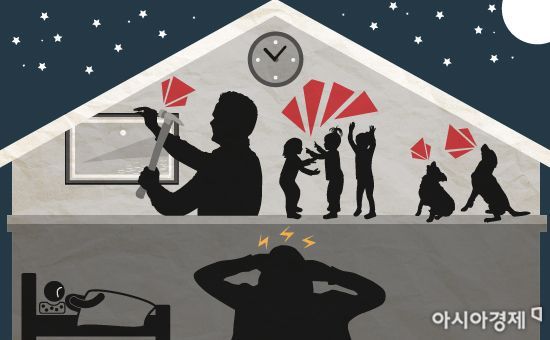
Incidents and accidents caused by 'wall noise,' where noise from neighboring units is transmitted through walls, continue to occur and are being neglected in blind spots of management. Unlike floor noise, wall noise lacks legal measures to regulate impact noise during the construction phase, making it more vulnerable to management issues.
According to related laws such as the Housing Act, in the case of multi-family housing, construction companies must submit the results of floor impact noise insulation performance to the Ministry of Land, Infrastructure and Transport before obtaining approval for use after completion. If the measured floor impact noise exceeds 49 dB, the construction company is recommended to perform supplementary construction or compensation even after completion. As conflicts between neighbors due to floor noise have been ongoing, the government authorities have introduced special measures to ensure that construction companies prevent noise from the construction stage. The 49 dB level corresponds to the noise level generated by a copier running or typing on a keyboard in a quiet office.
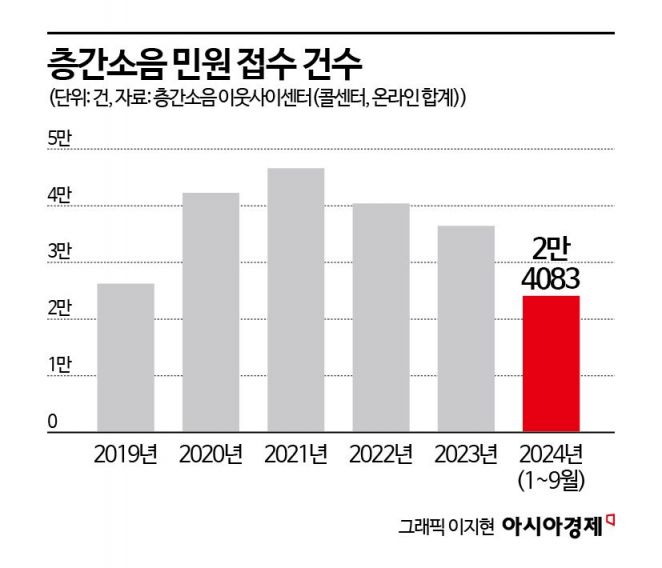
On the other hand, there are no specific regulatory measures for wall noise. According to regulations on housing construction standards, boundary walls of multi-family housing must be at least 15 cm thick if made of reinforced concrete, and at least 20 cm thick if made of plain concrete or stone. However, this is only a guideline at the design stage, and there is no requirement to verify actual impact noise on site after completion. Related statistics are also not separately compiled. According to the Korea Environment Corporation's Neighbor Noise Center for Floor Noise, the number of complaints about floor noise (including wall noise) recorded up to September this year exceeded 24,000, but there are no statistics separately classified for wall noise.
Due to this situation, residents living in places where neighbors are close, such as corridor-style apartments and officetels, are exposed to wall noise without protection. Yuga-young (29), an office worker living in an officetel in Seongbuk-gu, Seoul, said, "When I come home after work, I want to rest quietly, but I can even hear what kind of YouTube videos my neighbor is watching," adding, "I worry that the neighbor can hear my daily sounds too, so I cannot rest comfortably at home and always feel uneasy."
Experts emphasize the need to raise social awareness about wall noise and establish practical legal measures. Cha Sang-gon, director of the Housing Culture Improvement Research Institute, said, "Previously, floor noise only had guidelines at the design stage, and there was no system like on-site impact noise testing, but as social awareness of floor noise increased, legal regulations were strengthened. Since incidents and accidents caused by wall noise are occurring mainly in buildings vulnerable to wall noise, such as illegal subdivided buildings and goshiwons, legal regulations that can practically verify wall impact noise are necessary," he pointed out.
Yu Young-kwon, an engineer at the Korea Environment Corporation, also advised, "In general apartments, floor noise often transmits through walls and becomes wall noise, so wall noise statistics are not separately compiled. Because of this, buildings vulnerable to wall noise, such as officetels and goshiwons, are left in management blind spots. There seems to be a need to establish practical regulatory measures like wall impact noise testing, similar to floor impact noise testing."
© The Asia Business Daily(www.asiae.co.kr). All rights reserved.
![Clutching a Stolen Dior Bag, Saying "I Hate Being Poor but Real"... The Grotesque Con of a "Human Knockoff" [Slate]](https://cwcontent.asiae.co.kr/asiaresize/183/2026021902243444107_1771435474.jpg)
















