2025 Economic and Financial Outlook Seminar
"Need to Consider Trends in Credit Risk and Capital Regulation Strengthening"
Next year, the net profit of domestic banks is expected to decrease slightly compared to this year. In light of the high level of credit risk and the trend of strengthened capital regulations, there is an opinion that a balanced management strategy between growth and capital adequacy needs to be established.
Kim Young-do, head of the Banking Research Department at the Korea Institute of Finance, stated this on the 12th at the ‘2025 Economic and Financial Outlook Seminar’ held at the Bankers’ Hall in Jung-gu, Seoul. First, Kim projected that the net interest margin (NIM) of domestic banks will shrink to 1.55% compared to this year’s 1.59%, but interest income is expected to remain at a similar level of 62 trillion won due to an increase in interest-earning assets, compared to 60.5 trillion won this year. However, regarding loan loss costs, as the real economy’s growth slows somewhat, they are expected to rise overall, with the net increase in loan loss provisions anticipated to be 9.3 trillion won, up from 8.4 trillion won this year.
The growth rate of won-denominated loans by domestic banks is forecasted to slow to 4.5% compared to this year. The growth rate of household loans is expected to decelerate due to policy factors such as the implementation of the third stage of the stress Debt Service Ratio (DSR), while corporate loan growth is expected to slow as credit risk rises and large corporations continue to expand market-based financing through corporate bond issuance.
Kim identified the major issues affecting the domestic banking industry next year as ▲interest rate decline ▲intensified competition within and outside the banking sector ▲increased burden of managing capital adequacy and asset soundness ▲weakening of banks’ growth foundations. With the onset of a period of falling interest rates, bank profitability through interest income, the main source of bank revenue, is expected to decline. He also predicted that the growth of long-term savings deposits such as time deposits will decrease, while demand deposits, which are short-term liquid funds, will increase, reducing the stability of banks’ main funding sources.
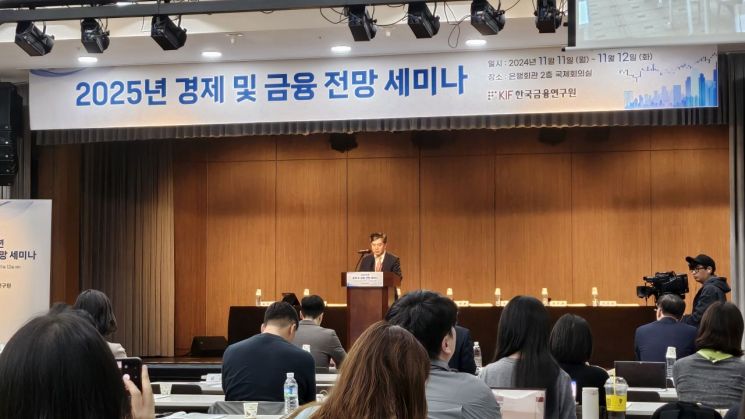 On the 12th, at the ‘2025 Economic and Financial Outlook Seminar’ held at the Korea Federation of Banks Building in Jung-gu, Seoul, Lee Hang-yong, President of the Korea Institute of Finance, is delivering a greeting. Photo by Oh Gyu-min
Kim expects that regulations on the household loan market will tighten, leading to intensified competition in the corporate loan market. Additionally, with the allowance of physical transfers of retirement pension accounts, the phenomenon of money moving to other sectors is expected to expand. The gradual strengthening of stress DSR regulations and the imposition of countercyclical capital buffers will increase banks’ management burdens due to capital regulation tightening. As the government accelerates management of household loans, policy-driven expansion of household loans is also expected to decrease, weakening banks’ asset growth potential based on household loans.
Kim suggested that domestic banks should manage vulnerable risk sectors while establishing a mid- to long-term growth foundation. In terms of strengthening risk management, banks need to prepare for increased default risks in loans to self-employed individuals, make mid- to long-term preparations for the trend of capital regulation tightening, and develop their own management plans for mortgage loans. To establish a sustainable growth foundation, efforts should be made to discover new loan demand, diversify revenue bases, and explore overseas expansion.
Meanwhile, financial authorities stated that domestic banks should strive not only for revenue diversification but also for social contribution to achieve sustainable growth. Kim Kyung-ho, a banking officer at the Financial Services Commission, said, “Recently, issues regarding trust in banks have been continuously raised, and efforts to enhance trust, such as strengthening internal controls and increasing social roles, are believed to contribute to sustainable growth.”
© The Asia Business Daily(www.asiae.co.kr). All rights reserved.

















