Installation of Fog-Type Cooling System and Smart Electric Windows
Korea Airports Corporation Jeju Airport is saving 200 million KRW annually by applying eco-friendly innovative technologies to practice carbon neutrality by 2050 with the vision of becoming a "Glocal Net-Zero Airport Creating Environmental Value."
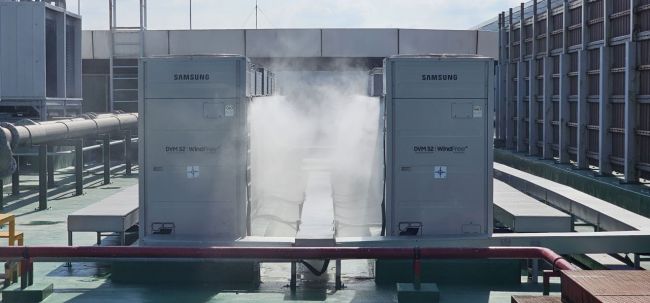
Jeju Airport announced on the 12th that it has newly installed and operated a fog-type cooling system (water mist spraying device) for cooling facilities and smart electric windows for the first time among airports nationwide.
In addition, it is actively practicing energy saving by improving the system to recycle 100% of the hot water produced by the existing renewable energy fuel cells.
The fog-type cooling system is a device that sprays water finely and lowers the surrounding temperature by about 5 to 12℃ as it evaporates.
Although mainly installed in parks and pedestrian crossing shades, Jeju Airport installed it around large outdoor units and cooling towers, which not only prevents equipment overheating and fire caused by direct sunlight but also increases operational efficiency, resulting in an annual cooling energy saving effect of 30 million KRW.
The smart automatic door, developed through in-house research last year, compares indoor and outdoor temperatures in real time during seasonal transitions and early summer, automatically allowing cold outside air to flow indoors, thereby drastically reducing cooling energy usage.
Jeju Airport developed, installed, and is operating smart electric windows this year, which induce the chimney effect by discharging hot air from the upper floors of the building to the outside, expecting to save more than 100 million KRW annually in operating costs.
Along with the application of these innovative energy-saving new technologies, improvement projects for existing facilities are also actively underway.
To maximize the utilization of fuel cells, all discharged hot water is being recycled. This has helped save 45 million KRW annually in water supply and electricity usage, contributing significantly to energy saving. Additionally, by installing an additional air conditioning condensate water recycling system last year, it saves 2,745 tons and 13 million KRW annually in water and sewage fees, actively practicing water conservation.
Kim Bok-geun, Jeju Airport Director of Korea Airports Corporation, said, “We will continue to do our best to become a carbon-neutral airport by expanding sustainable eco-friendly and new technology facilities to achieve greenhouse gas reduction goals and realize carbon neutrality.”
© The Asia Business Daily(www.asiae.co.kr). All rights reserved.
![Clutching a Stolen Dior Bag, Saying "I Hate Being Poor but Real"... The Grotesque Con of a "Human Knockoff" [Slate]](https://cwcontent.asiae.co.kr/asiaresize/183/2026021902243444107_1771435474.jpg)















