Alibaba "Home Appliances Up"... JD.com "Customers Up 20%"
Consumer Spending Decreases Amid Prolonged Economic Downturn
China's top two online shopping mall operators, Alibaba and JD.com, announced that sales increased during China's largest shopping event, the "Guanggun Festival (光棍節, November 11)," focusing on categories such as home appliances, electronics, and clothing. Although it is evaluated that domestic demand increased thanks to economic stimulus measures, both companies have not disclosed specific sales figures for the second consecutive year, leading to analyses that consumers are still reluctant to open their wallets amid the economic downturn.
According to the South China Morning Post (SCMP) on the 12th, Alibaba Group stated that demand significantly increased this year in four sectors: home appliances, consumer electronics, beauty, and clothing. The total sales were not disclosed.
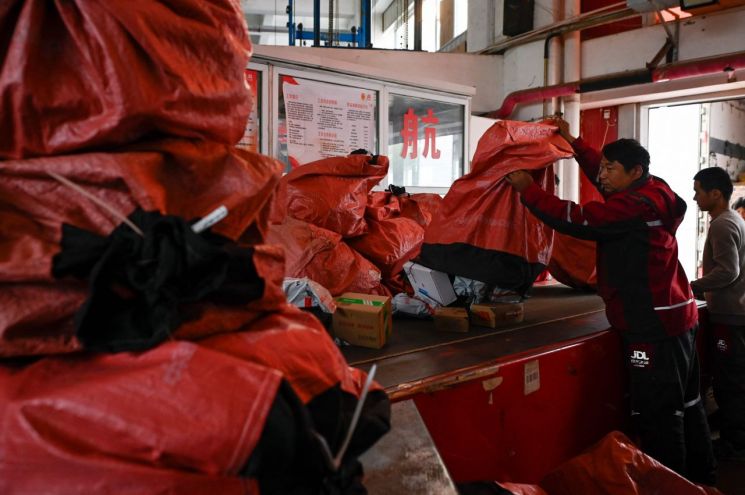 During the Singles' Day period, employees are sorting parcels at a logistics warehouse in Beijing, China. Photo by AFP Yonhap News
Alibaba's e-commerce platforms Taobao and Tmall reported that a total of 139 home appliance and furniture brands, including Haier, Midea Group, and Dyson, each recorded a total transaction volume (GMV) of 100 million yuan.
As of midnight on the 10th, sales of more than 9,600 brands in the category doubled, with government subsidies and platform discounts said to have stimulated this demand.
In consumer electronics, more than 30 brands including Apple, Huawei, Xiaomi, and Oppo each recorded a total transaction volume exceeding 100 million yuan (approximately 19.4 billion KRW).
Seventy-nine beauty brands and 66 clothing brands also surpassed a total transaction volume of 100 million yuan each. Brands such as Uniqlo and Victoria's Secret recorded sales exceeding 1 billion yuan.
SCMP, a media outlet owned by Alibaba, stated, "These encouraging results following the Chinese government's extensive economic stimulus measures show that consumer spending is recovering in the world's second-largest economy."
JD.com announced through its company blog that Guanggun Festival shoppers increased by 20% compared to the previous year. JD.com's live streaming orders surged 3.8 times year-on-year, transaction volumes increased more than fivefold across over 17,000 brands, and transactions by about 30,000 small and medium sellers rose 200% compared to the previous year.
By category, transaction volumes in 519 home appliance categories increased by 200% year-on-year, with air conditioners and robot vacuum cleaners being popular. Sales of AI-based electronic products such as laptops and learning devices also increased. In the clothing sector, transaction volumes doubled year-on-year for down jackets, outdoor jackets, cashmere sweaters, and children's winter boots. More than 300 winter accessory brands, including hats and scarves, also saw transaction volumes double.
Foreign media analyzed that the sales of high-end home appliances increased due to the effect of a 150 billion yuan (approximately 29 trillion KRW) consumer goods replacement subsidy announced in July to stimulate consumption.
However, neither Alibaba nor JD.com disclosed specific sales figures. In the past, they held glamorous events featuring celebrities and disclosed performance results, but since 2022, they have not revealed Guanggun Festival sales. This has led to interpretations that due to recent domestic demand sluggishness, youth unemployment, and real estate downturn, Chinese consumers are closing their wallets, and the Guanggun Festival performance is not as good as before, so sales figures are not being disclosed.
Data analytics firm Xintun estimated that total merchandise sales on major e-commerce platforms during last year's Guanggun Festival grew by 2% year-on-year, reaching about 1.14 trillion yuan (approximately 221 trillion KRW). This contrasts with the double-digit growth rates before COVID-19. This year's estimate has not been disclosed.
Sean Lane, founder of China Market Research Group, said, "Consumers are not interested in spending and are cutting back on high-priced items," adding that consumers expect the economic situation to be difficult ahead and are reducing spending, forecasting a low growth rate for the Guanggun Festival.
AP News reported, "With the real estate crisis and deflationary pressures, China's domestic economy is sluggish, and consumers are no longer enthusiastic about shopping."
© The Asia Business Daily(www.asiae.co.kr). All rights reserved.
![Clutching a Stolen Dior Bag, Saying "I Hate Being Poor but Real"... The Grotesque Con of a "Human Knockoff" [Slate]](https://cwcontent.asiae.co.kr/asiaresize/183/2026021902243444107_1771435474.jpg)















