Next Year's Growth Rate Forecast Set at 2.0%
If Trump's Tariff Barriers Materialize, It Could Fall Further
The Korea Development Institute (KDI), a government-funded research institute, has downgraded its economic growth forecast for this year to 2.2%. This adjustment is based on the assessment that the recovery of domestic demand was delayed due to the interest rate cuts occurring later than expected. For next year, the growth forecast was lowered to 2.0%, anticipating a slowdown in export growth due to the 'Trump risk.'
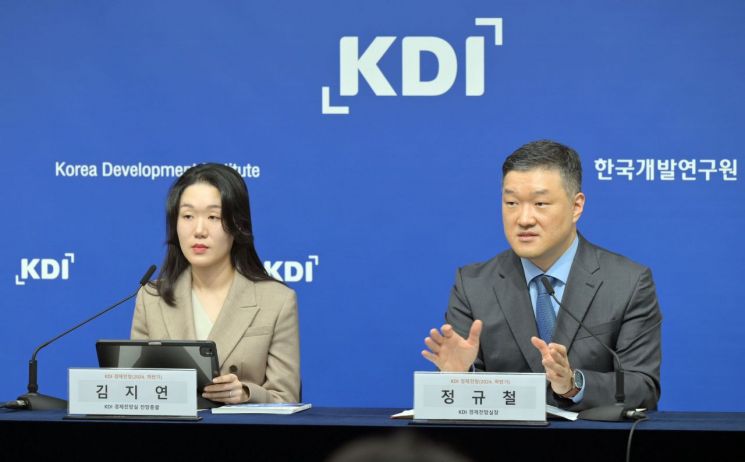
On the 12th, KDI released its 'KDI Economic Outlook' containing these details. KDI projected that the Korean economy will grow by 2.2% this year, a 0.3 percentage point decrease from the August forecast of 2.5%. Jung Kyu-chul, head of KDI’s Economic Outlook Office, explained, “The downward revision of this year’s growth rate is entirely due to domestic demand,” adding, “The negative impact was greater than expected because the interest rate cuts were delayed more than anticipated.”
KDI judged that the prolonged high-interest rate environment delayed the recovery of private consumption. This year, private consumption is revised down to a 1.3% increase from the previous forecast of 1.5%. Due to the slowdown in domestic demand, the inflation rate forecast was also adjusted to 2.3%, which is 0.1 percentage points lower than the previous forecast of 2.4%.
The export growth forecast for this year remains at 7.0%, as favorable export trends centered on semiconductors continued. KDI stated, “Global semiconductor transaction volumes maintained a high growth rate, and the easing of sluggish global trade led to a favorable increase in our exports, mainly in semiconductors.” Consequently, a large current account surplus trend continued, with net external assets rising to nearly 50% of the Gross Domestic Product (GDP), indicating sound external stability. Facility investment is expected to increase by 1.6%, higher than the previous forecast of 0.4%.
KDI also lowered next year’s economic growth forecast by 0.1 percentage points to 2.0%. Jung said, “Looking at President Trump’s pledges, they include raising tariffs worldwide,” and explained, “Since President Trump’s election, uncertainty has increased, which will negatively affect our country’s exports.” KDI forecasts that total export volume will increase by 2.1% next year.
However, if President-elect Trump’s tariff increase pledges are implemented within next year, there is a possibility that the growth rate could be even lower. Jung noted, “The scenario for next year assumes that President-elect Trump’s tariff increases will not occur,” but added, “If the tariff increases proceed rapidly, there could be a growth rate gap.”
On the same day, KDI emphasized the need for interest rate cuts as the Korean economy faces structural difficulties. Considering that the inflation rate is below the price stability target, KDI stated that the base interest rate should be gradually lowered. Jung argued, “Monetary policy needs to focus more on inflation,” and added, “If core inflation rises slightly to 1.6% next year, it could reach the 2% range by the second half of next year, so interest rate cuts are necessary.”
© The Asia Business Daily(www.asiae.co.kr). All rights reserved.
![Clutching a Stolen Dior Bag, Saying "I Hate Being Poor but Real"... The Grotesque Con of a "Human Knockoff" [Slate]](https://cwcontent.asiae.co.kr/asiaresize/183/2026021902243444107_1771435474.jpg)















