"Rising Construction Costs Due to Cement Price Increase Difficult to Accept"
Continued Expansion of Eco-Friendly Facility Investment, Huge Funding Burden... Public Investment Needed
The 'Construction Material Supply Stabilization Council' meeting, held under the government-led initiative involving the Ministry of Land, Infrastructure and Transport, Ministry of Economy and Finance, Ministry of Trade, Industry and Energy, Ministry of Environment, and attended by the Korea Cement Association, Korea Ready-Mixed Concrete Association, and the Korea Construction Material Workers' Council (Geonjahui), is facing difficulties in stabilizing construction costs.
Since the government announced the 'Measures to Stabilize Construction Costs for Revitalizing the Construction Industry' on the 2nd of last month, two meetings have been held, but only 'cement price adjustments' have been discussed, causing backlash from the cement and ready-mixed concrete industries.
Lee Chang-gi, Vice Chairman of the Korea Cement Association, said in an interview with Asia Economy on the 12th, "We need to find clues to resolve the sharp conflicts of interest among related industries through comprehensive discussions," adding, "If the discussions are distorted to focus solely on lowering the price of specific materials, it is doubtful whether the council can achieve its intended goals."
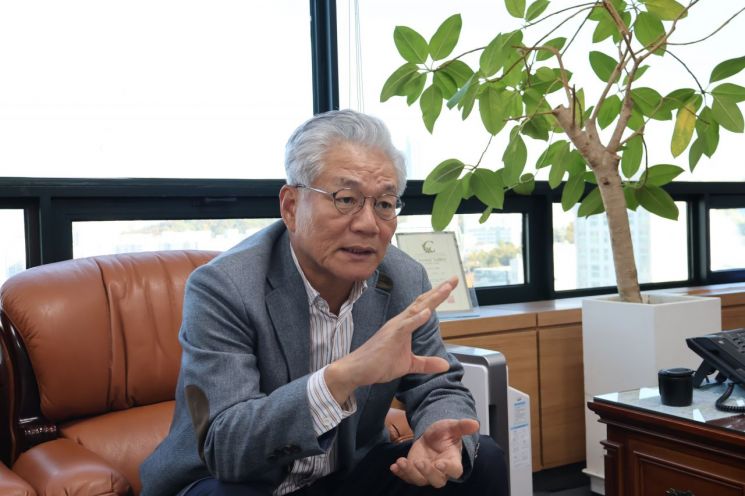 Lee Chang-ki, Vice Chairman of the Korea Cement Association, is being interviewed by Asia Economy. Photo by Korea Cement Association
Vice Chairman Lee emphasized, "It is hard to accept the claim that the rise in construction costs is due to the increase in cement prices," adding, "Labor costs and financial costs, among other social costs, have all risen. We must first analyze whether this is a temporary issue caused by external factors or a long-term challenge due to structural problems in the industrial ecosystem."
Regarding eco-friendly facility investments in the cement industry, he mentioned the 'necessity of public investment.' Lee said, "The trend of expanding eco-friendly facility investments to achieve a 53% reduction in carbon emissions by 2050 and to ensure stable and large-scale supply of recycled resources will continue," but added, "However, the burden of raising the enormous funds required for facility investment is also significant."
He revealed, "The European Union (EU) is expected to double cement prices by 2026 by introducing a carbon border tax to secure funds for carbon-neutral investments," adding, "Domestic cement prices are about two-thirds of the global average, and if this continues, the industry may find itself unable to secure funds independently." He continued, "For stable and predictable funding, it is crucial that cement is properly valued as a product in the market," and appealed, "In the long term, policy fund support through public investment should also be considered."
The cement industry accounts for only 0.3% of the Gross Domestic Product (GDP) but is a high-carbon industry responsible for 8% of total greenhouse gas emissions. Although large-scale investments such as policy fund inputs are inevitable for capital-intensive industries, if greenhouse gas reduction technologies accumulate, positive effects such as ripple effects on related industries and improvements in citizens' quality of life can be expected.
Regarding overcoming the crisis in the cement industry, he predicted, "North Korea could also be an opportunity." Vice Chairman Lee said, "With the rapid changes in the Korean Peninsula situation following the election of former U.S. President Donald Trump, if the focus shifts from confrontation to peace mode, opportunities may arise for the cement industry," adding, "Since the domestic cement industry already has experience entering North Korea through the Korea Peninsula Energy Development Organization (KEDO), preparations should be made for expansion into North Korea."
Below is a Q&A with Vice Chairman Lee.
- The government-led 'Construction Material Supply Stabilization Council' is operating. What is the cement industry's position?
▲ The cement industry acknowledges the necessity and welcomes the initiative as a measure to revitalize the construction market. However, since construction and cement industries are important upstream and downstream industries, sustainable development cannot be expected without organic cooperation between industries. Therefore, this council should diagnose the entire industrial ecosystem related to construction, including cement, steel, and ready-mixed concrete, and seek comprehensive solutions to overcome the crisis.
- The council meetings seem to focus only on lowering cement prices?
▲ If discussions are distorted to focus solely on lowering the price of specific materials, it is doubtful whether the council can achieve its intended goals. We need to find clues to resolve the sharp conflicts of interest among related industries through comprehensive discussions. It is hard to accept the claim that the rise in construction costs is due to the increase in cement prices. The Korea Construction Policy Institute has also released research showing that a 10% increase in cement prices only raises construction costs by 0.20 to 0.36%. The price supplied by the cement industry is 112,000 KRW per ton, but the actual supply price is somewhat lower. Therefore, the impact on cost increase would be even less when converted to the actual supply price. Additionally, labor costs and financial costs, among other social costs, have all risen. We must first analyze whether this is a temporary issue caused by external factors or a long-term challenge due to structural problems in the industrial ecosystem. Based on that, detailed industry-specific measures, so-called 'pinpoint solutions' to overcome the crisis, should be prepared.
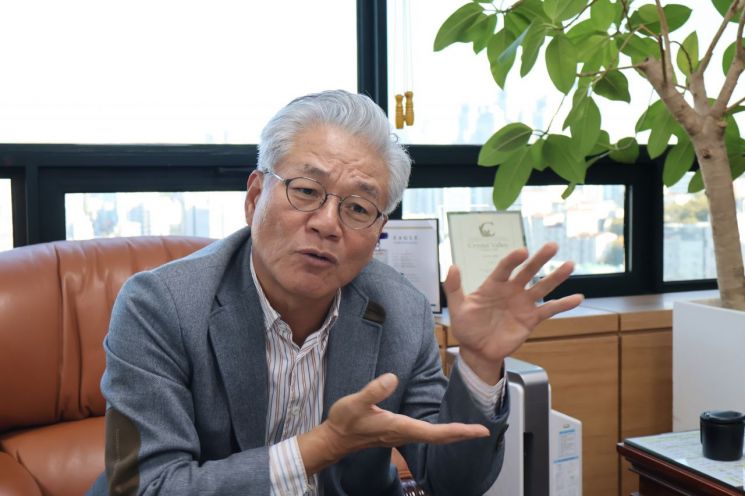 Lee Chang-gi, Vice Chairman of the Korea Cement Association, is being interviewed by Asia Economy. Photo by Korea Cement Association
- What is your stance on the government's support for importing Chinese cement?
▲ Although the possibility of actual imports seems low, the Chinese cement industry may see it as an opportunity to escape domestic market stagnation. China produces about 2 billion tons annually, which is similar to the cumulative domestic cement production over 66 years. If price dumping and volume offensives begin, the domestic cement industry will have no chance to withstand them. The government's consideration of importing Chinese cement could lead to dumping exports of Chinese products, as seen in steel and petrochemicals, and if imports expand in the long term, the domestic cement industry will inevitably collapse. There is no way to compete against huge capital and volume. If that happens, the selling price could be controlled by the Chinese cement industry. Ultimately, it would give China a new opportunity to target the domestic cement market. Therefore, even the announcement of considering Chinese imports causes a sensitive reaction from the cement industry, which heavily depends on the domestic market.
- The cement industry is severely sluggish. How long do you expect this slump to continue?
▲ Cement shipments (domestic demand) from the first to third quarter this year were 32.22 million tons, about 13% lower than the same period last year (36.98 million tons, down 4.76 million tons). Considering this trend, the total domestic shipment volume this year is expected to fall below 44 million tons. Especially in September, which is usually the month with the highest shipments, domestic demand plummeted nearly 30% in one month, leading to pessimistic forecasts that it could drop to 42 million tons. Next year, it is expected to decrease to about 40 million tons. Before the IMF foreign exchange crisis in 1997, cement shipments reached 61.76 million tons, the highest in domestic cement industry history, but plummeted to about 44.62 million tons just one year later. Japan's cement industry, which once recorded annual shipments of 100 million tons, is expected to fall to 35 million tons this year, a level seen in the 1960s. The domestic cement industry is panicking over the expectation that it will follow Japan's path.
- I heard the increase in electricity rates has also caused significant damage?
▲ Until now, the cost of procuring bituminous coal, a fuel cost, accounted for the largest portion (about 30%) of cement manufacturing costs, but due to electricity rate hikes over the past 2-3 years, the share of electricity costs (industry average about 30%) has increased, while bituminous coal (average 20-25%) has decreased. Especially, with two electricity rate hikes totaling 30.4 KRW/kWh in November last year (13.5 KRW/kWh) and October this year (16.9 KRW/kWh), the burden of rising manufacturing costs is significant. Although bituminous coal procurement costs will continue to decrease due to reduced cement production caused by weak demand, electricity usage necessary for stable plant operation and equipment will continue to increase. Also, additional electricity consumption is inevitable due to investments in environmental regulation response facilities, such as selective catalytic reduction (SCR) facilities. Therefore, demands to lower cement prices citing the drop in bituminous coal prices ignore reality.
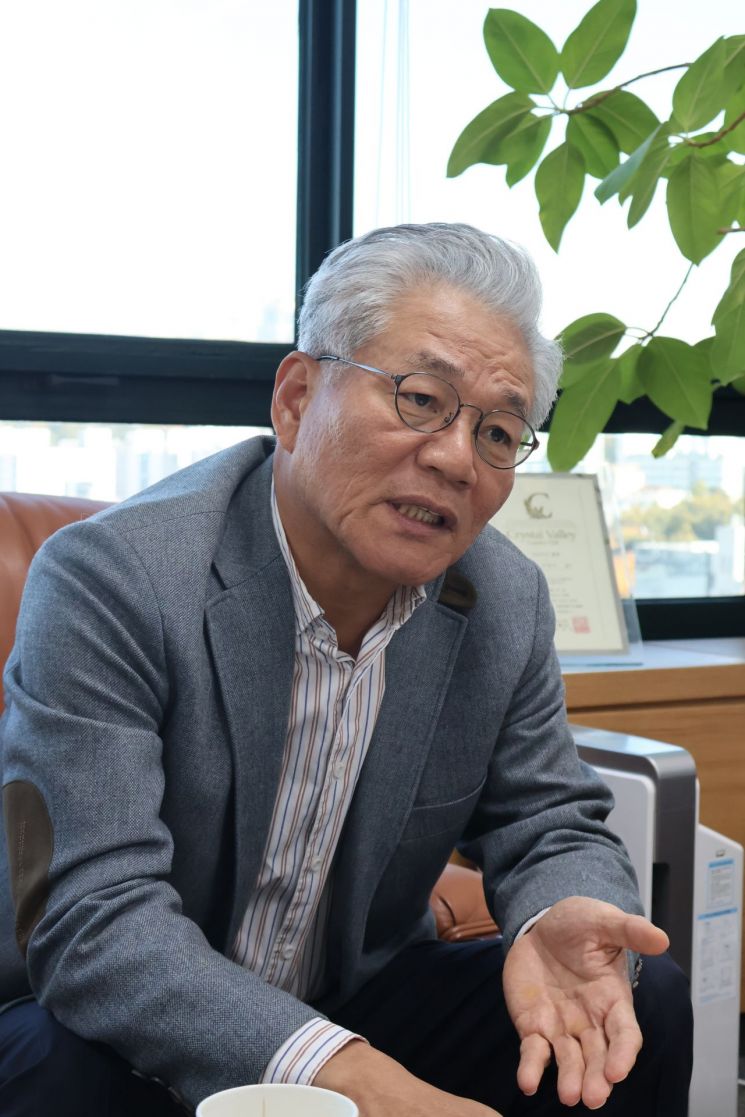 Lee Chang-gi, Vice Chairman of the Korea Cement Association, is being interviewed by Asia Economy. Provided by the Korea Cement Association
- What is the breakthrough for the cement industry to overcome the crisis?
▲ The recent situation reminds us of the IMF foreign exchange crisis when the industry recorded its highest performance and then collapsed the following year. We only hope this year's sales growth is not a d?j? vu of the IMF crisis. Some production lines have recently been shut down because they are unprofitable and cannot sustain cement production due to soaring costs. The crisis is becoming visible. However, North Korea could be an opportunity. With the election of former U.S. President Donald Trump, rapid changes in the Korean Peninsula situation are expected. If a peace mode is established, opportunities may come to the cement industry. Since we already have experience entering North Korea through KEDO, expansion into North Korea will be an opportunity for us. Although it cannot be concluded definitively, a long-term perspective is necessary. The clear point is that our cement industry must prepare to respond quickly to the rapidly changing situation.
- The cement industry's 2050 carbon emission reduction target is 53%. Is it achievable?
▲ We are doing our best. Recycled resources made from recyclable waste will play a key role in achieving the target. To meet the 2030 Nationally Determined Contribution (NDC) for greenhouse gas reduction, we plan to expand technologies that replace limestone, a major source of greenhouse gases, with non-carbonate raw materials, and gradually reduce fossil fuel bituminous coal while increasing alternative fuels such as waste plastics and synthetic resins. We will also increase mixed cement production and devote all efforts to developing technologies to capture greenhouse gases generated during manufacturing processes, aiming for a 12% reduction by 2030. By 2050, we plan to achieve a 53% reduction compared to 2018 by expanding existing reduction methods and introducing new technologies such as hydrogen and biomass fuel conversion and low-carbon cement.
- Are there any issues with securing funding?
▲ The burden of raising enormous funds needed for facility investment is significant. The EU is introducing a carbon border tax to secure funds for carbon-neutral investments, with plans to use the tariffs as policy funds for carbon neutrality. Because of this, European cement prices are expected to double by 2026. Domestic cement prices are currently only about two-thirds of the global average, and if this continues, the industry may find itself unable to secure funds independently. Globally, cement prices are rising, but we are being asked to lower them, which is perplexing. For stable and predictable funding, it is crucial that cement is properly valued as a product in the market. Long-term policy fund support through public investment is also necessary.
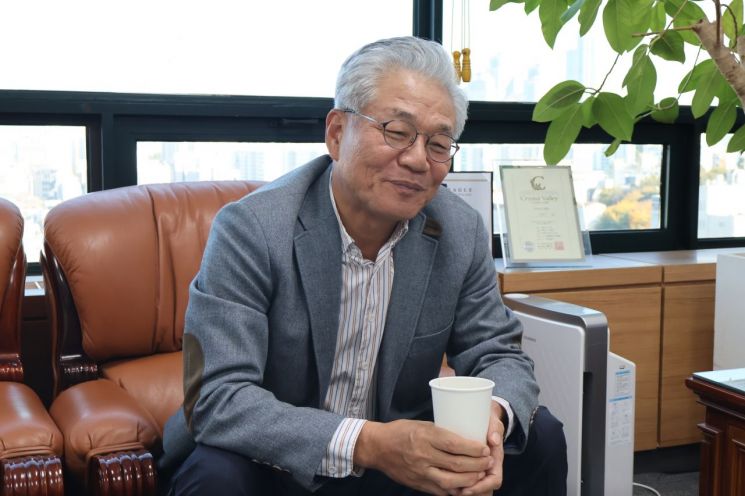 Lee Chang-ki, Vice Chairman of the Korea Cement Association, is being interviewed by Asia Economy. Photo by Korea Cement Association
- Recently, transportation conditions have worsened due to the closure of railway distribution bases and scrapping of old freight cars. What is your view?
▲ The scrapping of cement transport railway freight cars, which have reached the end of their service life after long-term operation, is increasing rapidly, but the production of new freight cars is delayed, causing a sharp decline in railway transport capacity. Also, the closure of major cement distribution bases such as Gwangwoon University Station (Nowon-gu, Seoul), the largest in the metropolitan area in 2020, raises concerns about cement supply disruptions. Expanding railway transport, which reduces greenhouse gas emissions and social and environmental costs such as traffic congestion compared to land transport, is urgent. Establishing cement distribution bases in the metropolitan area, especially in eastern Seoul, is urgent. Even if in the outskirts, distribution bases must be established.
- Do you have any opinions on cement industry positioning itself as a sustainable industry?
▲ Internally, only flexible crisis response and proactive management capable of adapting to paradigm shifts will enable the future development of the cement industry. Externally, understanding and communication between industries are essential so that the cement, ready-mixed concrete, and construction industries, which form an upstream and downstream value chain, can positively influence each other. Ultimately, the construction industry can generate profits much more easily when the upstream material industries of cement and ready-mixed concrete maintain stable management. Achieving the 53% carbon emission reduction target by 2050 also requires communication and understanding with major consumers such as ready-mixed concrete and the construction industry. One more thing to add is that the reason cement plants have operated for over 60 years is thanks to the consideration and support of local communities, including residents and local governments, who have shared hardships and joys. Going forward, communication must be sufficiently expanded, and based on this, social contribution activities should be increased. Although still in its infancy, efforts should be made to embody the aspirations of the community through the Cement Industry Social Contribution Foundation.
◆ Who is Lee Chang-gi, Vice Chairman of the Korea Cement Association?
Born in 1960. Graduated from Busan National University with a degree in Trade, and holds a master's degree from Northwestern University Law School in the U.S. He served as CEO of Dongyang Cement (now Sampyo Cement), was Vice Chairman of Samhwa Accounting Corporation, and Chief Accountant of Wonji Accounting Corporation. He was appointed Vice Chairman of the Korea Cement Association in March 2017 and has concurrently served as Chairman of the Korea Cement New Materials Research Association since April 2022.
© The Asia Business Daily(www.asiae.co.kr). All rights reserved.



















