Won-Dollar Exchange Rate Breaks Highest Level in 2 Years
Concerns Over Trump's Intensified Protectionism
Authorities May Intervene but Strong Dollar Expected to Persist
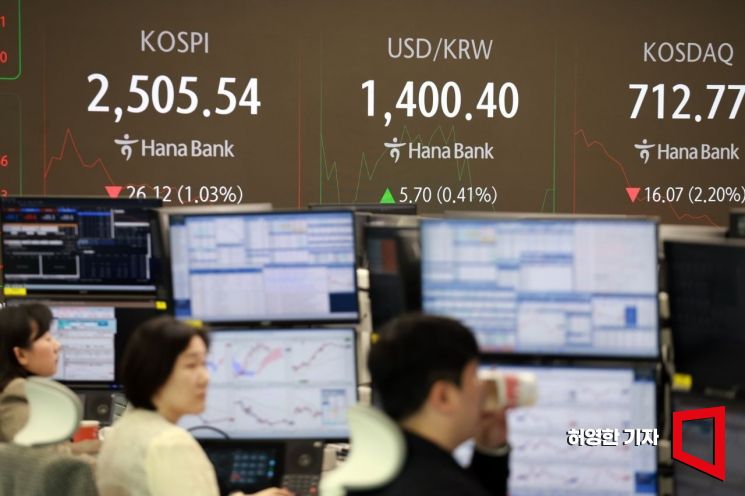 After President Trump's re-election, the three major U.S. stock indices in New York have been hitting record highs day after day. Meanwhile, on the 12th, the domestic stock market started with both KOSPI and KOSDAQ falling. The won-dollar exchange rate rose, surpassing 1,400 won. Employees are working in the dealing room at Hana Bank in Euljiro, Seoul.
Since the election of former President Donald Trump in the U.S. presidential election, the won-dollar exchange rate has been fluctuating around 1,400 won, maintaining a strong dollar phenomenon. Although there is a view that further sharp rises are limited due to the possibility of intervention by foreign exchange authorities, there are also forecasts that the strong dollar will become entrenched for a long period due to Trump's America First policy.
Won-Dollar Exchange Rate Hits Highest Level in 2 Years
On the 12th at the Seoul foreign exchange market, the won-dollar exchange rate opened at 1,399.1 won, up 4.4 won from the previous trading day. The closing price at 2 a.m. that day was 1,401.0 won. This is the highest figure in over two years since November 7, 2022, based on the closing price. As of 9:43 a.m., it was trading at 1,400.5 won.
The surge in the exchange rate is due to a global dollar strength phenomenon occurring after the election of former President Trump. Due to the protectionist trade policies of the second Trump administration, there are expectations that global trade conflicts may intensify, and the dollar has been showing strength day after day. Trump pledged to impose a universal tariff of 10% on all imports coming into the U.S. and a 60% tariff on imports from China. With the Republican Party controlling not only the White House but also both houses of Congress in a red sweep, concerns have grown that Trump's pledges may become reality.
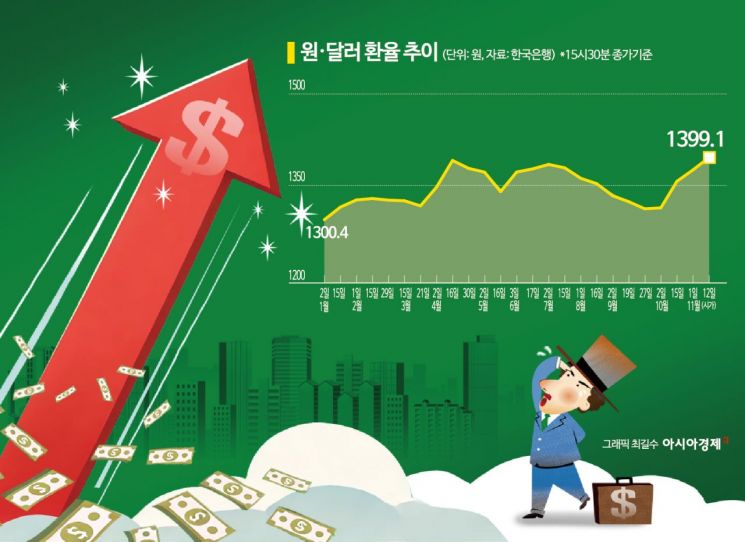
The dollar index, which reflects the value of the dollar against six major world currencies, rose to 105.7 that day, marking the highest level in four months. This is despite the U.S. Federal Reserve (Fed) lowering the benchmark interest rate by 0.25 percentage points on the 7th, and the dollar's unusual strength continues.
Lee Sang-won, Deputy Senior Fellow at the International Finance Center, analyzed, "Despite the Fed's policy rate cut, the dollar index has strengthened above 105 as the red sweep in the U.S. election results became likely, reinforcing the momentum for a strong dollar."
Domestic banks are also raising their upper forecasts for the won-dollar exchange rate. Woori Bank projected that the won-dollar exchange rate could rise to as high as 1,420 won this month, while KB Kookmin Bank and Shinhan Bank set the upper limit at 1,410 won. Just last month, the upper forecast was around 1,340 won, but the atmosphere has changed significantly since Trump's election.
The market expects the strong dollar to continue for some time. Global investment bank JP Morgan evaluated, "This election result will strengthen America's exceptionalism (which is good only for the U.S. economy)," and predicted, "Even without official tariff hikes, pressure for a strong dollar will intensify."
Lee Min-hyuk, economist at KB Kookmin Bank, explained, "With the Republican majority in the U.S. House of Representatives becoming more likely, the possibility of a red sweep has increased, and the resulting Trump trade is a factor for dollar strength and won weakness. Currently, Trump's proposed universal tariffs and tax cuts are factors for dollar strength as they cause U.S. inflation to reaccelerate and fiscal deficits to expand."
Shinhan Investment Corp. expressed concerns that the won's weakness will become entrenched due to the weakening of Korea's industrial structure. As Korean companies continue to be excluded from and lose competitiveness in leading industries such as artificial intelligence (AI), it is difficult for the won-dollar exchange rate to fall back to the pre-COVID-19 pandemic level of around 1,200 won.
Kim Chan-hee, economist at Shinhan Investment Corp., said, "The won's weakness continues as Korean companies have been excluded from the platform cycle that began in earnest in the mid-2010s," adding, "There is a possibility that the 1,300 won level will become the new normal until next year."
Higher Exchange Rate Increases Possibility of Foreign Exchange Authorities' Intervention
However, there is also a view that if the won-dollar exchange rate continues to rise, intervention by Korea's foreign exchange authorities may become more active, limiting further sharp increases. If it rises further, it is expected that the Korean government or the Bank of Korea may take more proactive measures to manage the exchange rate.
Min Kyung-won, economist at Woori Bank, said, "If exchange rate volatility increases, fine-tuning by foreign exchange authorities for speed control may appear," and added, "As the exchange rate rises, exporters are selling dollars, so further increases are unlikely." Economist Lee Min-hyuk also analyzed, "Due to exporters' negotiation (dollar selling) volume based on the perception of a peak and caution over intervention by foreign exchange authorities, further sharp rises will be difficult."
© The Asia Business Daily(www.asiae.co.kr). All rights reserved.


















