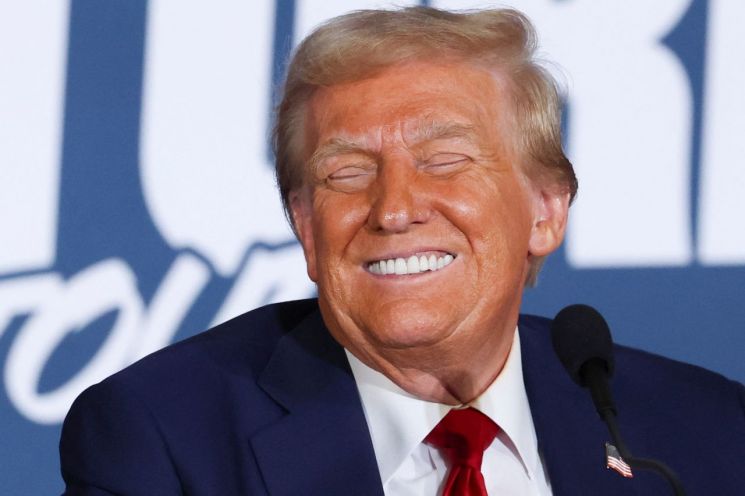
The New York Times (NYT) reported on the 11th (local time) that China, which faced high tariffs during the first term of President-elect Donald Trump, has factors that will help it better withstand the pressure from the second Trump administration. Trump pledged to impose high tariffs of over 60% on Chinese products, and the general view is that this could put Chinese industries at great risk.
According to the NYT, whatever measures the second Trump administration takes, China can strengthen its ability to endure them. First, the Chinese government possesses vast resources that it can deploy to revive the domestic economy. For example, shortly after Trump's election victory, China announced a $1.4 trillion economic stimulus package on the 8th. Unlike democratic countries, the Chinese Communist Party's ruling system has the power to swiftly implement policies once a direction is decided.
Additionally, thanks to government-led manufacturing promotion policies implemented over several years, China has become the dominant supplier of clean energy technologies such as electric vehicles and solar panels. Through this, Chinese companies have been able to secure rapidly growing key markets regardless of U.S. tariffs. Although the Biden administration controlled exports of advanced technology to curb China, some view this as having instead promoted China's self-sufficiency.
Another difference from Trump's first term is that China is less dependent on the U.S. market. When exports to the U.S. became difficult due to high tariffs during Trump's first term, Chinese companies developed alternative export markets in Southeast Asia and Latin America. According to the UK research institute TS Lombard, the share of Chinese goods in total U.S. imports has decreased from 20% to 13% over the past six years. However, some see this as influenced by China rerouting exports to the U.S. through Mexico and Vietnam.
China's retaliatory responses could also be a variable for the Trump administration. China retaliated against the U.S. by purchasing some agricultural products like soybeans, previously imported from the U.S., from other countries such as Brazil and Argentina. The NYT predicted that this time China might respond to U.S. tariffs by restricting exports of critical minerals. The NYT stated, "Trump may decide to ease tariff threats and conclude that the U.S. economy could be endangered by tariffs."
However, if Trump imposes high tariffs on China, damage to Chinese industries appears inevitable. Larry Hu, chief economist for China at the financial firm Macquarie Group, analyzed that after additional tariffs, China's exports would decrease by 8% over one year, and the annual economic growth rate would drop by 2%. If Trump blocks products that China exports to the U.S. through other countries like Mexico, the damage to China's economy would be greater. There is also speculation that Chinese state-owned enterprises, which operate under bureaucratic systems, will not be able to respond nimbly to market changes.
The NYT forecasted, "Trump's new tariff measures will be a challenge (to China), but they could also serve as an opportunity to strengthen China's economic self-reliance."
© The Asia Business Daily(www.asiae.co.kr). All rights reserved.
![Clutching a Stolen Dior Bag, Saying "I Hate Being Poor but Real"... The Grotesque Con of a "Human Knockoff" [Slate]](https://cwcontent.asiae.co.kr/asiaresize/183/2026021902243444107_1771435474.jpg)















