"Death Penalty Is Generally Confidential but Has Exceptions"
Indirect Acknowledgment of Political Prison Camps
North Korea has effectively acknowledged the practice of public executions, considered an extreme human rights violation by the international community.
On the 10th (local time), the British daily The Times reported that during the United Nations' Universal Periodic Review (UPR) procedure on North Korea held recently at the UN Geneva Office, Park Kwang-ho, director of the Central Court and a member of the North Korean delegation, stated that "public executions can exceptionally take place."
Director Park said, "In principle, executions are carried out privately at designated locations," but added, "public executions can exceptionally take place." He explained that exceptions may occur if ▲repeat offenders cause serious harm to others, ▲commit murder and show no remorse, or ▲the victim's family strongly demands a public execution, thereby effectively admitting the existence of the public execution practice.
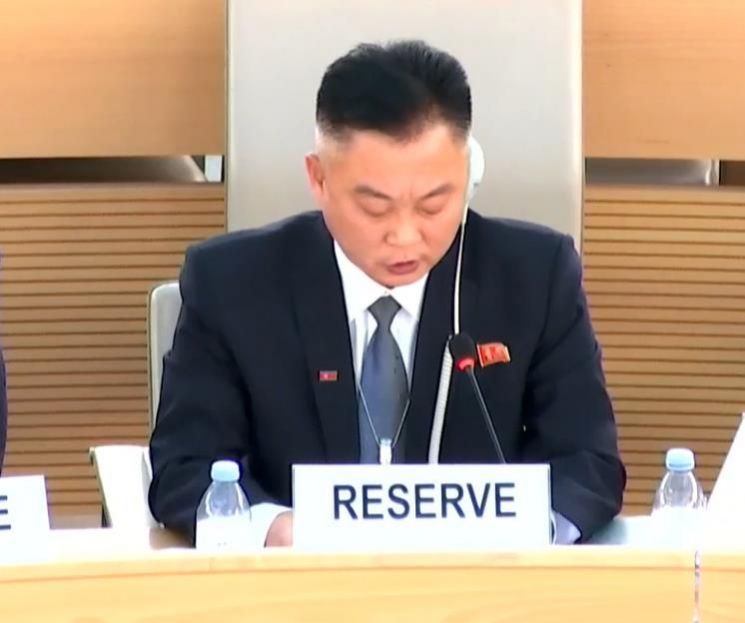 On the 7th (local time), Park Kwang-ho, Director of the Central Court, who appeared as a member of the North Korean delegation, is speaking during the United Nations' Universal Periodic Review (UPR) procedure on North Korea held at the UN Office at Geneva. Photo by UN TV
Director Park also indirectly acknowledged the existence of political prison camps, which North Korea has denied until now. He said, "The number of anti-state criminals such as spies or terrorists and those who committed subversive crimes due to dissatisfaction with socialism is not large," but added, "these criminals are detained in reeducation facilities, separated from other criminals." He further claimed, "Inmates in reeducation facilities operate their own libraries and can read newspapers," and "they are provided with hygienic environments and opportunities for exercise." While these remarks were made to deny international criticism of human rights abuses such as torture in reeducation facilities, they effectively acknowledge that political prisoners are held separately in distinct detention facilities.
Until now, North Korea has denied the existence of political prison camps, claiming to the international community criticizing human rights abuses that "there are no political prisoners in the Republic."
The UPR is a system where the 193 UN member states take turns reviewing each other's human rights situations and the implementation of recommendations. On the 7th, North Korea became the subject of the UPR for the first time in five years. Based on testimonies from many defectors who have suffered severe human rights violations such as torture, abuse, and sexual violence in political prison camps and correctional facilities called reeducation centers, UN member states demanded institutional reforms from North Korea.
Meanwhile, in North Korea, under the 'Law on the Elimination of Reactionary Thought and Culture,' those who distribute or watch South Korean songs, movies, or dramas are reportedly publicly executed. In July, it was reported that about 30 middle school students were publicly shot because they watched Korean dramas stored on USB drives contained in large balloons sent by defector groups.
Human rights violations under the pretext of COVID-19 quarantine measures have also occurred. Between 2020 and 2021, three cases were collected where individuals violating lockdown policies in border areas (Yanggang Province and Jagang Province) were shot dead or executed by firing squad. A man who defected in 2021 testified that two officials, including a local party organization secretary and a people's committee chairman, were executed without trial for accepting residents' requests for bathing in quarantine facilities that year. In the same year, a resident was sentenced to death after a vehicle fleeing a checkpoint established by the Emergency Anti-epidemic Committee in North Pyongan Province caused a fatal accident by violating quarantine rules.
© The Asia Business Daily(www.asiae.co.kr). All rights reserved.
![Clutching a Stolen Dior Bag, Saying "I Hate Being Poor but Real"... The Grotesque Con of a "Human Knockoff" [Slate]](https://cwcontent.asiae.co.kr/asiaresize/183/2026021902243444107_1771435474.jpg)
















