2025 Economic and Financial Outlook Seminar
South Korea's economic growth rate for next year is projected to be 2%, lower than this year's figure. Experts particularly point to the uncertainty surrounding the economic policies of President-elect Donald Trump as a negative factor affecting the growth rate.
At the '2025 Economic and Financial Outlook Seminar' held on the 11th at the Bankers Hall in Jung-gu, Seoul, Park Chun-sung, Head of the Macroeconomic Research Department at the Korea Institute of Finance, stated, "Next year, our economy is expected to see some improvement in domestic demand, but due to a slowdown in exports, the growth rate is projected to be 2%, lower than this year's 2.2%."
Park predicted that while private consumption will gradually improve in the second half of the year and facility investment will show signs of recovery, the pace of domestic demand recovery will be somewhat slow and exports are expected to weaken, leading to an overall economic growth rate decline compared to this year. In particular, he forecasted that construction investment will contract by 2.3% this year and further decline by 2.7% next year, worsening the downturn. He explained that due to sharp interest rate hikes in 2022, project financing (PF) defaults in real estate, and adjustments in the housing market, key leading indicators of construction investment such as orders, permits, and groundbreaking have continuously deteriorated from mid-2022 to recently. "Although there may be some fluctuations in construction progress speed, construction investment is expected to remain sluggish as the planned construction volume itself decreases," he said. The total export growth rate is expected to slow from 7.2% this year to 2.3% next year due to potential trade conflicts such as tariffs imposed by the Trump administration. He also anticipated increased volatility in major export items to the U.S., including automobiles and semiconductors.
Furthermore, he viewed that the global economy next year will face increased uncertainty due to the Trump administration's potential strengthening of protectionism and the pursuit of an America-first policy. If policies such as the introduction of universal tariffs or intensified bilateral trade pressures on the U.S. are implemented, there is concern that global trade volume could shrink.
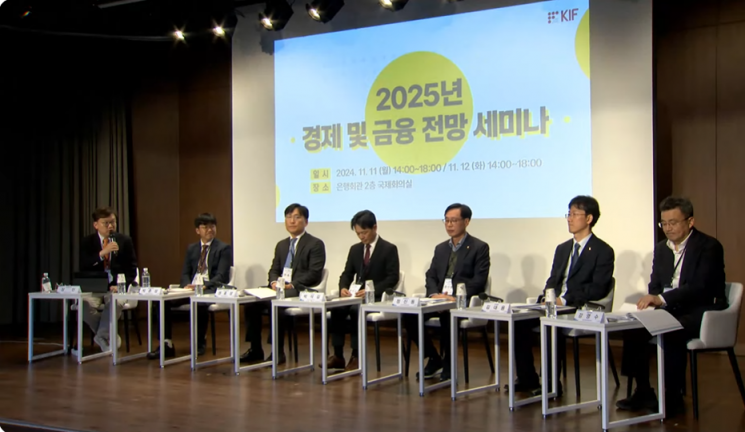 On the 11th, experts including Park Chun-sung, Head of the Macroeconomic Research Office at the Korea Institute of Finance, participated in a panel discussion at the "2025 Economic and Financial Outlook Seminar" held at the Bankers Hall in Jung-gu, Seoul. Screenshot from the Korea Institute of Finance YouTube channel
Park emphasized that given the situation where inflation is gradually easing while growth is weakening, South Korea needs to activate domestic demand through expansionary monetary policy. However, he noted that risks such as increased debt and overheating of the housing market due to interest rate cuts, as well as external uncertainties including the policy direction of the Trump administration and foreign exchange market pressures, act as constraints on lowering the base interest rate. He suggested, "Monetary policy should be operated flexibly depending on external conditions, and financial imbalances such as household debt increases that may arise in the process should be addressed through financial policies."
Experts forecast South Korea's economic growth rate for next year to be lower than Park's projection due to uncertainties in the Trump administration's policy direction. Park Seok-gil, Chief Economist at JP Morgan, predicted 1.7%, stating, "Although this year saw unusually good results in net exports, it is uncertain whether net exports will play as significant a role in economic growth next year." However, he added, "Some loss in growth rate is expected, but South Korea has sufficient resilience due to significant improvements in external soundness." Kwon Hyo-sung, Chief Economist at Bloomberg Korea, forecasted 1.9%, noting, "Since the two largest trading partners, the U.S. and China, are expected to experience slower economic growth next year compared to this year, South Korea is likely to be affected."
There was also analysis that the return of the Trump administration could trigger geopolitical risks, negatively impacting the South Korean economy. Jeong Shin-dong, Director of KB Management Research Institute, said, "There is concern whether the new U.S. government might consider physical conflict with China," adding, "Geopolitical risks such as the North Korean issue and cross-strait issues involving China and Taiwan must also be considered." Economist Kwon added, "If tensions on the Korean Peninsula escalate, capital outflows from financial markets could occur, posing a significant risk."
Meanwhile, the seminar also featured outlooks on financial markets, digital finance, and climate finance. Regarding financial markets, it was expected that stock and bond markets would benefit from asset price increases due to interest rate cuts, but the potential for further gains would be limited until uncertainties about economic recovery are resolved. Seo Byung-ho, Head of the Digital Finance Research Department at the Korea Institute of Finance, presented forecasts related to digital finance, including electronic financial transactions, big data and AI, cloud and security, virtual assets, digital currencies, and fintech businesses. Regarding climate finance, it was anticipated that the scope of disclosures would expand to include biodiversity and human rights, and with increasing demand for transition finance, major countries are establishing institutional frameworks, which will activate discussions on transition finance. Although the Trump administration's emergence could influence international climate finance policies, it was noted that green policies might be used as economic security tools amid conflicts between China and the U.S., potentially resulting in less impact than expected.
© The Asia Business Daily(www.asiae.co.kr). All rights reserved.
![Clutching a Stolen Dior Bag, Saying "I Hate Being Poor but Real"... The Grotesque Con of a "Human Knockoff" [Slate]](https://cwcontent.asiae.co.kr/asiaresize/183/2026021902243444107_1771435474.jpg)















