"Subsidy Support, Discretionary Regulation Not Mandatory Rule"
On the 11th, the People Power Party proposed the Semiconductor Industry Competitiveness Enhancement and Innovation Growth Special Act (Semiconductor Special Act) as a party bill. The key provisions of the bill include allowing the government to provide financial support such as subsidies to semiconductor companies and an exemption from the 52-hour workweek.
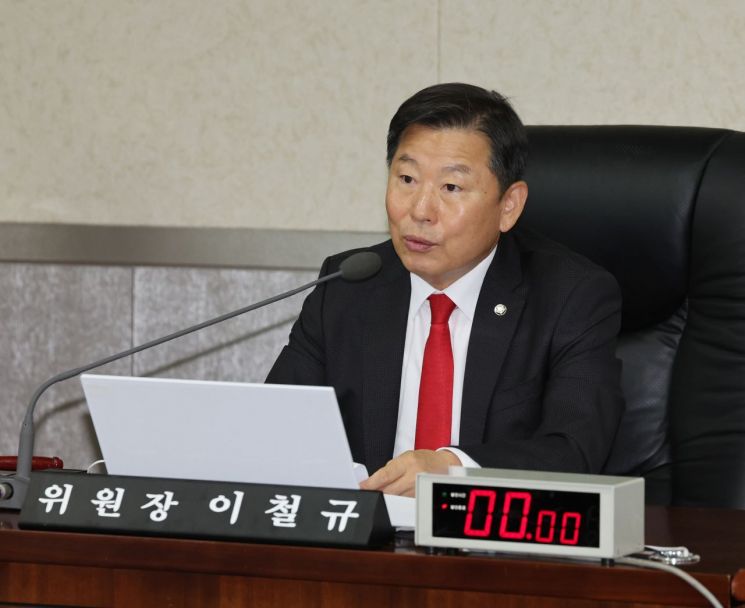
Lee Cheol-gyu, a member of the People Power Party and chairman of the National Assembly’s Industry, Trade, Energy, Small and Medium Enterprises Committee, stated the reason for proposing the bill: "The global semiconductor competition among advanced rival countries is unfolding as a 'national contest' that determines the fate of nations," adding, "However, our government’s policies are limited to indirect support such as tax credits, facing significant internal and external challenges."
He continued, "Major competitors such as the United States, Japan, China, and Taiwan are providing astronomical subsidies at the national level, making all-out efforts to attract investment, build domestic production facilities, and expand exports." Lee emphasized the necessity of the special act, saying, "The competitiveness of the semiconductor industry is directly linked to national competitiveness and the future. It is urgent to prepare effective support measures at the national level."
The Semiconductor Special Act, which Lee proposed as the main sponsor, allows the state and local governments to swiftly establish and support industrial infrastructure such as power and water supply to strengthen semiconductor industry competitiveness, and to provide necessary financial support such as subsidies. Additionally, for semiconductor research and development (R&D) workers, an exception can be made to exempt them from the 52-hour workweek if there is an agreement between labor and management.
The bill also includes provisions to establish a "Semiconductor Industry Competitiveness Enhancement Committee" under the president to deliberate and decide on major government policies related to the semiconductor industry, and for the government to formulate a "Basic Plan for Semiconductor Industry Competitiveness Enhancement" every five years. It also contains a clause allowing the establishment and operation of a special account to strengthen semiconductor competitiveness and stabilize supply chains.
The People Power Party aims to designate the Semiconductor Special Act as a fast-track bill and pass it within the regular National Assembly session ending on the 9th of next month. Lee told reporters, "We are negotiating with the opposition party to have it designated as a fast-track bill so that it can pass during the regular session." Regarding concerns raised by the Democratic Party about "direct subsidy support" and the "52-hour workweek exemption," Lee explained, "Subsidy support is a discretionary provision, not a mandatory regulation." He also stated, "The flexible application for those working in semiconductor R&D is based on mutual agreement between the parties involved."
© The Asia Business Daily(www.asiae.co.kr). All rights reserved.
![Clutching a Stolen Dior Bag, Saying "I Hate Being Poor but Real"... The Grotesque Con of a "Human Knockoff" [Slate]](https://cwcontent.asiae.co.kr/asiaresize/183/2026021902243444107_1771435474.jpg)















