Increase in Bank Household Loans at 3.9 Trillion Won, Growth Slows... Sharp Rise in Secondary Financial Sector
Secondary Financial Sector Mortgage Loans, Mid-term and Final Payments Mainly Increase in Group Loans
'Recession-type Loans' Such as Credit Loans, Card Loans, and Insurance Contract Loans Also on the Rise
In October, while the pace of loan growth slowed mainly in the banking sector, which has been tightening household loan management, loan demand shifted to the secondary financial sector, resulting in an overall increase in household loan growth across the financial sector compared to September. Financial authorities plan to heighten vigilance over the rising household loan growth, particularly in the secondary financial sector, as loans related to urgent cash needs of low-income and vulnerable groups, such as insurance policy loans and card loans, are increasing.
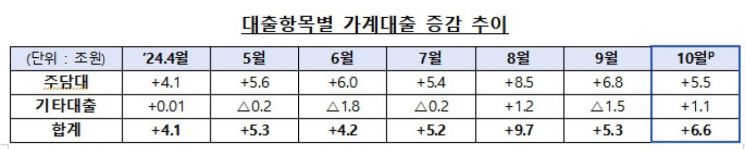
According to the 'Household Loan Trends' announced by financial authorities on the 11th, total household loans in the financial sector increased by 6.6 trillion won last month, about 1.3 trillion won more than the 5.3 trillion won increase in September. Mortgage loans increased by 5.5 trillion won, down from 6.8 trillion won in September, but other loans such as credit loans, card loans, and insurance policy loans turned to an increase in both the banking and secondary financial sectors, rising by 1.1 trillion won.
By sector, household loans in the secondary financial sector showed a clear surge. Household loans in the secondary financial sector increased by 2.7 trillion won, a significant rise compared to a 300 billion won decrease in September. This is the largest increase in two years and eleven months since November 2021, when loans increased by 3 trillion won. By loan type, mortgage loans rose by 1.9 trillion won, a steeper increase than the 700 billion won in September. This was influenced by group loans mainly for interim and final payments. Other loans increased by 800 billion won, centered on card loans and insurance policy loans.
Household loans in mutual finance increased by 900 billion won. Saemaeul Geumgo, which is at the center of household loan management success for the remainder of the year, led the increase in mutual finance with a 1 trillion won rise. Following were Nonghyup (20 billion won) and Suhyup (50 billion won), which also saw increases in household loan balances. Shinhan Credit Cooperative (-200 billion won) and Korea Forest Service Credit Cooperative (-10 billion won) saw slight decreases.
The balance of household loans by specialized credit finance companies also increased by 900 billion won, mainly in so-called 'recession-type loans.' Insurance companies followed with 500 billion won, and savings banks with 400 billion won. In the credit finance sector, card loans increased; in the insurance sector, insurance policy loans rose; and in the savings bank sector, credit loans were the main contributors to the increase.
The pace of household loan growth in the banking sector, which raised lending standards, slowed. According to the 'Financial Market Trends' announced by the Bank of Korea on the same day, as of the end of October, the balance of household loans (including policy mortgage loans) at deposit banks was 1,139.5 trillion won, an increase of 390 billion won from the end of September. Although the growth has continued for seven consecutive months since April this year, the increase was smaller than the 560 billion won in September.
By loan type, mortgage loans including jeonse deposit loans increased by 360 billion won, and other loans such as credit loans increased by 30 billion won. Mortgage loans increased by 150 billion won in bank-originated mortgage loans and 210 billion won in policy loans. Park Min-cheol, head of the Bank of Korea's Market General Team, said, "There is a shift in loan demand toward the non-bank sector," adding, "We are monitoring with caution to prevent speculative demand based on regulatory differences between sectors."
On the same day, the Financial Services Commission convened related agencies for a household loan inspection meeting and decided to receive annual household loan management plans from the secondary financial sector as well, following those from the banking sector. Additionally, the Financial Supervisory Service plans to inspect the overall handling of household loans, targeting sectors and financial companies with notable household debt growth, to verify whether the second-stage stress Debt Service Ratio (DSR) is properly implemented and whether credit screening guidelines are being well observed.

© The Asia Business Daily(www.asiae.co.kr). All rights reserved.
![Clutching a Stolen Dior Bag, Saying "I Hate Being Poor but Real"... The Grotesque Con of a "Human Knockoff" [Slate]](https://cwcontent.asiae.co.kr/asiaresize/183/2026021902243444107_1771435474.jpg)
















