'De Facto Military Alliance' Used to Justify Deployment of North Korean Troops
North Korea Can Ratify Anytime If Kim Jong-un Decides
ICBM Launched Without Engine Test, Has Technology Already Been Transferred?
The de facto 'military alliance' treaty signed between North Korea and Russia is about to come into full effect. Since it explicitly states mutual military support, there is speculation that it could be used as a justification for the 'formal participation' of North Korean troops deployed to the Russian battlefield. Recently, North Korea launched a new intercontinental ballistic missile (ICBM) without conducting engine tests, leading to assessments that the 'dangerous deal' between the two sides may have already begun.
According to TASS news agency and others on the 11th, Russian President Vladimir Putin signed the comprehensive strategic partnership treaty on the 9th (local time). Earlier, the Russian State Duma and Federation Council unanimously approved the treaty ratification bill submitted by President Putin. Once North Korea completes the procedures equivalent to ratification and signing and exchanges ratification documents with Russia, the treaty will come into effect indefinitely.
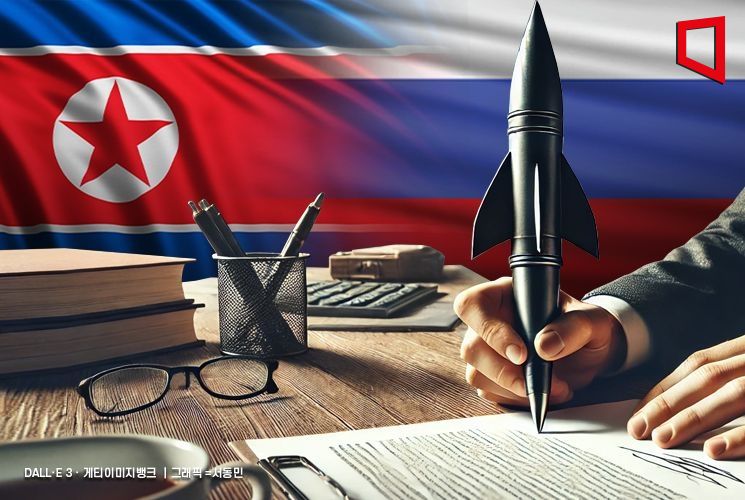
North Korea generally undergoes ratification procedures through the Supreme People's Assembly, which is equivalent to the National Assembly in South Korea. However, according to the North Korean constitution, for important treaties, the Chairman of the State Affairs Commission can directly ratify or annul them. In other words, if Chairman Kim Jong-un makes a decision, North Korea can immediately complete the necessary procedures and exchange ratification documents with Russia.
This treaty, signed in Pyongyang in June this year, is regarded as a revival of the 'automatic military intervention' clause (Article 4) found in alliance treaties from the former Soviet era. It stipulates that 'if either party is invaded and enters a state of war, the other shall promptly provide military assistance by all means at its disposal.'
The international community criticizes the deployment of North Korean troops as an illegal act of participating in aggression, but North Korea and Russia are likely to justify the deployment issue using this treaty as a pretext. For example, when satellite images suggesting North Korean troop deployment were released on the 25th of last month, President Putin did not outright deny it and instead recalled the problematic 'Article 4.' At that time, he said, "You are aware that the strategic partnership agreement between us and North Korea has been ratified," adding, "That treaty contains Article 4." Even if the North Korean troop deployment allegations pointed out by South Korea and the West are true, he argued that there is no legal problem under the automatic military intervention clause.
This treaty is expected to cause various security concerns on the Korean Peninsula beyond a simple troop deployment. The possibility of Russia's nuclear capabilities expanding and being transferred to North Korea or joint military exercises between North Korea and Russia has increased. President Putin has left open the prospect of North Korea-Russia joint exercises, saying, "Why not?"
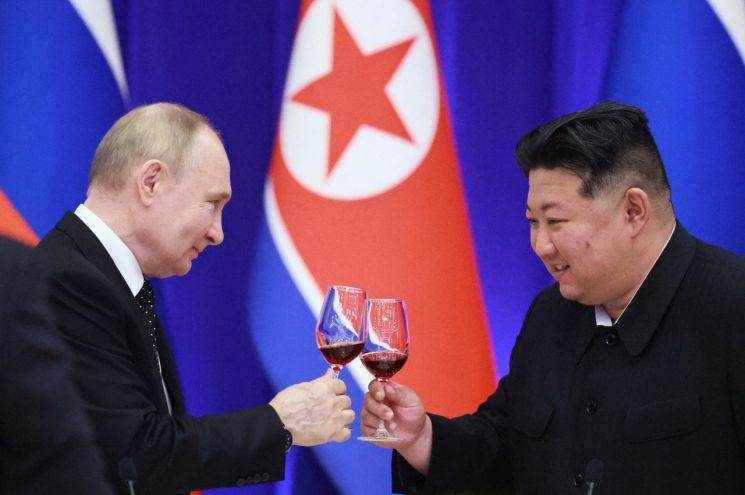 In June this year, Russian President Vladimir Putin and North Korean Supreme Leader Kim Jong-un are toasting at a state banquet held in Pyongyang. Photo by Yonhap News
Concerns have already arisen that Russian military technology may have been transferred to North Korea.
According to the office of Yoo Yong-won, a member of the National Assembly's Defense Committee from the People Power Party, the Defense Intelligence Headquarters has determined that North Korea launched the new ICBM 'Hwasong-19' without conducting engine tests. North Korea had publicly conducted a ground ejection test of a multi-stage engine for a new medium-range hypersonic missile in March this year, but since then, there have been no additional identified solid-fuel engine test indications, according to military authorities.
However, on the 31st of last month, North Korea launched the solid-fuel ICBM 'Hwasong-19,' which it self-described as the 'final version.' It was the first ICBM provocation of the year. The Defense Intelligence Headquarters assessed that considering the missile's increased body length, diameter, and maximum altitude, it is a new ICBM distinct from the 'Hwasong-18.' The mobile missile launcher (TEL) publicly shown by North Korea also used 11 axles, unlike the 8-axle Hwasong-18.
The fact that North Korea developed and launched a new missile without engine tests lends weight to the possibility of Russian technical support. Under the North Korea-Russia treaty, cooperation in the field of 'space technology' could be used as a pretext to receive technology that can be diverted to ballistic missile improvements. Although it can be disguised as peaceful purposes such as satellites, satellite and ICBM launch technologies are shared.
© The Asia Business Daily(www.asiae.co.kr). All rights reserved.
![Clutching a Stolen Dior Bag, Saying "I Hate Being Poor but Real"... The Grotesque Con of a "Human Knockoff" [Slate]](https://cwcontent.asiae.co.kr/asiaresize/183/2026021902243444107_1771435474.jpg)

















