Goal to Complete 3D UAM Transport Network by 2040
UAM Conference... 'Seoul-style UAM Vision'
Reduced Travel Time ↓ Increased Transport Market ↑ Economic Benefits
The era of covering the 25 km section between Pangyo and Gwanghwamun Station, which takes one hour by car, in just 15 minutes by urban air mobility (UAM) has arrived. Seoul, aiming for UAM commercialization by 2030, has decided to begin full-scale demonstrations centered around Yeouido and the Han River in the first half of 2025.
According to Seoul City on the 11th, Seoul Mayor Oh Se-hoon will attend the 'UAM·Drone·AI New Technology Cooperation Conference' held at Seoul City Hall from the 11th to the 12th, and as a keynote speaker, he will announce the 'Seoul-type Urban Air Mobility (S-UAM) Future Vision,' which includes a detailed roadmap such as UAM routes.
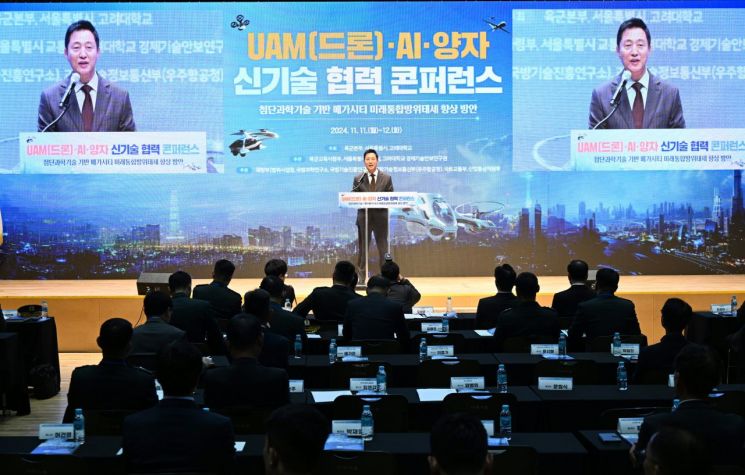 Seoul Mayor Oh Se-hoon attended the 'UAM, Drone, and AI New Technology Cooperation Conference' held at Seoul City Hall on the morning of the 11th and presented the 'Seoul-type Urban Air Mobility (S-UAM) Future Vision.' Photo by Seoul City Hall
This conference is jointly hosted by Seoul City, the Army, and Korea University, and was organized to secure a safe flight system based on public-private-military cooperation and to collaborate on building future advanced transportation services.
The Seoul-type urban air mobility future vision that Mayor Oh will present includes a plan to establish an urban air mobility system throughout Seoul centered on the 2040 Seoul Basic Urban Plan, aiming to leap into a '3D three-dimensional transportation city.' Before proceeding with the project, Seoul will gradually secure vertiport facilities, which are essential for UAM operations, to enhance transportation connectivity. For pilot and initial phase operations, major facilities will be established at four locations?Yeouido, Suseo, Jamsil, and Gimpo Airport?by 2030. Considering development plans and connected transportation systems, Seoul has reviewed about 500 sites and has preliminarily selected about 30 station sites.
The operation routes are planned in four stages according to the activation period: 'demonstration, initial, growth, and maturity.' During the demonstration period in the first half of next year, demonstrations will be conducted on two sections: KINTEX (Goyang)?Gimpo Airport?Yeouido Park and Jamsil?Suseo Station. Especially in the 'initial commercialization phase (2026?2030),' pilot operations will be centered on Yeouido, circulating the entire Han River section including Gimpo Airport?Yeouido?Jamsil?Suseo. From 2030 to 2035, a metropolitan route connecting the Han River and four major tributaries will be established to link the metropolitan area. After 2035, when the project matures, a trunk system connecting major downtown areas and customized routes for users are expected to be completed.
Metropolitan routes will add intermediate hub stations such as Sangam, Gasan, Gwanghwamun, Wangsimni, and Sangbong, connecting urban and residential areas and improving connectivity with Gyeonggi and Incheon airports. In the final stage of completing the UAM network, plans are being considered to connect areas with high transportation demand such as Sindorim, Gangnam, Suyu, and Mapo more densely.
Once the Seoul-type UAM system is completed, it is expected to open the era of '3D three-dimensional transportation' services beyond existing ground and underground transportation modes. The 25 km section from Pangyo to Gwanghwamun Station, which takes about one hour by public transportation or car, will be covered in about 15 minutes by UAM, and the Jamsil?Incheon Airport route will be accessible in 25 minutes. Additionally, during discussions, an operation information and safety system to ensure safety will be established. Flight information and air traffic communication, wind speed, radar, and other key information will be monitored during takeoff, cruising, and landing phases, and emergency landing sites and emergency response measures will also be prepared.
Seoul City analyzes that travel time within the metropolitan area will be drastically reduced, resulting in an annual economic effect of about 2.2 trillion KRW. The expansion of the metropolitan transportation market is expected to generate about 4 trillion KRW annually, and the construction of vertiports within Seoul is expected to bring about an astronomical economic ripple effect of about 1.2 trillion KRW. Mayor Oh Se-hoon said, "Through the 'Seoul-type UAM Future Vision' that will open new paths in the Seoul sky, the freedom of urban mobility will no longer be a concept but a reality. Seoul and the Army will cooperate to combine the experience and technological capabilities accumulated by both organizations to create a safe and efficient future transportation environment so that Seoul can leap into a world-class 3D three-dimensional transportation city."
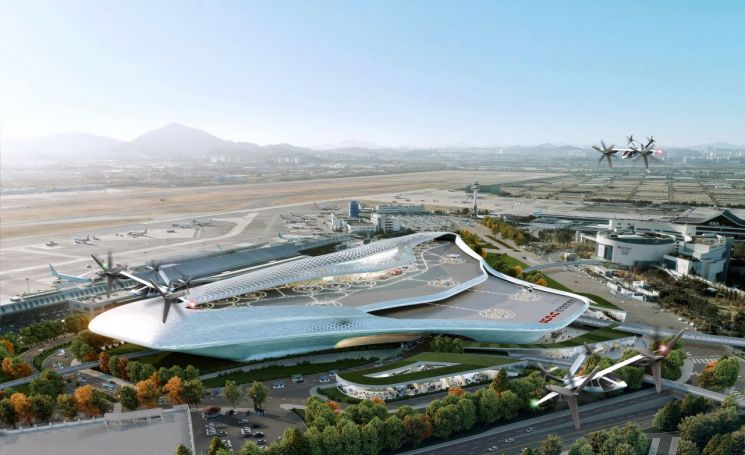 Perspective view of the complex transfer facility including the Gimpo Airport UAM takeoff and landing site. Provided by Seoul City
© The Asia Business Daily(www.asiae.co.kr). All rights reserved.
![Clutching a Stolen Dior Bag, Saying "I Hate Being Poor but Real"... The Grotesque Con of a "Human Knockoff" [Slate]](https://cwcontent.asiae.co.kr/asiaresize/183/2026021902243444107_1771435474.jpg)
















