Leading Future Industries such as AI and Mobility
Accelerating Business Attraction, Talent Development, and Living Conditions
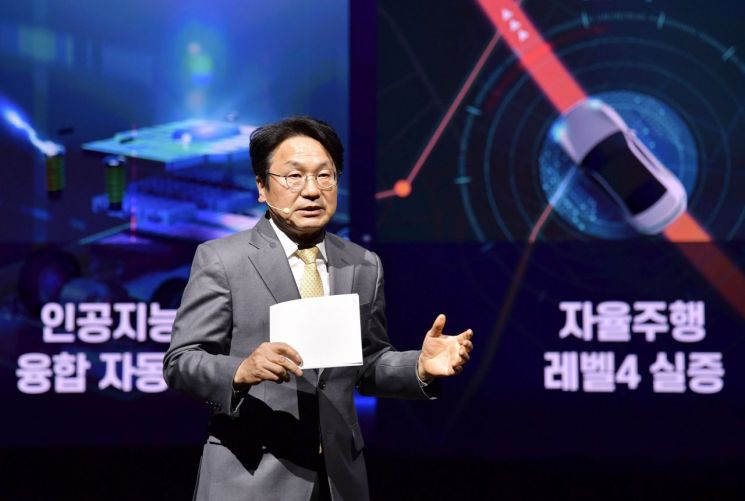 Gwangju Mayor Kang Gi-jung is announcing four major strategies to enhance the competitiveness of the future car industry at the 'Gwangju Future Car Vision Declaration Ceremony' held on the afternoon of March 29 last year at the VX Studio on the first floor of the Gwangju Real Content Cube (GCC) in Nam-gu. Photo by Gwangju City
Gwangju City has achieved a triple crown by being consecutively designated as an Education Development Special Zone pilot, an Opportunity Development Special Zone, and an Urban Convergence Special Zone. Including the Asia Culture Centered City project, it has effectively dominated the government's four major special zone projects promoted as part of the local revitalization policy. Through these special zone projects, the city plans to focus on nurturing the artificial intelligence (AI) and future car industries, establish a systematic talent development ladder, and strengthen regional competitiveness by developing complex areas that integrate work, residence, and leisure.
According to Gwangju City on the 10th, following the designation of the Education Development Special Zone pilot area on February 28 this year, the Opportunity Development Special Zone and Urban Convergence Special Zone were newly designated on the 6th and 7th, respectively.
The Opportunity Development Special Zone includes 686,797㎡ (207,000 pyeong) of the Bitgreen National Industrial Complex in Gwangsan-gu and 523,560㎡ (158,000 pyeong) of the Advanced 3 District in the Gwangju Research and Development Special Zone in Buk-gu. The city plans to develop Bitgreen Industrial Complex as a ‘Mobility Special Zone’ and the Advanced 3 District as an ‘Artificial Intelligence Special Zone’ to invigorate the local economy and secure future growth engines. The Opportunity Development Special Zone is a special area based on the Special Act on Local Autonomy Decentralization and Regional Balanced Development, aimed at promoting region-led economic growth and job creation. Tax benefits and regulatory relaxations are provided, creating an environment conducive to economic growth through corporate attraction and advanced infrastructure development. The goal is to promote relocation of individuals and companies to the region through locally led special zone development and achieve balanced development using private capital.
The Mobility Special Zone aims to transform the internal combustion engine-centered automobile industry ecosystem into future mobility and actively foster future car parts industries such as electronic components and secondary batteries. The Artificial Intelligence (AI) Special Zone will advance core infrastructure for the commercialization of AI technology and demonstrate and implement AI convergence services.
The Urban Convergence Special Zone was designated in the Sangmu district of Seo-gu. Gwangju City plans to utilize urban infrastructure to induce complex development, transforming the Sangmu district into a young and attractive innovation platform space that integrates advanced and venture jobs, life, and leisure. Various charges such as national and public land usage fees and development charges are reduced in the special zone. Additionally, if requested by local governments, the government may prioritize designation as research and development special zones or regulatory free zones.
Gwangju City will invest a total project cost of 1.579 trillion won, including private capital and city funds, to develop an area of 852,693㎡ in the Sangmu district as an Urban Convergence Special Zone. Furthermore, a related special zone project will be promoted on a nearby 91,298㎡ area. The Urban Convergence Special Zone will pursue ▲smart advanced specialized projects ▲medical and digital convergence projects ▲research and development (R&D) innovation projects ▲MICE (Meetings, Incentives, Conferences, and Exhibitions) and cultural convergence projects. Related projects include the Gwangju-type integrated public rental housing and the Sangmu complex community center, and plans are underway to establish the Gwangju Medical Center and the second exhibition hall of the Kim Dae-jung Convention Center.
The city aims to designate the special zone project implementer and establish an implementation plan by 2026, proceed sequentially with land compensation, and complete the project by 2031.
Mayor Kang Gi-jung stated, “We will devote all efforts to attracting companies, nurturing talent, and preparing residential conditions based on the Opportunity Development Special Zone, Urban Convergence Special Zone, and Education Development Special Zone. This will be a stepping stone for Gwangju’s new leap forward. The city will continue to lead in adding vitality to citizens’ lives and creating a city of opportunities where tomorrow shines.”
© The Asia Business Daily(www.asiae.co.kr). All rights reserved.
![Clutching a Stolen Dior Bag, Saying "I Hate Being Poor but Real"... The Grotesque Con of a "Human Knockoff" [Slate]](https://cwcontent.asiae.co.kr/asiaresize/183/2026021902243444107_1771435474.jpg)















