UNIST and University of Zurich Research Team Develop Protective Material for Metal Oxide Photoelectrodes
Selective Hole Transport Increases Efficiency and Prevents Corrosion... Published in Nat. Commun.
Commercialization of solar-powered green hydrogen production technology is within reach.
This is thanks to the development of a material that protects the core component of the technology, the photoelectrode, ensuring its performance is maintained over a long period.
Professor Jeongki Ryu of the Department of Energy and Chemical Engineering at UNIST (President Jongrae Park) and Professor David Tilley of the University of Zurich (UZH) in Switzerland have developed a protective layer that dramatically improves the durability of metal oxide photoelectrodes used in solar hydrogen production.
 Professor Ryu Jeong-gi, UNIST.
 Professor S. David Tilley, University of Zurich (UZH), Switzerland.
 Dr. Baesanghyun (First Author).
Solar hydrogen production is a technology that produces hydrogen by irradiating sunlight onto photoelectrodes submerged in water. The principle involves water undergoing electrochemical reactions on the surface of the photoelectrode exposed to sunlight, decomposing into hydrogen and oxygen.
This technology faces the problem of photoelectrode corrosion during the water oxidation process, making the development of materials that can effectively protect the electrodes essential for commercialization. In particular, metal oxide photoelectrodes, despite being inexpensive materials, have seen slow technological progress due to the lack of suitable protective layers.
The research team developed a protective layer for metal oxide photoelectrodes by adding polyethyleneimine polymer to titanium dioxide, which is conventionally used to protect expensive semiconductor photoelectrodes. This protective layer blocks electrons (negatively charged particles) generated by the photoelectrode absorbing light, while selectively allowing holes (positively charged particles) involved in the water oxidation reaction to pass through, thereby enhancing the photoelectrode’s performance and preventing corrosion.
When the developed protective layer was applied to bismuth vanadate (BiVO4) photoelectrodes, it maintained a high current density (2.03 mA/cm2) and stably sustained water-splitting reactions for over 400 hours. This represents a significant improvement in stability compared to unprotected photoelectrodes, which showed performance degradation within just 5 hours. Current density is an indicator of the photoelectrode’s efficiency.
Moreover, the developed protective layer can be used not only with bismuth vanadate but also with various metal oxide-based photoelectrodes such as iron oxide (Fe2O3).
Professor Jeongki Ryu of the Department of Energy and Chemical Engineering said, “This research result will be an important breakthrough in developing low-cost, highly stable solar water-splitting technology,” adding, “It is also expected to contribute to the development of other photoelectrochemical cells that produce high-value resources using solar energy.”
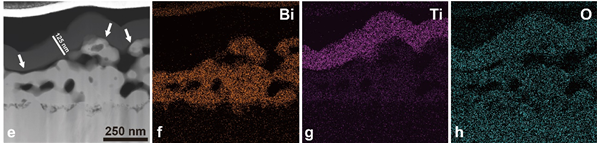 Cross-sectional transmission electron microscopy image and elemental mapping image of the hybrid protective layer-coated photoelectrode (BiVO4/PEI/TiO2) (white arrows indicate the interfacial PEI). Photo by UNIST
The research findings were published on November 1 in the international journal Nature Communications, with Dr. Sanghyun Bae of UZH’s Department of Chemistry as the first author, and UNIST doctoral candidates Minjeong Kim and Yuri Choi participating.
The research was supported by the Swiss National Science Foundation (SNSF) and the National Research Foundation of Korea (NRF), among others.
© The Asia Business Daily(www.asiae.co.kr). All rights reserved.
![Clutching a Stolen Dior Bag, Saying "I Hate Being Poor but Real"... The Grotesque Con of a "Human Knockoff" [Slate]](https://cwcontent.asiae.co.kr/asiaresize/183/2026021902243444107_1771435474.jpg)















