'Automobile Management Act' Subordinate Legislation Amendment Notice
Public Consultation from 11th to 23rd Next Month for 42 Days
Includes Detailed Procedures for Battery Certification and History Management Systems
The Ministry of Land, Infrastructure and Transport (MOLIT) will establish safety certification procedures for electric vehicle batteries and assign identification numbers to all batteries. Instead of battery manufacturers, the government will directly verify battery safety and manage the entire lifecycle of all batteries from production to disposal.
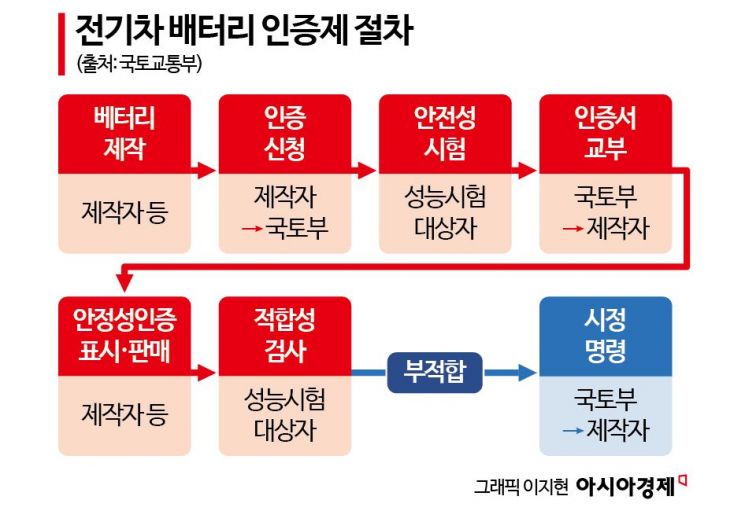
On the 10th, MOLIT announced that it will give a 42-day public notice period from the 11th until the 23rd of next month for amendments to six subordinate laws under the 'Automobile Management Act,' including the 'Automobile Registration Decree' and 'Automobile Registration Rules,' which contain these provisions. This move aims to prepare detailed procedures ahead of the battery certification system and traceability system implementation scheduled for February next year.
According to the public notice draft, in the future, manufacturers seeking battery safety certification must submit a battery specification sheet containing information such as the battery manufacturer and production site to the Minister of MOLIT. Through this method, MOLIT will directly verify battery safety by implementing a battery certification system. Previously, manufacturers themselves certified battery safety.
The safety evaluation items remain the same as before, including 12 categories such as vibration and thermal shock. Once the government confirms the battery's safety, manufacturers must mark the battery with the MOLIT certification label.
Even for batteries certified by the government, performance conformity inspections will be conducted every three years to ensure they continue to meet safety standards. The Korea Transportation Safety Authority’s Automotive Safety Research Institute will carry out the inspections and must prepare an annual inspection plan to report to MOLIT.
Additionally, MOLIT will define factors that could reduce battery safety. If such factors are found, manufacturers must undergo safety certification again.
Battery manufacturers must also assign battery identification numbers on the vehicle registration certificate. This measure is to manage the entire lifecycle history of individual batteries from production to operation. The number consists of up to 24 characters, including the production year and month. If a vehicle has two or more batteries, each identification number must be recorded in the vehicle registration ledger. When batteries are replaced, change registration is required.
Jeon Hyung-pil, Director of the Mobility and Automobile Bureau at MOLIT, said, "We will prepare to ensure the smooth implementation of the battery certification system and traceability system from February next year so that the public can use electric vehicles with confidence."
The amendment draft can be viewed on MOLIT’s website under 'Policy Data - Legal Information - Legislative Notice & Administrative Notice.' Opinions can be submitted via mail or through the website.
Meanwhile, to facilitate the rapid establishment of the battery certification system, the government decided last month to conduct a pilot project with five companies, including Hyundai Motor Company and Kia. This measure follows a social concern over electric vehicle batteries after an electric vehicle fire occurred in an underground parking lot of an apartment complex in Incheon in August.
© The Asia Business Daily(www.asiae.co.kr). All rights reserved.
![Clutching a Stolen Dior Bag, Saying "I Hate Being Poor but Real"... The Grotesque Con of a "Human Knockoff" [Slate]](https://cwcontent.asiae.co.kr/asiaresize/183/2026021902243444107_1771435474.jpg)















