Customs Service and Customs Logistics Association System Integration... Development of More Advanced Services
Based on 'Blockchain Smart Contract', Introducing New Authentication Methods, AI, and Chatbots
Automation of Logistics Management... Significant Improvement in Accessibility and Convenience Expected for Bonded Transport Operators
Busan City has completed the advancement of the bonded transportation work processing system with a more enhanced form based on blockchain and artificial intelligence (AI) through the ‘Smart Bonded Transportation Service.’
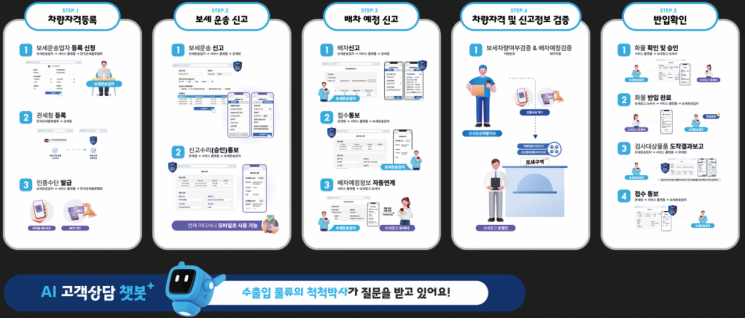
The ‘Smart Bonded Transportation Service’ is a platform for licensing, access management, and bonded transportation reporting and management services for bonded transportation workers.
Bonded transportation refers to the procedure of transporting imported cargo from abroad to another bonded area without immediate customs clearance at the port of entry, by reporting or obtaining approval from the customs office while keeping the foreign goods in their original state. In this process, only authorized bonded transportation vehicles can transport the cargo, and vehicle identification verification and recording procedures are strictly conducted when entering and exiting bonded areas.
This project is led by the city and the Ministry of Science and ICT, and executed by Busan Technopark as part of the ‘Blockchain Specialized Cluster Development Project’ (2024?2026, total budget of 20 billion KRW). It was selected in this year’s open call for free projects and is a project by the ‘M2Korea Consortium’ (including Dube and Neotek). Development has been completed, and the service has now entered full-scale commercialization.
Bonded transportation conducted in Busan accounts for about 50% of the total bonded transportation nationwide, and a platform that can maximize work efficiency is urgently needed to effectively manage this volume.
The existing bonded transportation work processing system caused considerable inconvenience due to complicated authentication procedures such as qualification registration and entry/exit reporting, and manual work performed via paper, phone, and fax. To improve this, a bonded transportation vehicle qualification management platform was established in 2022, but it had limitations in terms of user convenience.
To overcome these issues, the system was further advanced by reflecting the diverse demands of bonded transportation workers and logistics companies, incorporating feedback from the field, and linking with the Korea Customs Service and the Korea Customs Logistics Association systems.
Particularly, emphasis was placed on significantly improving accessibility and convenience by considering the age group of bonded transportation operators and the characteristics of bonded transportation work.
Considering the difficulty elderly drivers face in using mobile apps, the existing authentication procedures were simplified, and near-field communication (NFC) or radio-frequency identification (RFID) technologies were introduced to provide users with an easy and intuitive authentication method, enabling elderly drivers to use the service more easily.
Additionally, to resolve frequent driver and vehicle changes occurring during bonded transportation, a ‘blockchain smart contract’ that automatically executes when conditions are met was introduced to enhance management stability.
A smart contract is a blockchain-based digital contract that automatically executes when specific conditions are fulfilled.
Departing from the existing personal identity-centered decentralized identity (DID) authentication method, the system issues NFC cards that can be kept in vehicles using smart contracts, allowing simultaneous verification of individuals and vehicles, with verification histories processed quickly, accurately, and conveniently on the blockchain.
This authentication method is expected to improve work efficiency by providing an authentication system suitable for the frequent personnel changes in bonded transportation.
Furthermore, as part of service advancement, functions such as ‘bonded transportation customs declaration,’ ‘entry/exit management,’ and a ‘dedicated AI chatbot for bonded transportation’ were additionally developed to enhance user experience and strengthen the service’s marketability.
The entire bonded transportation process has been digitized, allowing vehicle registration, transportation reporting, dispatch, and entry procedures to be handled easily anytime and anywhere via PC and smartphones without paper documents.
Moreover, by applying blockchain technology, security was enhanced through digital certificate issuance and qualification applications, transparency was increased, and an interactive AI service was introduced to respond promptly to complex inquiries 24 hours a day.
Nam Dong-woo, the city’s Financial Startup Policy Officer, said, “Through this service advancement, we have simplified and automated tasks to implement a safe bonded transportation history management system.” He added, “The city will continue to strive to contribute to improving the productivity and cost reduction of small bonded logistics companies in Busan and to promote digital work transformation through various policies and system developments.”
© The Asia Business Daily(www.asiae.co.kr). All rights reserved.
![Clutching a Stolen Dior Bag, Saying "I Hate Being Poor but Real"... The Grotesque Con of a "Human Knockoff" [Slate]](https://cwcontent.asiae.co.kr/asiaresize/183/2026021902243444107_1771435474.jpg)















