Local Taxes Increase by 15%... General Budget Exceeds 3 Trillion Won for the First Time
Mayor Jeong Myeong-geun: "Expansionary Fiscal Policy to Restore People's Livelihood and Economy"
Hwaseong City in Gyeonggi Province, which will be promoted to a special city next year, is taking steps to revive the livelihood economy through an expanded budget allocation.
On the 8th, Hwaseong Mayor Jeong Myeong-geun unveiled the next year's main budget of 3.5027 trillion won at a city administration briefing held in the city hall's large conference room. This amount represents a 9.98% increase compared to this year's main budget of 3.1849 trillion won. During the briefing, Mayor Jeong presented the city's future vision as a "Special City for Science and Technology Talent" following the launch of the special city status and expressed his determination to attract a science high school.
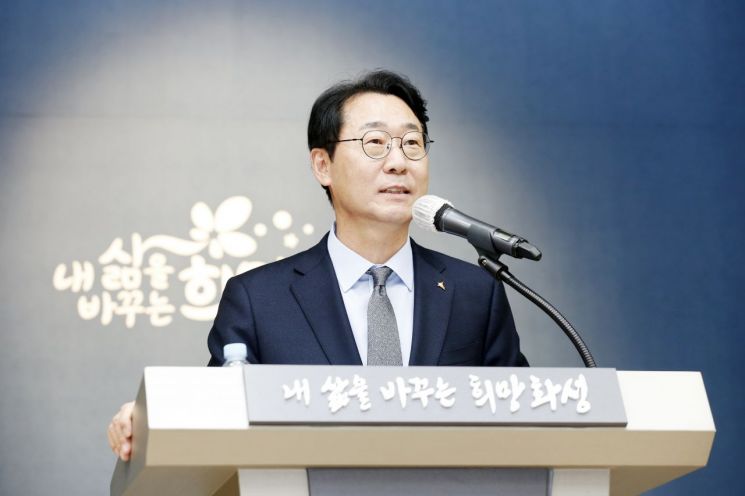 Jung Myung-geun, Mayor of Hwaseong, is explaining the budget plan for next year during a city administration briefing on the 8th. Hwaseong City has prepared a budget of 3.5027 trillion won for next year, an increase of 9.98% compared to this year. Photo by Hwaseong City
"Proactive Expansionary Fiscal Policy for Livelihood Recovery"
At the briefing, Mayor Jeong defined next year's budget as a "Rapid Recharge Budget for Livelihood." He emphasized, "While maintaining sound fiscal management as a basic principle, we have prepared a budget to revive the livelihood economy through proactive expansionary fiscal policy," adding, "We will execute the budget to deliver warmth to the capillaries of the local economy, such as traditional markets and self-employed businesses."
The next year's main budget is composed of 3.1187 trillion won in the general account and 384 billion won in the special account. In particular, the main revenue budget of the general account saw local taxes increase by about 14.99% to 1.465 trillion won compared to the previous year. Non-tax revenue also increased by about 3 billion won, raising the city's own revenue by 194 billion won. A city official explained the background of the tax revenue increase, stating, "Corporate income tax from large companies such as Samsung Electronics has increased compared to the previous year."
Mayor Jeong also explained specific budget execution plans for livelihood economy recovery. He stated, "We secured a subsidy of 45.6 billion won to issue local currency worth 509 billion won, the largest scale nationwide," and emphasized, "Along with this, we allocated 106.3 billion won for industry, small and medium enterprises, and energy sectors, including support for small and medium enterprises and small business owners (12.1 billion won)." The city will invest 299.2 billion won in the agriculture, forestry, marine, and fisheries sectors, including ▲free meal support of 41.7 billion won ▲basic public payment system of 23.9 billion won ▲Gyeonggi Province farmers' basic income support of 18.2 billion won.
Additionally, Mayor Jeong added that the city allocated the largest scale nationwide among basic local governments for citizen safety insurance support (2.8 billion won) and public taxi loss compensation support (2.4 billion won).
Meanwhile, among Hwaseong City's budget for new projects next year, notable initiatives include ▲operation of a laundry service for workers' uniforms ▲support for activating nighttime taxi operations ▲Hwaseong-type integrated home care for the elderly project ▲Hwaseong-type RE100 basic income village support ▲support for renewable energy convergence ▲establishment of an autonomous driving living lab base.
Mayor Jeong Myeong-geun said, "Despite difficult fiscal conditions, we have prepared a proactive expansionary budget to revitalize the local economy and recover the livelihood economy," adding, "We will also actively promote the revitalization of the local construction industry through budgets for major public facility construction and infrastructure."
The budget proposal submitted by the city is scheduled to be finalized on the 16th of next month after review and approval by the Hwaseong City Council, which will convene from the 11th.
Future Vision: "Special City for Science and Technology Talent"... Full Effort to Attract Science High Schools and Meister High Schools
At the city administration briefing, Mayor Jeong presented "Special City for Science and Technology Talent" as the city's future vision and expressed strong determination to attract science high schools and meister high schools.
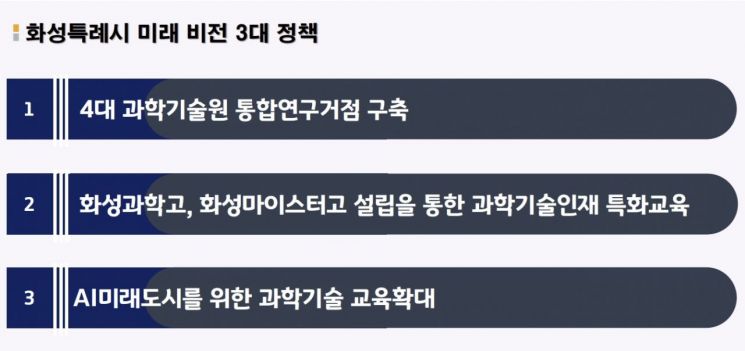
Mayor Jeong said, "Hwaseong City's population is expected to increase to 1.6 million by 2040," emphasizing, "As the most dynamic growth city, a special vision that fits this status is necessary."
He outlined detailed tasks for talent acquisition, including ▲establishing an integrated research hub for the four major science and technology institutes (KAIST, GIST, DGIST, UNIST) ▲specialized education for science and technology talent through the establishment of science high schools and meister high schools ▲expansion of science, technology, and information and communication education for citizens, public officials, and elementary to secondary students.
Since 2021, the city has been operating a Science Hub with KAIST to nurture core talent in advanced science and technology fields. The KAIST Semiconductor Design Education Center (IDEC) has produced a total of 480 system semiconductor design experts to date, successfully placing 236 in the semiconductor industry. Mayor Jeong plans to leverage this experience and capability to establish integrated research hubs with GIST, DGIST, and UNIST, aiming to grow into a city centered on advanced science and technology.
Mayor Jeong particularly intends to focus all efforts on attracting science high schools and meister high schools to cultivate future technology and advanced industry-tailored talent, based on infrastructure such as the semiconductor mega cluster, West Coast K-Future Car Valley, and K-Bio Belt.
He expressed his ambition, saying, "In an era of rapid change and fierce competition, the development of science and technology determines the nation's future," and declared, "We will create 'Hwaseong, the Special City for Science and Technology Talent' to become the hope of the Republic of Korea."
© The Asia Business Daily(www.asiae.co.kr). All rights reserved.
![Clutching a Stolen Dior Bag, Saying "I Hate Being Poor but Real"... The Grotesque Con of a "Human Knockoff" [Slate]](https://cwcontent.asiae.co.kr/asiaresize/183/2026021902243444107_1771435474.jpg)
















