Sale of P&O Chemical followed by Chinese Zhangjiagang Steel Plant and others
Policy to streamline low-profit and non-core subsidiaries
Posco Group's restructuring efforts are gaining momentum. Following the divestment of its low-profit secondary battery anode coating materials business, the group is also pushing forward with the sale of its stainless steel mill in China. Posco Group aims to streamline its low-profit domestic and overseas businesses to focus selectively on low-carbon steelmaking and secondary battery businesses.
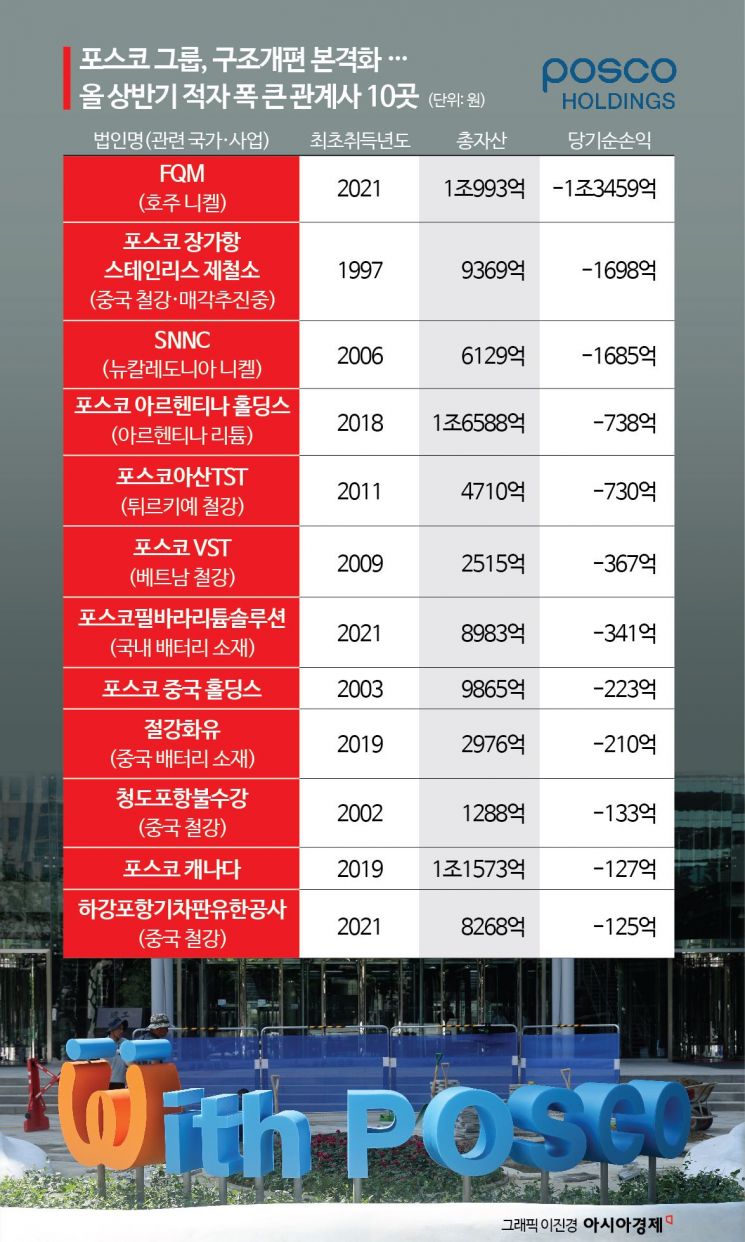
According to Posco Holdings' semi-annual report on the 8th, out of a total of 72 unlisted companies invested in by Posco Holdings (excluding simple investment purposes), 30 recorded net losses in the first half of this year.
FQM, which posted a deficit of 1.34 trillion KRW in the first half of this year, recorded the largest loss. It is a Canadian mining company operating the Ravensthorpe mine in Western Australia. In May 2021, Posco Group acquired a 30% stake in Ravensthorpe for $240 million (approximately 270 billion KRW at the time). Posco agreed to receive 32,000 tons annually (7,500 tons of nickel content) of nickel processed products from the Ravensthorpe mine starting this year. This volume corresponds to the amount used in 180,000 electric vehicles. The large loss by FQM in the first half of this year is interpreted as a consequence of production halts due to the decline in raw material prices such as nickel.
Posco Zhangjiagang Stainless Steel (PZSS) recorded a loss of 169.8 billion KRW in the first half of this year. Established in 1997 in Zhangjiagang City, China, it was Posco's first overseas integrated steel mill. The group recently decided to sell it and has begun selecting advisory firms. Next, SNNC, a nickel production company in New Caledonia, posted a loss of 168.5 billion KRW, and Posco Argentina Holdings recorded a loss of 73.8 billion KRW. In addition, companies related to steel and battery materials, including Posco Philbar Lithium Solutions, also posted losses. Due to China's economic slowdown and global steel oversupply, deterioration in steel business performance was inevitable, and the battery materials sector is simultaneously experiencing demand and price declines due to the chasm effect (temporary demand stagnation in growth industries).
The scale of losses alone does not necessarily make a business a target for restructuring. Since Chairman Jang's inauguration, some group businesses outside the 'core businesses' such as steel and secondary battery materials have been targeted for restructuring. Losses from FQM, SNNC, and Posco Argentina Holdings are linked to investments in the group's future growth engine, the battery materials business, so the possibility of divestment is low. However, due to policies excluding Chinese battery materials from North America and Europe, there is an open possibility of divesting stakes and assets in joint ventures related to anode graphite materials.
Posco Group began restructuring efforts after Chairman Jang In-hwa took office. The group plans to streamline about 120 businesses that have sustained losses or lost investment purposes and to continue this process over the next three years. Through restructuring by 2026, the group plans to generate approximately 2.6 trillion KRW in cash inflows to reinvest in core businesses and return value to shareholders.
Posco Group plans to divest low-profit businesses and invest anew in future new materials businesses alongside steel and secondary battery businesses. In the steel sector, it will pursue upstream and downstream investments in India and the United States and enhance asset management efficiency through restructuring of low-profit assets. The secondary battery materials industry aims to strengthen fundamental competitiveness by securing high-quality resources and establishing efficient mass production systems during the market slowdown period, targeting to become a global top-tier raw materials and materials company. Additionally, the group plans to pursue mergers and acquisitions (M&A) of promising leading companies within three years.
© The Asia Business Daily(www.asiae.co.kr). All rights reserved.
![Clutching a Stolen Dior Bag, Saying "I Hate Being Poor but Real"... The Grotesque Con of a "Human Knockoff" [Slate]](https://cwcontent.asiae.co.kr/asiaresize/183/2026021902243444107_1771435474.jpg)
















