Deputy Prime Minister Presides Over Macroeconomic and Financial Meeting
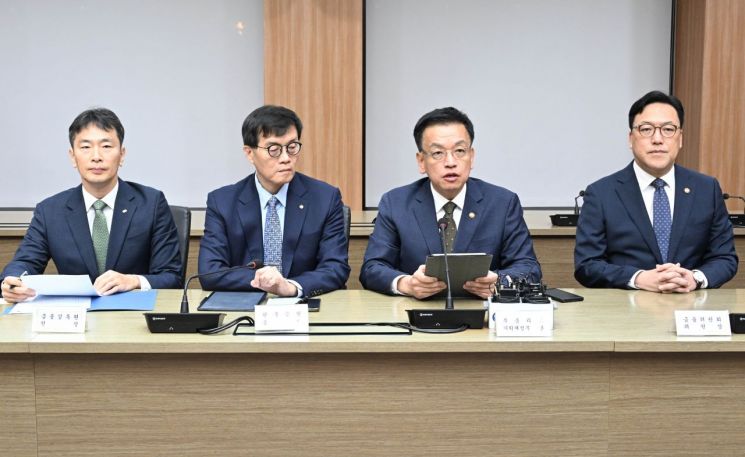 Choi Sang-mok, Deputy Prime Minister for Economic Affairs and Minister of Economy and Finance, is delivering opening remarks at the Macroeconomic and Financial Meeting held on the 8th at the Korea Eximbank in Yeongdeungpo-gu, Seoul. From the left in the photo are Lee Bok-hyun, Financial Supervisory Service Governor; Lee Chang-yong, Bank of Korea Governor; Choi Sang-mok, Deputy Prime Minister; and Kim Byung-hwan, Financial Services Commission Chairman. Photo by [Photographer's Name]
Choi Sang-mok, Deputy Prime Minister for Economy and Minister of Strategy and Finance, announced on the 8th that in response to increased market volatility following the Federal Open Market Committee (FOMC)'s small rate cut decision and the U.S. presidential election results, the government will expand and reorganize the 24-hour joint inspection system of related agencies to cover the financial and foreign exchange markets.
On the same day, Deputy Prime Minister Choi held a joint macroeconomic and financial meeting with related agencies at the Korea Eximbank in Yeongdeungpo-gu, Seoul, to review the impact of the FOMC's rate cut decision and the recent U.S. presidential election results on domestic and international financial and foreign exchange markets, and to discuss response strategies. The meeting was attended by Lee Chang-yong, Governor of the Bank of Korea; Kim Byung-hwan, Chairman of the Financial Services Commission; and Lee Bok-hyun, Governor of the Financial Supervisory Service, among others.
At the FOMC meeting held overnight, the Federal Reserve (Fed) cut the benchmark interest rate by 0.25 percentage points to 4.50?4.75%, as expected, following the September cut. The Fed's statement hinted at a slower pace of some inflation progress but maintained the overall rate cut stance. Although the 0.25 percentage point rate cut was somewhat anticipated, the victory of former Republican President Donald Trump in the November 5 U.S. presidential election raised uncertainties about whether the Fed might lower rates in the long term.
Deputy Prime Minister Choi evaluated that the global financial markets accepted the meeting results as expected and showed overall stability as the ripple effects of the previous day's U.S. election results eased. However, he expressed concerns that "geopolitical risks such as those in the Middle East and Ukraine, along with the potential strengthening of protectionism, could increase uncertainties regarding global economic growth, inflation trends, and major countries' monetary policy stances."
He added that the government would maintain heightened vigilance toward these external uncertainties and that related agencies would closely cooperate to ensure thorough risk management. Deputy Prime Minister Choi diagnosed that "recently, our financial and foreign exchange markets have experienced increased volatility, such as exchange rate rises due to the U.S. election impact, but stock prices, bond yields, and short-term interest rates like CP and CD have remained relatively stable." Nevertheless, he emphasized, "Since external uncertainties may persist for some time, we will expand and reorganize the 24-hour joint inspection system, which has so far focused on the Middle East situation, to include the financial and foreign exchange markets, and respond promptly according to contingency plans if market volatility excessively increases."
He also announced thorough management of potential risks such as household debt, the real estate market, and project financing (PF). Deputy Prime Minister Choi stated, "If the housing market overheats or household debt rapidly increases as the August 8 real estate supply measures accelerate, we will promptly and decisively implement additional management measures." Regarding real estate PF, he said the second round of feasibility assessments will be completed within this month, and from next month, a regular evaluation system will be introduced to ensure an orderly soft landing.
Despite uncertainties such as the inauguration of the Trump administration's second term, the government plans to respond proactively. Deputy Prime Minister Choi conveyed, "Amid changes in the external environment, including the launch of the new U.S. administration and shifts in monetary policy, we will accelerate efforts for the sustainable growth of our economy." Regarding potential changes in the trade environment, he added, "We will prepare contingency plans for major trade issues and activate the 'Ministerial Meeting on Strengthening Industrial Competitiveness' within this month to fundamentally enhance the competitiveness of our industries."
© The Asia Business Daily(www.asiae.co.kr). All rights reserved.
![Clutching a Stolen Dior Bag, Saying "I Hate Being Poor but Real"... The Grotesque Con of a "Human Knockoff" [Slate]](https://cwcontent.asiae.co.kr/asiaresize/183/2026021902243444107_1771435474.jpg)















