Copernicus Climate Change Service Announcement
Average Temperature Increase of 1.55 Degrees Compared to Pre-Industrial Levels
A study has revealed that this year is set to be recorded as the hottest year in the history of global climate observation. Additionally, the average temperature increase compared to the pre-industrial era is expected to exceed 1.55 degrees Celsius, raising serious concerns that the 1.5-degree Celsius threshold set at the 2015 Paris Climate Agreement (COP21) may be broken for the first time in history.
On the 7th (local time), foreign media including AP and DPA reported that the Copernicus Climate Change Service (C3S), the European Union's (EU) climate monitoring agency, announced these observation results. The Copernicus Institute stated that from January to October, the Earth's average temperature was excessively high, and unless abnormal temperatures close to 0 degrees Celsius persist over the remaining two months, this year will undoubtedly be the hottest year on record.
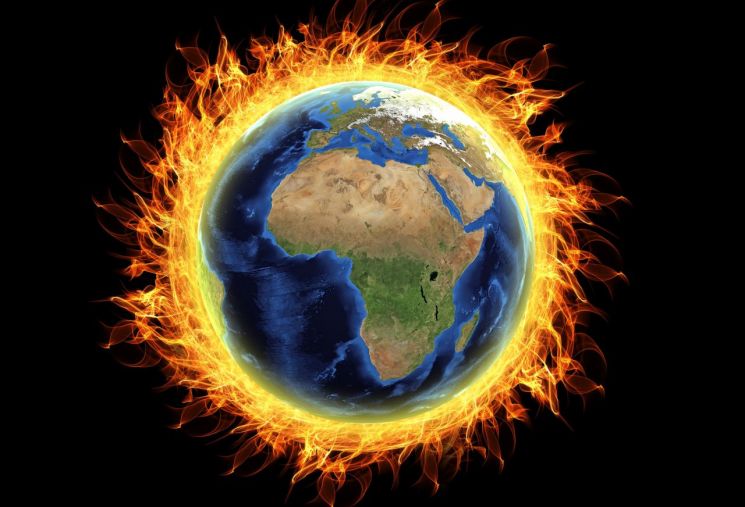
The institute also expressed concern that the average temperature increase compared to the pre-industrial era, which was 1.48 degrees Celsius last year, is expected to reach over 1.55 degrees Celsius this year. This would mark the first time the 1.5-degree Celsius limit agreed upon by 195 countries worldwide under the 2015 Paris Agreement has been breached. The institute explained that since the 1.5-degree target is based on a long-term average, surpassing 1.5 degrees this year does not immediately mean failure to meet the climate agreement goals, but it expressed deep concern over the ongoing global warming.
Carlo Buontempo, director of the Copernicus Institute, stated, "During unusually high temperature periods like last year and this year, other factors such as El Ni?o, volcanic eruptions, and changes in solar energy also had an impact," but added, "The long-term temperature rise is a bad sign." Earlier, Samantha Burgess, deputy director of the institute, said, "The only way to stop the rise in Earth's temperature is to drastically reduce greenhouse gas emissions."
Experts have also warned of worsening conditions as the '1.5-degree threshold' collapse becomes a reality. Michael Mann, a meteorologist at the University of Pennsylvania, said, "Surpassing the 1.5-degree line this year does not necessarily mean the overall trend of global warming has been exceeded, but without unified efforts, the threshold will soon collapse." Natalie Mahowald, chair of the Department of Earth and Atmospheric Sciences at Cornell University, warned, "The 1.5-degree target was set to prevent the worst impacts of climate change, and the heatwaves, storms, and droughts we are experiencing now are just the tip of the iceberg."
There were also calls for countries worldwide to agree on stronger measures at the 29th United Nations Climate Change Conference of the Parties (COP29), scheduled for the 11th.
Sonia Seneviratne, a climate scientist at the Swiss Federal Institute of Technology Zurich, said, "The pace of global climate action is too slow, and the limits set by the Paris Agreement have begun to break down," urging, "At COP29, governments must agree on stronger measures to move away from fossil fuels."
© The Asia Business Daily(www.asiae.co.kr). All rights reserved.
![Clutching a Stolen Dior Bag, Saying "I Hate Being Poor but Real"... The Grotesque Con of a "Human Knockoff" [Slate]](https://cwcontent.asiae.co.kr/asiaresize/183/2026021902243444107_1771435474.jpg)















