Summary of Opinions from 15 Experts: Analysis of Sectoral Impacts
Highlighting Universal Tariffs, Fossil Revival, Uncertainty, Currency Intervention, and Personal Diplomacy
"Samsung, SK, Hyundai Motor, LG, etc. Respond to Trade Surplus Risks"
Experts have analyzed that if former President Donald Trump returns to power, the scope of comprehensive changes in trade, energy, advanced industries, and North Korea policy will widen, increasing uncertainty in corporate management. Keywords such as universal tariffs, revival of fossil fuels, increased uncertainty in advanced industries, intervention in monetary policy, and personal diplomacy between North Korean and U.S. leaders?summarized as 'T·R·U·M·P'?are expected to emerge. It is advised to actively respond by combining pragmatic government diplomacy with private outreach (proactive communication and contact activities).
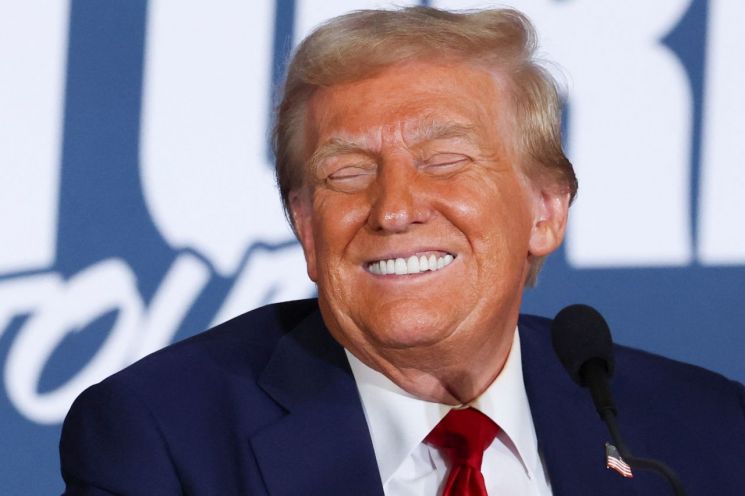 Former U.S. President and Republican presidential candidate Donald Trump is laughing heartily during an election rally held in Pennsylvania on the 29th of last month (local time). Photo by Reuters Yonhap News
On the 7th, the Korea Chamber of Commerce and Industry (KCCI) compiled opinions from 15 economic and industrial experts and announced an analysis of the impact of the election of U.S. President Trump on the Korean economy by sector.
The KCCI stated, "Trump's election will have a significant impact across the Korean economy, including exports and trade, energy, advanced industries, financial markets, and North Korea policy," adding, "The most likely scenario involves the introduction of universal tariffs, revival of fossil fuels, increased uncertainty in advanced industries, intervention in monetary policy, and personal diplomacy between the North Korean and U.S. leaders."
Trade barriers against the U.S. are expected to rise due to the application of universal tariffs and the reciprocal trade law. Professor Heo Yoon of Sogang University Graduate School of International Studies said, "Trump will seek to reduce the U.S. trade deficit and pursue global trade balance by imposing universal tariffs of 10-20% on all imports and introducing the reciprocal trade law, which applies the same import tariff rates as the counterpart country," adding, "Trade barriers and pressure on countries with trade surpluses with the U.S. will increase regardless of whether they are allies or non-allies."
South Korea recorded a trade surplus of $44.4 billion (approximately 62 trillion won) against the U.S. last year and $28.7 billion (approximately 40 trillion won) in the first half of this year. Increased trade due to major companies such as Samsung Electronics, SK Hynix, Hyundai Motor, and LG investing in the U.S. is also a burden. Professor Heo advised, "There is a high possibility of attempts to renegotiate existing trade agreements such as the Korea-U.S. Free Trade Agreement (FTA)," and emphasized, "The increase in intra-company trade due to increased investment in the U.S. could be a significant factor. The government needs to increase imports of U.S. energy and agricultural products to mitigate the growth of the trade surplus with the U.S. after next year."
It is necessary to respond to U.S. pressure together with state governments, legislatures, and workers in regions where Korean companies are located. Professor Min Jeong-hoon of the Korea National Diplomatic Academy emphasized, "If Korean companies suffer damage due to changes in U.S. trade policy, it will be possible to pressure the U.S. government by linking with U.S. companies, state governments, legislatures, and workers who are affected by the same factors."
The increase in fossil fuel supply may increase management uncertainty for companies investing in clean energy such as solar and wind power. Professor Kim Yoon-kyung of Ewha Womans University’s Department of Economics said, "After Trump's election, deregulation of fossil fuels and expedited federal government approvals for fossil fuel projects will expand U.S. oil and gas production and exports," adding, "Increased domestic demand for cheaper gas may reduce exports, or geopolitical risks may rise due to deteriorating relations with Middle Eastern countries, potentially raising energy prices."
It is expected to be difficult to completely repeal the U.S. Inflation Reduction Act (IRA). Professor Ha Yoon-hee of Korea University Graduate School of Energy and Environment said, "While a full repeal of the IRA seems unlikely, adjustments to the scope or scale of key programs such as the clean energy investment tax credit (ITC) and production tax credit (PTC) may occur, heightening uncertainty for domestic solar, wind, and battery companies."
The possibility of adjustments to incentives such as semiconductor subsidies is increasing, which may heighten corporate anxiety. Professor Kwon Seok-jun of Sungkyunkwan University’s Department of Chemical Engineering said, "The Trump administration is likely to strengthen guardrail provisions under the Semiconductor Act and alliance investment requirements for receiving subsidies to pressure China and expand domestic investment," adding, "Policies imposing penalties rather than investment incentives on semiconductor companies from Korea, Taiwan, Japan, and Europe that do not invest are highly likely."
Preparation is also needed for requests to cooperate with trade restrictions on China. Jeong Eun-mi, head of the Growth Engine Industry Research Division at the Korea Institute for Industrial Economics and Trade, said, "China (including Hong Kong) accounts for about 50% of Korea's semiconductor exports, so there will likely be requests from the U.S. for cooperation on trade restrictions against China," advising, "It is necessary to develop response strategies to minimize damage to Korean companies that have major production lines and markets in China."
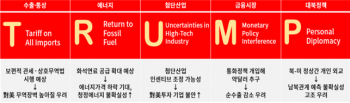 The impact of Trump's election on various sectors of the Korean economy. Provided by the Korea Chamber of Commerce and Industry
Negative impacts on U.S. electric vehicle exports are also expected. Professor Lee Ho-geun of Daeduk College’s Department of Future Automotive Studies said, "Trump is likely to roll back electric vehicle transition policies because electric vehicles, which have about 30% fewer parts than internal combustion engine vehicles, are reducing jobs in the U.S.," adding, "Since about half of domestically produced electric vehicles are exported to the U.S., it is necessary to develop various models such as hybrid vehicles and respond flexibly to changes in U.S. policies."
There is also a possibility of intervention in monetary policy to induce a weaker dollar. The second Trump administration is expected to leverage restrictions on the Federal Reserve's independence to pursue interest rate cuts and a weaker dollar. Professor Kim Young-ik of Sogang University Graduate School of Economics said, "Due to concerns about slower U.S. economic growth next year, the Federal Reserve's interest rate cut stance, and central banks around the world reducing their dollar holdings, the dollar is likely to weaken in the medium to long term."
Professor Kim Jin-il of Korea University’s Department of Economics also expressed concern, saying, "Trump will continue to pressure the Federal Reserve to lower the benchmark interest rate," adding, "If the government increases bond issuance due to budget deficits caused by various tax cuts and increased fiscal spending without covering it with tariff revenues, a weaker dollar and increased U.S. Treasury bonds will cause a decrease in Korea's net exports to the U.S. and capital outflows."
Diplomatic uncertainty may also increase due to more one-on-one negotiations with North Korean State Affairs Commission Chairman Kim Jong-un. Professor Park Won-gon of Ewha Womans University’s Department of North Korean Studies said, "The Trump administration is likely to return to North Korea diplomacy centered on personal relations between the North Korean and U.S. leaders," adding, "In this process, various scenarios are possible, ranging from completely pressuring North Korea to recognizing North Korea's nuclear regime, which will heighten geopolitical uncertainty on the Korean Peninsula."
Park Il-jun, Executive Vice Chairman of the KCCI, said, "It is true that Trump's election causes uncertainty in existing advanced industry investment in the U.S., trade, and North Korea policy," but added, "If the government, which has already experienced the Trump administration, pursues pragmatic diplomacy and negotiation efforts along with private outreach activities, the situation could develop in a 'win-win' direction for both countries."
© The Asia Business Daily(www.asiae.co.kr). All rights reserved.
![Clutching a Stolen Dior Bag, Saying "I Hate Being Poor but Real"... The Grotesque Con of a "Human Knockoff" [Slate]](https://cwcontent.asiae.co.kr/asiaresize/183/2026021902243444107_1771435474.jpg)

















