Over 300 Residents Participate at 3:30 PM on the 13th in Gwangjin-gu Office Auditorium
City Divided into Four Main Axes and Four Zones, Core Projects and Development Plans Announced for Each Zone
Aiming to Create Premium Residential Areas, Establish Regional Specialization Strategies, and Generate Future Growth Engines
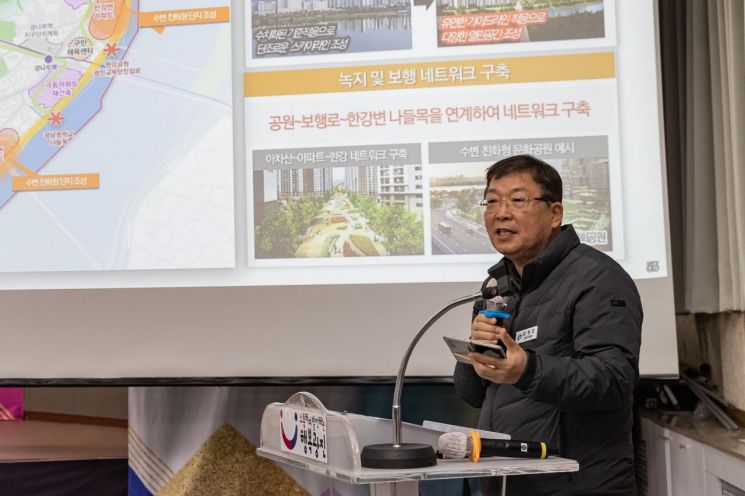
Gwangjin-gu (Mayor Kim Kyung-ho) will hold the ‘2040 Gwangjin Re-Creation Plan Proclamation Resident Report Meeting’ at 3:30 PM on the 13th in the main auditorium of Gwangjin-gu Office.
The ‘2040 Gwangjin Plan’ is a blueprint to realize balanced urban development by fostering future growth engines, and it is a core pledge project of the 8th term of the elected government. It is essentially a map and compass for urban development in Gwangjin-gu, created through continuous communication with experts and residents over the past two years.
The proclamation ceremony will be attended by about 300 people including residents, guests, and officials. The event will proceed in the order of greetings, proclamation of the future city development vision, explanation of the Gwangjin Plan, and Q&A session. In particular, it is expected to be an opportunity to provide residents with detailed reports on the changes in Gwangjin since the 8th term and the progress made so far.
Specifically, aiming to promote urban development based on the ‘4 major axes and 4 major zones,’ the plan focuses on ▲creating premium residential areas through low-rise residential zones, the Han River area, and complex development ▲establishing regional specialization strategies utilizing local resources such as the Han River and Achasan Mountain ▲and generating future growth engines through commercial areas and key spaces.
The 4 major axes are divided into the Advanced Industry Axis along Achasan-ro, the Youth Advanced Innovation Axis along Neungdong-ro and Dongil-ro, the Industrial Support Axis along Cheonho-daero, and the Creative Culture Axis along Jayang-ro and Yongmasan-ro.
The 4 major zones are ▲Junggok Zone, a medical specialization hub ▲Hwayang-Gunja Zone, aspiring to be one of Seoul’s top three youth downtowns ▲Jayang Zone, an advanced business complex hub ▲and Guui-Gwangjang Zone, a historical cultural and arts hub, with specialized plans for each zone.
Additionally, the proportion of commercial areas, which ranked 23rd among Seoul’s autonomous districts, has jumped to 19th. Based on this, the Gunja Station district will be developed as a business center with commercial, office, residential, and cultural functions, while the Dongil-ro district will be nurtured as a youth-specialized center along with the Konkuk University area transit station.
Furthermore, a comprehensive development plan for restructuring the Children’s Grand Park area and a district unit plan around Achasan Station will be established, and high-density mixed-use development of residential, office, commercial, and cultural complexes along Cheonho-daero will be promoted to achieve regional balanced development.
Kim Kyung-ho, Mayor of Gwangjin-gu, said, “I have always dreamed of decent apartments coming to the Junggok-dong area. Through the 2040 Gwangjin Plan, we have prepared residential development measures and actively requested the Seoul Metropolitan Government to increase the redevelopment possible area by 90 times. I hope this proclamation ceremony will be another starting point for balanced urban development in Gwangjin-gu. I thank everyone who participated in the 2040 Gwangjin Plan, the blueprint for urban development.”
He also stated, “We will continue to communicate tirelessly with experts and related organizations to ensure the proper realization of the 2040 Gwangjin Plan. I hope the residents will also lend their support and encouragement.”
© The Asia Business Daily(www.asiae.co.kr). All rights reserved.

















