Research by the Korean Association for Public Administration
The majority of judges believe that the judiciary's budget is insufficient. Out of 10 judges, 9.8 think that the judiciary's budget is not enough for prompt rulings, and 9.3 believe that the budget is also inadequate for fair judgments.
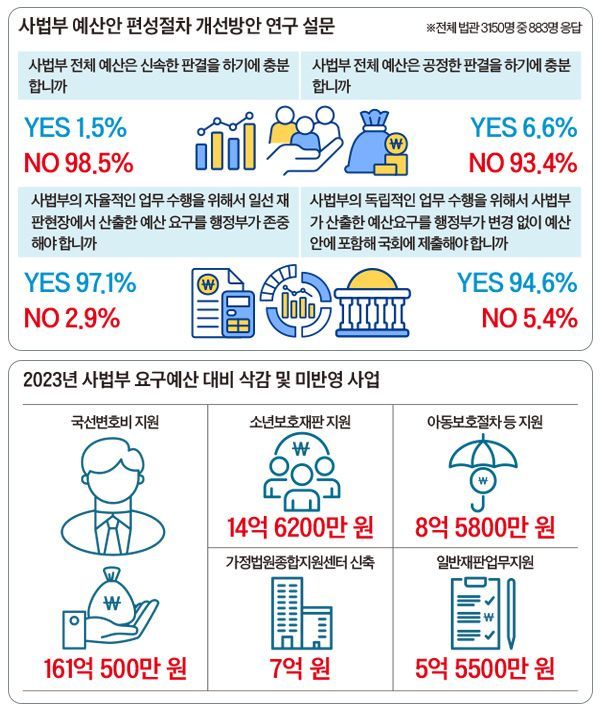
The Court Administration Office conducted a policy research project titled "Study on Improving the Budget Formulation Process to Guarantee the Independence and Autonomy of the Judiciary." The Korea Association for Public Administration, the researcher, surveyed all 3,150 judges in March, and 883 respondents answered as such.
This year, the judiciary's budget is 2.1738 trillion won, accounting for only 0.33% of the total national budget (656.6 trillion won). It decreased from 0.42% in 2014 to 0.33% this year
42% Dissatisfied with Salary Intend to Change Jobs
The majority of respondents expressed negative opinions about the independence of the judiciary's budget. Judges agreed with the criticism that the legislature and executive control the judiciary's budget.
When asked how independent they think the budget is, 99.1% of respondents answered that the judiciary does not freely formulate its budget without interference from the executive branch (Ministry of Economy and Finance). 98% responded that the judiciary does not freely formulate its budget without interference from the legislature.
97.1% of respondents expressed that the executive branch should respect the judiciary's budget. 94.6% said that the executive should include the judiciary's budget request in the budget proposal submitted to the National Assembly without changes to ensure independent work performance.
This aligns with the opinion of frontline judges and the diagnosis by Chief Justice Cho Hee-dae at his first press conference after taking office in February: "Because the judiciary has no authority at all, it keeps having to ask the political circles, and when it asks, the political circles inevitably ask back."
The report diagnosed that compared to international standards, Korea has established an effective judicial progress and processing system in civil and criminal cases, but inefficiencies exist, such as the continuous increase in trial processing days and unresolved cases. It analyzed that a major cause of inefficiency is the insufficient staffing, including the lack of additional judges, due to the failure to secure budget independence.
The survey results showed that judges are dissatisfied with their salaries. About half (42.2%) expressed an intention to change jobs, citing low pay (91.4%) and excessive workload (75%) as the main reasons, and mainly hoping to move to the legal sector offering higher salaries.
Ministry of Economy and Finance Cuts Budget by an Average of 148.7 Billion Won Annually
It was also analyzed that the judiciary's budget for improving judicial service quality was cut or not allocated by the government. Budgets for projects supporting socially vulnerable groups, such as △public defender fees, △juvenile protection trial support, △witness support office and visitation center installation, △child protection procedures support, as well as projects enhancing public access to justice and court trial efficiency, such as △publication of rulings and △criminal electronic litigation system establishment, were reduced after review by the Ministry of Economy and Finance.
According to the report, over the past 10 years, the Ministry of Economy and Finance has cut an average of about 148.7 billion won annually from the judiciary's requested budget before submitting it to the National Assembly. Especially in the 2023 budget, significant cuts were made to ongoing projects such as public defender fees (-16.105 billion won), juvenile protection trial support (-1.462 billion won), and child protection procedure support (-858 million won). Reductions were also made in the Family Court Comprehensive Support Center construction (-700 million won) and general trial work support (-555 million won).
These budget cuts have led to increased workload burdens for frontline judges. When asked whether they receive adequate human resources necessary for their work, 57.1% responded negatively, and 71.4% said they do not receive adequate material resources such as budget.
"Establish Regulations to Submit Budget Without Changes by Government"
There was also a suggestion to establish legal regulations or constitutional provisions on budget independence to submit the judiciary's budget to the National Assembly without changes.
The report stated, "Countries like the United States, Japan, and Germany do not have special constitutional regulations on judiciary budget formulation, and include it in the budget submitted by the government." It added, "Like the U.S., it is possible to secure independence by recognizing the executive's budget formulation authority but legally requiring the judiciary's budget to be submitted to the legislature without changes, or, like Japan, to amend the constitution to allow the legislature to increase or add new budget items, enabling the legislature to restore judiciary budgets changed by the executive through parliamentary review."
Furthermore, "Long-term consideration can be given to establishing constitutional provisions on budget independence, as some countries (Mexico, Iraq, Bolivia, etc.) have constitutional regulations on the judiciary's independent budget formulation," the report said.
The importance of finance for the realization of judicial independence was also emphasized. The report noted, "The current Court Organization Act and National Finance Act guarantee the autonomy of independent institution budgets during government budget formulation, respect the judiciary's independence and autonomy, and stipulate that court expenses be independently accounted for in the national budget." However, it pointed out, "The judiciary's requested budget is significantly cut during the Ministry of Economy and Finance's budget formulation process, depriving it of even the opportunity for parliamentary review."
It added, "If the judiciary's budget request were submitted without modification, as in the U.S. and Germany, the necessity and appropriateness of the budget could be explained during the parliamentary review process, greatly contributing to securing the judiciary's independence."
Meanwhile, the report also proposed strengthening the judiciary's budget analysis function and enhancing opportunities for public participation to hear citizens' opinions during the budget formulation process.
By Park Su-yeon and Hong Yoon-ji, Legal News Reporters
※This article is based on content supplied by Law Times.
© The Asia Business Daily(www.asiae.co.kr). All rights reserved.
![Clutching a Stolen Dior Bag, Saying "I Hate Being Poor but Real"... The Grotesque Con of a "Human Knockoff" [Slate]](https://cwcontent.asiae.co.kr/asiaresize/183/2026021902243444107_1771435474.jpg)











