Middle-Class Wallets Close, Luxury Brand Performance Declines
"Trend Toward Escaping Conspicuous Consumption"
As luxury consumption in China slows down, global luxury brands are struggling to stay afloat.
According to Bloomberg on the 4th (local time), due to the slowdown in the Chinese economy, the housing market slump, and the Chinese government's anti-corruption policies, the Chinese middle class is tightening their wallets, causing luxury brands' sales performance to plummet. Consulting firm Digital Luxury Group forecasts that the rapidly growing Chinese luxury market over the past few years will shrink by up to 15% this year.
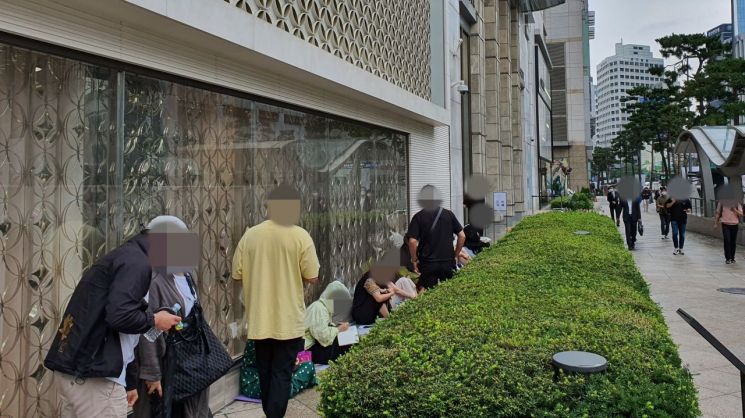
French luxury group LVMH, which owns brands such as Louis Vuitton, Dior, and Celine, is also suffering from the impact of the slowdown in Chinese consumption. Bernard Arnault, chairman of LVMH, visited Beijing last June to personally oversee the opening of a flagship Louis Vuitton store. However, the store opening scheduled for the first half of this year was canceled, and currently, fences surround the building. Bloomberg noted that the slow progress of LVMH's key project, the Beijing Louis Vuitton store opening, symbolically reflects the difficulties European luxury companies are facing in China.
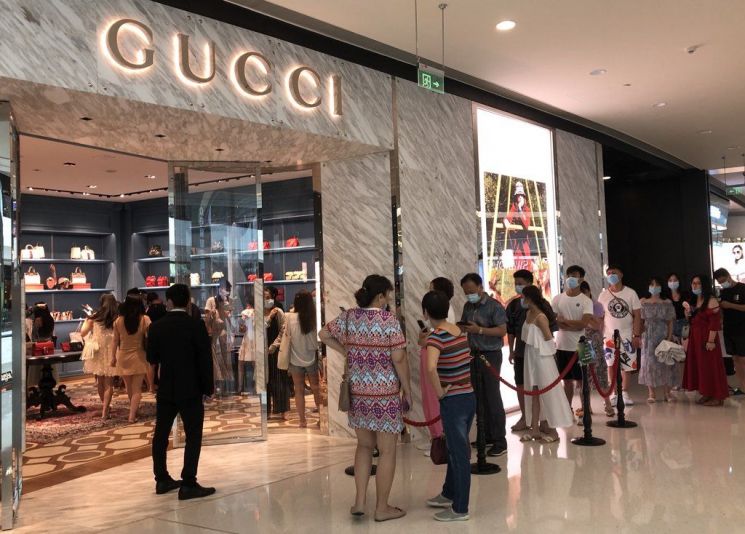 Customers are lining up at the entrance of the Gucci store in Sanya International Duty-Free City (cdf Mall), a downtown duty-free shop in Hainan Province, China. Photo by Yonhap News
Originally, China was one of the world's major luxury consumption countries. In fact, according to consulting firm Bain & Company, China's luxury market grew more than fourfold from 2011 to 2021, reaching $66 billion (approximately 90.97 trillion KRW). However, recently, a cold wind is blowing through luxury stores in China. LVMH reported a 16% decrease in sales in regions including China in the third quarter. Kering Group, which owns brands such as Gucci and Saint Laurent, expects its annual revenue to record the lowest figure since 2016.
This phenomenon appears to be influenced by changes in Chinese consumers' spending trends. Bloomberg reported that young Chinese consumers are spending more on travel and self-development rather than purchasing luxury goods. The luxury industry is exploring various ways to retain Chinese VIP customers. Last summer, LVMH provided VIP customers with airline tickets to Paris, where the Summer Olympics were held, and other brands like Burberry are clearing inventory through discounts of up to 50%.
Meanwhile, experts predict that the shift away from conspicuous consumption will continue for the time being. Accordingly, if changes in Chinese consumers' values and economic uncertainties persist, there is analysis that luxury brands may find it difficult to maintain their presence within China in the future.
© The Asia Business Daily(www.asiae.co.kr). All rights reserved.
![Clutching a Stolen Dior Bag, Saying "I Hate Being Poor but Real"... The Grotesque Con of a "Human Knockoff" [Slate]](https://cwcontent.asiae.co.kr/asiaresize/183/2026021902243444107_1771435474.jpg)
















