Continuous Increase Except May After Medical Crisis
Shortage of Medical Staff and Accumulated Fatigue
Rise in Infectious and Cardiovascular Diseases During Winter
As the medical gap caused by the departure of residents continues for the 10th month, the number of deaths in August has increased by more than 5% compared to the same period last year. With a shortage of doctors in the medical field and accumulated fatigue among medical staff, concerns are growing that the number of deaths in the winter season could surge between the end of this year and early next year.
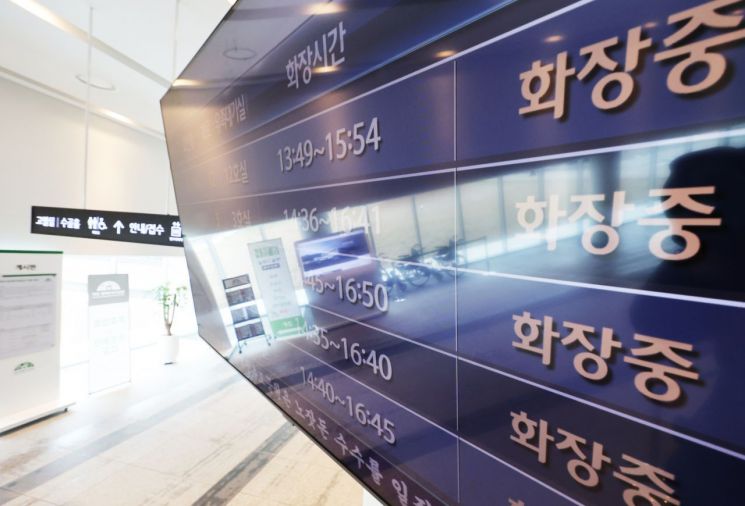
According to the 'August Population Trends' announced by Statistics Korea on the 23rd of last month, the number of deaths in August this year was 32,244, an increase of 5.6% compared to August last year (30,540). This is also the highest monthly death toll since the medical crisis in February this year.
Except for May, the monthly number of deaths increased compared to last year. In February, the number of deaths was 29,977, up 9.6% from the same month last year. In March and April, 31,160 and 28,659 people died respectively, which is 7.6% and 4.0% higher than the same months last year. In June and July, the increases were slight at 0.6% and 0.4%, but the increase expanded again in August. The total number of deaths from February to August this year was 205,777, a 3.7% increase compared to the same period last year (198,450).
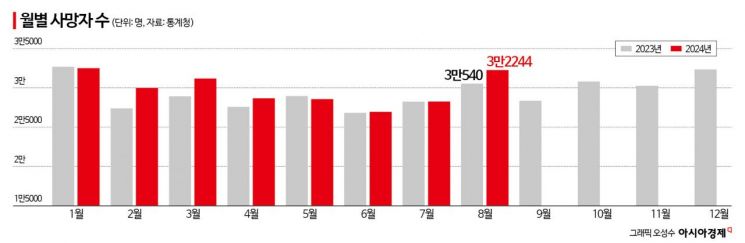
As the medical crisis shows no signs of resolution, concerns are growing that the number of deaths in the upcoming winter season will increase significantly. Deaths tend to increase from early winter, when temperatures drop sharply, through midwinter. The average monthly number of deaths from February to September last year was 28,352, but from October last year to January this year, when cold winds blow, the average monthly number of deaths reached 31,470.
Professor Oh Seung-won of the Department of Family Medicine at Seoul National University Hospital Gangnam Center said, "When the weather gets colder, ventilation is poor, leading to an increase in infectious and respiratory diseases, so the number of flu and COVID-19 patients also rises." He added, "With reduced physical activity, the conditions of patients with existing metabolic diseases such as hypertension and diabetes, as well as chronic diseases, will worsen." Professor Oh explained, "In particular, the risk of complications and cardiovascular diseases such as stroke occur more frequently in winter. These risks cause the number of deaths in winter to be relatively higher."
The shortage of medical staff and accumulated fatigue also heighten concerns about a winter medical crisis. Professor Park Eun-chul of the Department of Preventive Medicine at Yonsei University College of Medicine said, "While seasonal factors play a role, after residents left the hospitals without replacements, professors have become extremely exhausted," adding, "Measures must be taken to address the absolute shortage of medical staff and accumulated fatigue."
The government is also busy preparing emergency medical measures for winter. Earlier, the Presidential Office stated in a briefing on the 17th of last month, "Winter is expected to be a difficult period due to (medical gaps)," and "Emergency measures for respiratory, cardiovascular, cerebrovascular, and infectious diseases will be announced soon." Kim Guk-il, Director of Health and Medical Policy at the Ministry of Health and Welfare, said, "We are preparing (the winter emergency medical measures)," but added, "They have not been finalized yet, so we cannot disclose them."
© The Asia Business Daily(www.asiae.co.kr). All rights reserved.
![Clutching a Stolen Dior Bag, Saying "I Hate Being Poor but Real"... The Grotesque Con of a "Human Knockoff" [Slate]](https://cwcontent.asiae.co.kr/asiaresize/183/2026021902243444107_1771435474.jpg)

















