Due to the continued strength of the dollar influenced by the 'Trump Trade,' which bets on the election of former President Donald Trump in the U.S. presidential election, South Korea's foreign exchange reserves decreased for the first time in four months.
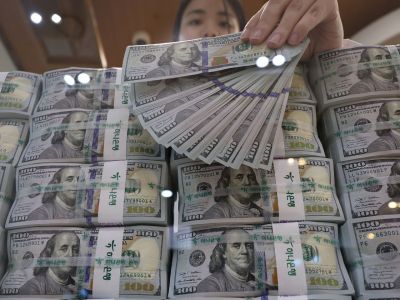
According to the 'End of October Foreign Exchange Reserves' announced by the Bank of Korea on the 5th, South Korea's foreign exchange reserves last month amounted to $415.69 billion, a decrease of $4.28 billion compared to the end of the previous month.
The foreign exchange reserves had increased for three consecutive months since July. This was due to the U.S. implementing a big cut (a 0.5 percentage point interest rate cut) and growing expectations of further rate cuts, which weakened the dollar. However, recently, with the 'Trump Trade' betting on the election of former President Donald Trump in the U.S. presidential election, the dollar strengthened, causing the foreign exchange reserves to turn to a decline for the first time in four months. At the end of October, the U.S. dollar index was 103.99, rising about 3.6% during October.
A Bank of Korea official explained, "The foreign exchange reserves decreased due to the reduction in the U.S. dollar equivalent amount of other currency foreign assets caused by the U.S. dollar's strength and the decline in foreign currency deposits of financial institutions due to the disappearance of the quarter-end effect."
The foreign exchange reserves consisted of securities worth $373.25 billion (89.8%), deposits of $18.42 billion (4.4%), Special Drawing Rights (SDR) at the International Monetary Fund (IMF) of $15.05 billion (3.6%), gold worth $4.79 billion (1.2%), and IMF positions of $4.18 billion (1.0%).
As of the end of September, South Korea's foreign exchange reserves ranked 9th in the world. China ranked first with $3.3164 trillion, followed by Japan with $1.2549 trillion. Next were Switzerland with $950.4 billion, India with $705.8 billion, Russia with $633.7 billion, Taiwan with $577.9 billion, Saudi Arabia with $456.8 billion, and Hong Kong with $422.8 billion.
© The Asia Business Daily(www.asiae.co.kr). All rights reserved.
![Clutching a Stolen Dior Bag, Saying "I Hate Being Poor but Real"... The Grotesque Con of a "Human Knockoff" [Slate]](https://cwcontent.asiae.co.kr/asiaresize/183/2026021902243444107_1771435474.jpg)















