Korea's Tax Rates Criticized as High Compared to Other Countries
Lower ROE and ROIC Than Other Nations
Shareholder Activism Expected to Increase Further
"The value-up direction is correct, but if the relatively high tax rates compared to other countries are improved, there is potential for further increases."
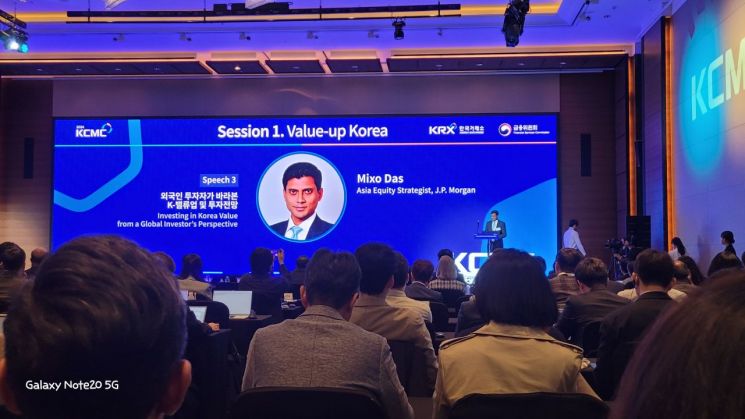 Mixo Das, JP Morgan Asia Equity Strategist, is delivering a keynote presentation at the 'Korea Capital Market Conference 2024' held on the 4th at the Conrad Hotel in Yeouido, Seoul. (Provided by Korea Exchange)
Mixo Das, JP Morgan Asia Equity Strategist, pointed out at the 'Korea Capital Market Conference 2024' held on the 4th at Conrad Hotel in Yeouido, Seoul, that Korea's tax rates are high compared to other countries.
The tax reform bill announced by the government at the end of July includes corporate tax reductions and separate taxation benefits on dividend income for companies participating in shareholder returns and value-up. However, it has not passed the National Assembly due to disagreements between the ruling and opposition parties.
He said, "If tax reform is implemented, it will have a positive impact on value-up," adding, "Meaningful improvements can be made in areas such as dividend income tax."
Das, the equity strategist, observed that since the Korean government launched the value-up program, investors have shown a tendency to invest in undervalued Korean companies. He explained, "Since the value-up program started in January-February, foreign investment has steadily increased," and "especially undervalued sectors in Korea are finance and automobiles." He also suggested that the banking and automobile sectors remain promising industries.
Regarding why Korean companies' stock prices are not properly valued, he said it is because capital is not being effectively utilized.
Das stated, "Due to inefficient capital management, low shareholder participation, and lack of integrated system management with global capital markets," and added, "As another speaker mentioned, exchange rates could also be an issue."
He also mentioned that low capital efficiency indicators compared to other countries are a main factor for the Korea discount. He said, "Compared to Japan, return on equity (ROE), return on invested capital (ROIC), dividend payout ratio, and share buybacks are confirmed to be lower."
Das said that if Korea raises its ROIC further, it can also increase shareholder value. He stated, "Overall ROIC by industry is low, but I believe it can be raised to 5-12%," and "Through this, shareholder value can be increased by more than 100%."
He also addressed the low shareholder return rate. He said, "Although it has increased compared to the past, when looking at the dividend payout ratio, mid-sized companies are significantly lower compared to other countries," and "share buybacks are also at insufficient levels."
He reported that corporate governance scores are also considerably low compared to global standards. Das said, "Looking at the Morgan Stanley Capital International (MSCI) governance score, Korea is only at 26%, which is quite low compared to global standards," and "Issues related to related-party transactions and controlling shareholders need to be resolved."
He predicted that shareholder activism in the Korean capital market will increase further. He said, "Activism is increasing in Korea and is expected to continue to grow," adding, "Through more pressure, companies' capital management capabilities will be modernized. A virtuous cycle should occur through improvements in total shareholder returns."
© The Asia Business Daily(www.asiae.co.kr). All rights reserved.
![Clutching a Stolen Dior Bag, Saying "I Hate Being Poor but Real"... The Grotesque Con of a "Human Knockoff" [Slate]](https://cwcontent.asiae.co.kr/asiaresize/183/2026021902243444107_1771435474.jpg)
















