'Flamingo Challenge' Standing on One Leg
Shows How Strong Your Bones, Muscles, and Nerves Are
A study has found that middle-aged individuals who cannot stand on one leg for more than 10 seconds have a significantly increased risk of death within 10 years.

On the 1st, the British Daily Mail reported that researchers from the UK's National Health Service (NHS) discovered the optimal standing times by age group. Young people aged 18 to 39 should be able to balance on one leg for about 43 seconds to be considered healthy. It is explained that ideally, people in their 40s should stand for 40 seconds, those in their 50s for 37 seconds, those in their 60s for 30 seconds, and those in their 70s for about 18 to 19 seconds.
When standing on one leg, hands should be placed on the hips and only one leg should be used. The measurement ends if the foot touches the ground or the hands leave the hips. Also known as the 'Flamingo Challenge,' this study revealed that middle-aged people who cannot maintain balance on one leg for more than 10 seconds have a dramatically increased risk of early death.
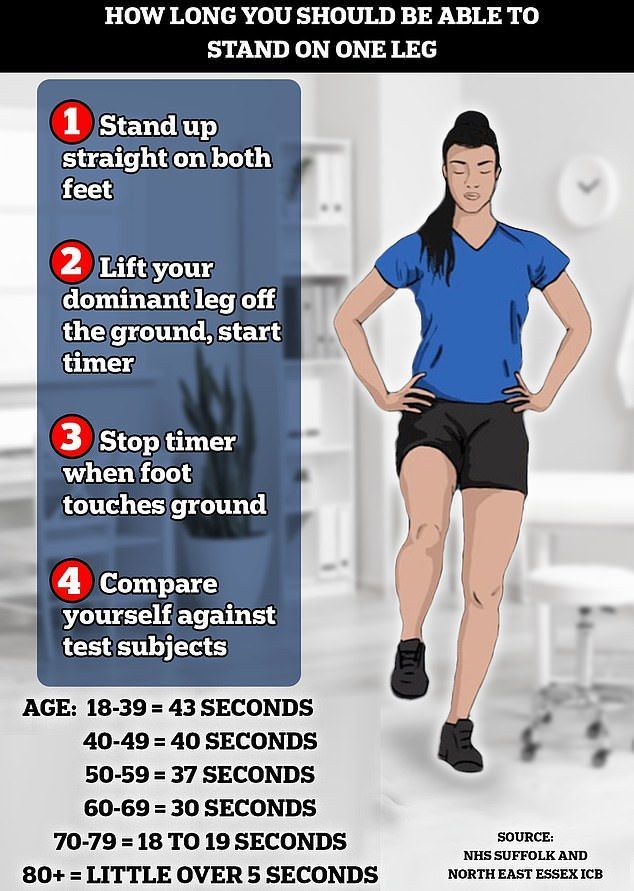
A study published in 2022 showed that elderly individuals who cannot stand on one leg for 10 seconds have about twice the risk of dying from any cause within the next 10 years.
Similar results were found in a study by Kyoto University in Japan. People who cannot stand on one foot for more than 20 seconds may have abnormal brain health. The researchers tested 1,300 participants by having them lift one leg and stand with their eyes open for 60 seconds while undergoing magnetic resonance imaging (MRI) of the brain. Among those with two or more brain lesions, 34.5% could not exceed 20 seconds, and among those with one lesion, 16% failed to do so. The brain lesions included asymptomatic stroke and lacunar infarction.
According to a recent announcement from the Mayo Clinic, a nonprofit academic medical center in the United States, the amount of time one can balance on one foot is an indicator of how strong their bones, muscles, and nerves are. The researchers stated, "With every 10 years of aging, the time one can stand on the less-used leg decreases by 2.2 seconds, and on the dominant leg, the time decreases by 1.7 seconds every 10 years."
Experts emphasize that "consistent posture correction and balance exercises can effectively manage health in old age by improving physical strength and flexibility."
© The Asia Business Daily(www.asiae.co.kr). All rights reserved.
![Clutching a Stolen Dior Bag, Saying "I Hate Being Poor but Real"... The Grotesque Con of a "Human Knockoff" [Slate]](https://cwcontent.asiae.co.kr/asiaresize/183/2026021902243444107_1771435474.jpg)
















