Weekly Market Report for Seoul Metropolitan Area Apartments in the Last Week of October
September Seoul Apartment Sales Volume Halved Compared to Previous Month
Seoul Apartment Sale and Jeonse Prices Each Up 0.01%
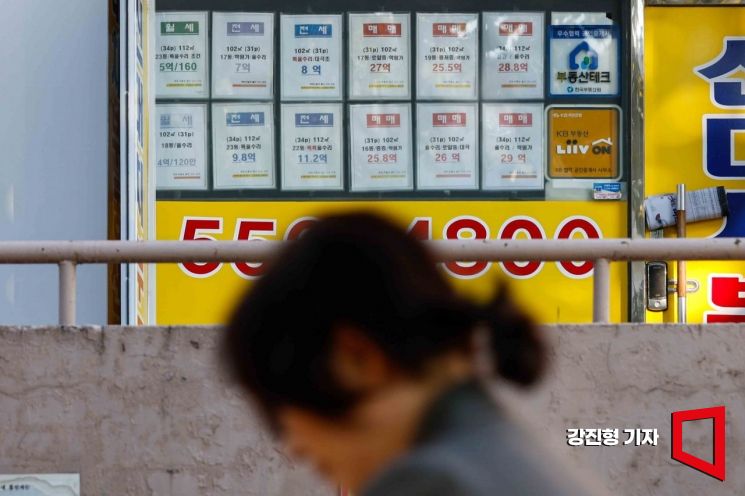 Due to the impact of loan regulations and other factors, apartment transactions have slowed down, causing listings to continue to accumulate. On the 24th, sales and jeonse (long-term lease) flyers were posted at a real estate office in Gangnam, Seoul. Photo by Kang Jin-hyung
The volume of apartment sales transactions in the Seoul metropolitan area peaked at 26,914 in July (based on the Ministry of Land, Infrastructure and Transport's actual transaction disclosure system, excluding contract cancellations) and has shown a decline for two consecutive months.
According to the 'Weekly Market Report for Apartments in the Seoul Metropolitan Area for the Last Week of October' released by Real Estate R114 on the 2nd, the number of transactions was 21,979 in August and dropped to 12,259 in September, a 44.2% decrease compared to the previous month. Among the metropolitan areas, Seoul experienced a sharper decline, falling 53.2% from 6,183 in August to 2,892 in September, which was a larger drop than in Gyeonggi and Incheon.
This is due to buyer fatigue from the short-term rapid rise in housing prices and weakened purchasing power caused by tightened loan regulations, combined with sellers holding firm on increased asking prices without adjustment, creating an environment where contracts are difficult to finalize. Based on current trends, the volume of sales transactions in October is expected to increase compared to September, but with the likelihood of continued loan restrictions until the end of the year, it will be difficult to expect active trading movements for the time being.
In the last week of October, apartment sale prices in Seoul rose by 0.01%, the same as the previous week. General apartments increased by 0.01%, while redevelopment apartments remained flat (0.00%). There were no significant price changes in new towns, Gyeonggi, or Incheon.
By individual areas in Seoul, prices rose in Gwanak (0.10%), Dongdaemun (0.04%), Gwangjin (0.04%), Guro (0.02%), Seongbuk (0.01%), and Seongdong (0.01%). Conversely, Geumcheon (-0.06%) and Gangseo (-0.01%) saw downward adjustments. In new towns, Jungdong and Sanbon each increased by 0.01%. Older apartments such as Boramaju in Bucheon Jungdong and Gaya 5th Complex Jugong 3rd in Gunpo Sanbon were adjusted upward by 1 to 1.5 million KRW.
In Gyeonggi and Incheon, prices rose in Hwaseong (0.07%), Osan (0.05%), Uiwang (0.01%), and Incheon (0.01%) in that order, while Ansan fell by 0.01% due to a 5 to 10 million KRW drop in Jugong 9th Complex in Gojan-dong.
In the jeonse (long-term lease) market, the number of jeonse listings has gradually increased since mid-October, but there remains a shortage of listings in preferred areas. Seoul's jeonse prices rose by 0.01% compared to the previous week, new towns remained flat (0.00%), and Gyeonggi and Incheon increased by 0.01%.
In Seoul, the largest increases were seen mainly in large complexes with over 1,000 households in the northeast and southwest areas. Individual areas with increases included Dongdaemun (0.05%), Nowon (0.05%), Gwanak (0.03%), Gangseo (0.03%), Songpa (0.02%), Geumcheon (0.02%), Guro (0.01%), and Gwangjin (0.01%).
In new towns, Jungdong rose by 0.01%, while other areas remained flat (0.00%). In Gyeonggi and Incheon, prices were adjusted upward in Suwon (0.06%), Hwaseong (0.04%), Incheon (0.03%), Guri (0.02%), Ansan (0.01%), Siheung (0.01%), and Gimpo (0.01%).
A Real Estate R114 official stated, "Apartment prices in the Seoul metropolitan area are taking a breather, recording 0.01% for three consecutive weeks amid expanding buyer hesitation," adding, "New towns and Gyeonggi-Incheon recorded flat (0.00%) prices showing limited price movements, while Seoul maintained a 0.01% increase for two consecutive weeks, sustaining the upward momentum."
He continued, "Looking at individual areas in Seoul, unlike the past three weeks where no areas declined, some parts of the southwest region recorded negative changes this week, increasing regional disparities," and said, "Overall, as the pace of apartment price increases slows, price fluctuation disparities between areas with localized buying interest and those without within Seoul are expected to become more pronounced."
© The Asia Business Daily(www.asiae.co.kr). All rights reserved.
![Clutching a Stolen Dior Bag, Saying "I Hate Being Poor but Real"... The Grotesque Con of a "Human Knockoff" [Slate]](https://cwcontent.asiae.co.kr/asiaresize/183/2026021902243444107_1771435474.jpg)
















