"Character Admired by Japanese Women"
Sales Decline in the 21st Century Poses Crisis
Diversification Strategy Succeeds with 'V-Shaped Recovery'
'Hello Kitty,' the character that achieved the second greatest success in Japan after 'Pokemon,' was created by the character-specialized production company Sanrio. Tomokuni Tsuji, CEO and grandson of Sanrio founder Shintaro Tsuji, who inherited the company from his grandfather, shared the behind-the-scenes story related to the birth of Hello Kitty.
Earlier in July, Jill Koff, Sanrio's Director of Retail Business Development, revealed in an interview with a US broadcaster that "Hello Kitty is not a cat but a human," which sparked public interest. Hello Kitty is a white cat character launched by Sanrio in 1974 and ranks second worldwide in cumulative revenue, just behind Pokemon.
Until now, fans had naturally assumed Hello Kitty to be a cat. However, Sanrio has never explicitly stated Hello Kitty's "species." The official website's description of Hello Kitty only says she is "a bright and kind-hearted girl born on November 1."
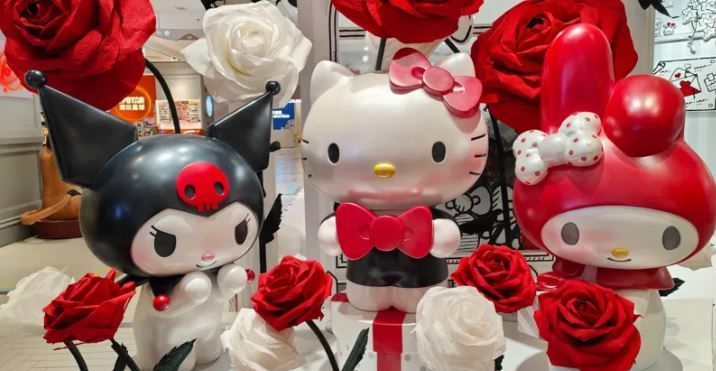 Hello Kitty (center) is Sanrio's representative character. On the left and right are other popular characters Kuromi and My Melody, respectively.
 [Image source=Getty Images]
So why did Sanrio clarify that Hello Kitty is human? Tomokuni Tsuji, who succeeded his grandfather as Sanrio's CEO, answered in an interview with the UK’s BBC on the 1st (local time) that it was "(the founder's) decision." He said, "Hello Kitty is just Hello Kitty. She could be your sister, your mother, or even another version of yourself."
Originally, founder Shintaro set Hello Kitty as a girl born in London, England. Regarding this, CEO Tomokuni speculated, "London was a city admired (in Japan during the 1970s). Many Japanese girls envied London, so (my grandfather) probably decided to make Hello Kitty from London."
After creating Hello Kitty, Shintaro founder grew Sanrio into a global company. He retired in 2020 and passed the CEO position to his grandson, Tomokuni. At that time, Tomokuni was 31 years old, making him the youngest CEO among listed companies in Japan.
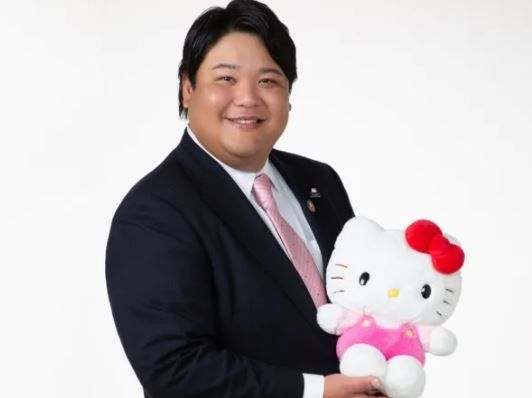 Tsuji Tomokuni, the grandson who inherited the position of Sanrio CEO from founder Tsuji Shintaro.
 [Image source=Sanrio]
Since then, CEO Tomokuni boldly shifted Sanrio's management strategy. At that time, Sanrio's growth had hit a ceiling. Hello Kitty's popularity was declining, and consequently, revenue from the character retail business also decreased. Instead of sticking only to "cute" characters like Hello Kitty, Tomokuni designed new characters reflecting diverse human archetypes.
For example, today Sanrio's most popular character is 'Cinnamoroll,' a puppy character with blue eyes and white fur. There are also 'Retsuko,' a red panda character reflecting modern Japanese working women; 'Kuromi,' a character resembling a demon; and 'Gudetama,' an egg character suffering from depression. Thanks to character diversification and aggressive overseas expansion, Sanrio achieved a classic "V-shaped recovery," with its stock price soaring tenfold over the past four years.
CEO Tomokuni revealed that he had this vision from the past but initially clashed with founder Shintaro, who was then CEO. He said, "Trying to persuade my grandfather, who was 60 years older than me, was arrogant in itself," but added, "Then my grandfather told me to run the company as I wished. He entrusted the company to me." He added that since then, Sanrio has "successfully achieved a beautiful 'V-shaped' recovery."
© The Asia Business Daily(www.asiae.co.kr). All rights reserved.
![Clutching a Stolen Dior Bag, Saying "I Hate Being Poor but Real"... The Grotesque Con of a "Human Knockoff" [Slate]](https://cwcontent.asiae.co.kr/asiaresize/183/2026021902243444107_1771435474.jpg)

















