A technology that dramatically improves the performance of quantum dot light-emitting devices (QD-LEDs) has been developed. Quantum dot light-emitting devices are optical devices that emit light by directly injecting electrons and holes into quantum dots of nanometer size.
 Professor Im Jae-hoon (left), graduate student Jung Woon-ho (right). Provided by the National Research Foundation of Korea
The National Research Foundation of Korea announced on the 31st that Professor Jae-Hoon Lim’s research team at Sungkyunkwan University (first author graduate student Unho Jeong) developed a fundamental material for the core element of all-inorganic devices, the ‘inorganic hole transport layer,’ which significantly enhances the brightness and stability of quantum dot light-emitting devices.
All-inorganic devices refer to multilayer thin-film device structures composed entirely of inorganic materials for both the electron transport layer and the hole transport layer. The hole transport layer functions as a layer that transfers holes from the anode to the quantum dots.
Quantum dot-based light-emitting devices are characterized by high color purity and are attracting attention as a key technology for realizing next-generation displays.
However, to expand quantum dot light-emitting devices to next-generation ultra-realistic displays, outdoor displays, industrial light sources, and more, the light output per unit area must be increased by more than ten times compared to conventional displays. Additionally, the currently mainly used organic hole transport layers have limited conductivity and instability, which have hindered the realization of quantum dot light-emitting devices.
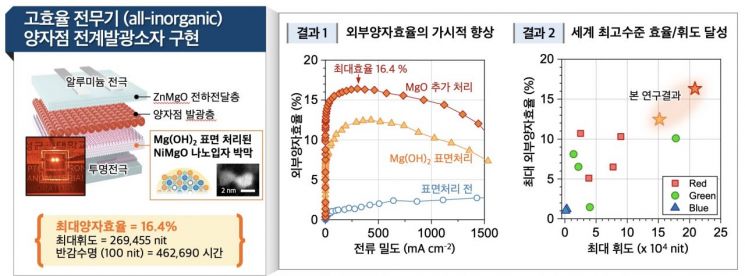 Achievement in implementing all-inorganic quantum dot light-emitting devices using nickel oxide-magnesium oxide alloy (NiMgO) nanoparticles. Provided by the National Research Foundation of Korea
To overcome these limitations, the research team introduced defect-controlled nickel oxide-magnesium oxide alloy nanoparticles as the hole transport layer in the light-emitting device, successfully increasing the external quantum efficiency of the all-inorganic light-emitting device to 16.4%. External quantum efficiency is the ratio of photons emitted outside the device to the charges injected into the device.
The nickel oxide-magnesium oxide alloy nanoparticles also solved the problem of excessive formation of ‘nickel vacancies’ (mediators that increase the quantity and mobility of holes within the nanoparticle thin film) inside and on the surface during synthesis, which had previously reduced optical efficiency.
The research team first lowered the hole conductivity of the hole transport layer to remove nickel vacancies present on the surface. Then, by treating the nanoparticle surface with magnesium hydroxide to suppress hole extraction inside the quantum dots and improve device efficiency, they raised the external quantum efficiency of the all-inorganic light-emitting device to a level comparable to existing technologies.
Professor Lim said, “This research is a significant example confirming that quantum dot technology can be used in next-generation ultra-realistic displays, one of Korea’s 12 major national strategic technologies. Further research is needed to refine the oxide nanoparticle synthesis method to enhance the efficiency and stability of all-inorganic devices and to manufacture ultra-high-resolution pixels.”
Meanwhile, this research was conducted with support from the Nano and Materials Technology Development Project, Mid-Career Researcher Program, and Future Materials Discovery Project, promoted by the Ministry of Science and ICT and the National Research Foundation of Korea. The research results were published in the September 23 issue of the international materials science journal Advanced Materials.
© The Asia Business Daily(www.asiae.co.kr). All rights reserved.
![Clutching a Stolen Dior Bag, Saying "I Hate Being Poor but Real"... The Grotesque Con of a "Human Knockoff" [Slate]](https://cwcontent.asiae.co.kr/asiaresize/183/2026021902243444107_1771435474.jpg)
















