Q3 Semiconductor Operating Profit Falls Below 4 Trillion
Total Sales Reach Record High
HBM4 Development and Mass Production Scheduled for Second Half of Next Year
The semiconductor (DS·Device Solutions) division of Samsung Electronics, which had written a letter of reflection due to poor performance, posted an operating profit of less than 4 trillion won in the third quarter of this year. Although the foundry business continued to struggle and one-time expenses increased significantly, the memory business performed better than expected, providing some consolation. However, the operating profit margin was somewhat lower compared to competitors. Samsung Electronics' total sales, including semiconductors, recorded an all-time high. Research and development (R&D) expenses were also at their largest scale, strongly demonstrating the company's determination to secure future technologies.
Samsung Electronics announced on the 31st that its confirmed third-quarter results showed sales of 79.1 trillion won and an operating profit of 9.18 trillion won. Sales surpassed the previous record of 77.78 trillion won in the first quarter of 2022, setting a new quarterly record. However, it was slightly below market expectations.
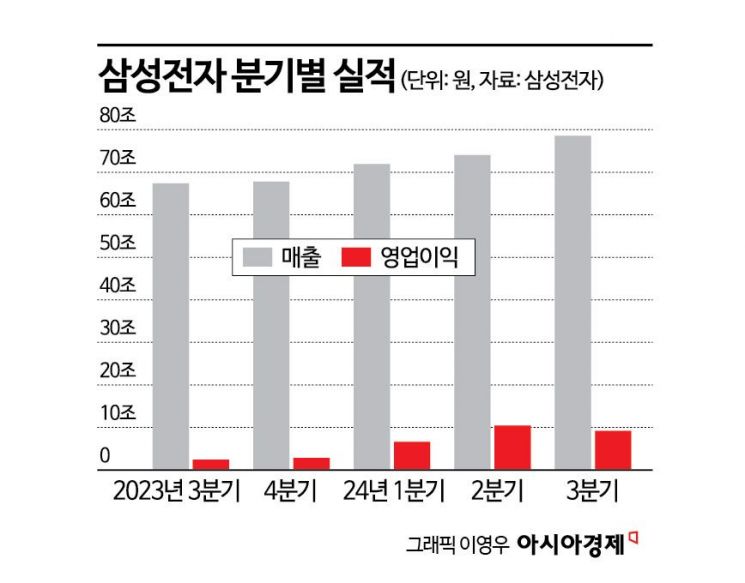
The operating profit was significantly affected by semiconductor sluggishness and increased one-time expenses. The company stated, "Compared to the previous quarter, the scale of inventory revaluation gains decreased, one-time expenses such as incentive provisions increased, and there was also an impact from the weaker dollar exchange rate."
The DS division recorded sales of 29.27 trillion won and an operating profit of 3.86 trillion won. Operating profit increased by 7.6% year-on-year but decreased by 2.59% compared to the previous quarter. Accordingly, the operating profit margin was 13.2%, lower than competitors such as SK Hynix.
However, the memory segment, which accounts for a significant portion of the DS division's performance, held up well. Memory business sales reached 22.07 trillion won, a 112% increase compared to the same period last year. The actual operating profit, excluding one-time expenses, is estimated to have approached the 7 trillion won mark. Samsung Electronics stated, "We actively responded to AI and server demand by expanding sales of high-value-added products such as High Bandwidth Memory (HBM), Double Data Rate (DDR) 5, and server Solid State Drives (SSD)." According to market research firm TrendForce, server DRAM prices rose by 13-18% compared to the previous quarter in the third quarter.
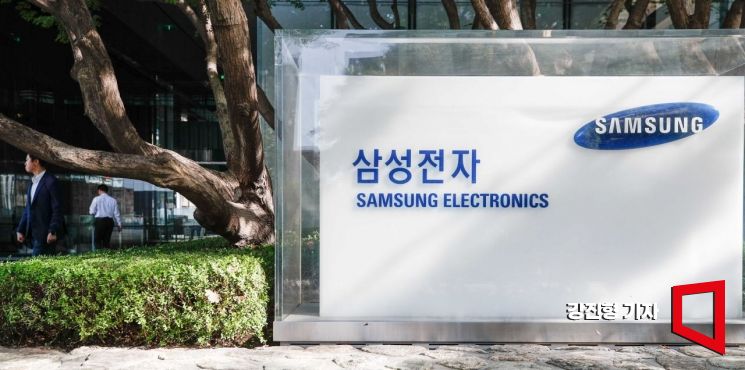 Samsung Electronics announced preliminary consolidated results for the third quarter with sales of 67 trillion KRW and an operating profit of 2.4 trillion KRW, exceeding expectations by more than 2 trillion KRW. The photo was taken on the 11th at Samsung Electronics Seocho Building in Seoul. Photo by Jinhyung Kang aymsdream@
One-time expenses such as third-quarter bonuses are estimated to be in the 1 trillion won range. Excluding one-time expenses from the DS division's operating profit, the profit would be close to 5 trillion won. This figure is about 20% higher than the securities industry's estimate of 4.1 trillion won. Considering that the System LSI and foundry (semiconductor contract manufacturing) divisions are estimated to have deficits of around 1.5 trillion won, the memory division's operating profit is analyzed to be around 7 trillion won.
Samsung Electronics' active response to high-profit products for AI and servers is seen as a key factor. Although the fifth-generation HBM, HBM3E, did not pass Nvidia's quality test, the company is holding up relatively well due to diversified customers such as AMD, Google, and Amazon Web Services (AWS). According to TrendForce, global HBM demand is led by Nvidia at 58%, followed by Google at 18%, AMD at 8%, and AWS at 5%. Samsung Electronics stated, "We significantly increased sales of HBM and server-oriented DDR5 compared to the previous quarter."
The foundry business, competing with Taiwan's TSMC, continues to post losses. With mobile and PC demand recovery weaker than expected and the impact of one-time expenses, performance declined compared to the previous quarter. Orders were secured mainly for advanced nodes below 5nm (1nm = one billionth of a meter), and the 2nm Gate-All-Around (GAA) Process Design Kit (PDK) was distributed to customers for product design. The System LSI division increased sales through maximizing revenue and minimizing inventory, but performance declined due to increased one-time expenses.
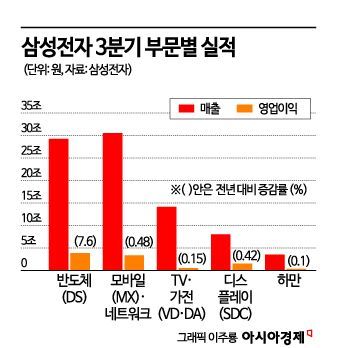
The mobile (MX) division, responsible for smartphones, drove the third-quarter results. The launch of the Galaxy AI phone contributed to overall sales and operating profit growth. Sales reached 29.98 trillion won, a 13% increase compared to the previous quarter, influenced by the launch of new smartphone models. The smartphone business accounted for about two-thirds of the Device Experience (DX) division's total sales of 44.99 trillion won, which combines the TV and home appliance (VD·DA) businesses. Samsung Electronics stated, "Although material costs increased due to enhanced specifications to strengthen product competitiveness, sales increased through flagship product-focused sales, securing a near double-digit (over 10%) profit margin."
Inside and outside the industry, there is an analysis that Samsung Electronics may have "overcome the critical point." Considering that pessimistic forecasts had poured in recently, lowering operating profit estimates and suggesting that Samsung was lagging behind competitors in key businesses such as HBM, the atmosphere may change starting with this earnings announcement. Cha Min-sook, a researcher at Korea Investment & Securities, said, "In the second quarter, there was a surprise performance due to inventory revaluation gains, but in the third quarter, an earnings shock was recorded due to incentive provisions, showing high quarterly performance volatility caused by one-time expenses," adding, "Since the impact of one-time factors on performance is expected to be low from the fourth quarter, it is believed that the critical point has been passed."
It is also positive that the company spent a record 8.87 trillion won on research and development (R&D) and increased facility investment by 300 billion won from the previous quarter to 12.4 trillion won. Samsung Electronics stated, "Next year, we plan to further expand sales of HBM3E and proceed with development and mass production of HBM4 in the second half. We will also actively respond to high-capacity demand based on QLC while fully transitioning to the eighth-generation V-NAND process."
© The Asia Business Daily(www.asiae.co.kr). All rights reserved.
![Clutching a Stolen Dior Bag, Saying "I Hate Being Poor but Real"... The Grotesque Con of a "Human Knockoff" [Slate]](https://cwcontent.asiae.co.kr/asiaresize/183/2026021902243444107_1771435474.jpg)













